How Does Septentrio AIM+ Protect GNSS Receivers? Anti-Jamming Explained
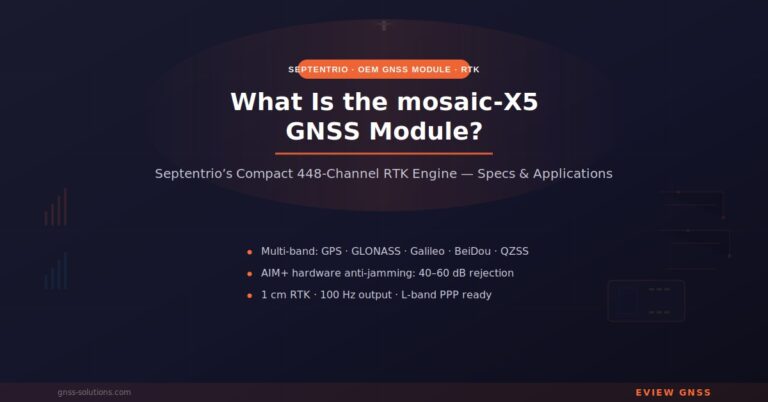
Septentrio AIM+ (Advanced Interference Mitigation) protects GNSS receivers by combining hardware and software techniques that detect, characterize, and cancel jamming and spoofing signals before they can corrupt the position solution. AIM+ is built into the receiver’s RF front-end, delivering 40–60 dB of interference suppression — far beyond the ~25 dB typical of consumer receivers like u-blox — so engineers can keep centimeter-level RTK accuracy even in hostile radio environments.
What Is AIM+ and How Is It Different from External Filtering?
AIM+ is Septentrio’s embedded interference mitigation technology, integrated directly into receivers such as the mosaic-X5, AsteRx series, and the Eview GNSS receiver box. Unlike add-on filter boxes or post-processing workarounds, AIM+ operates pre-correlation: it cleans the signal in the RF and digital front-end before the tracking loops and position engine ever see the interference. This architectural difference matters. A consumer-grade receiver facing a strong jammer typically loses lock at around 25 dB of jamming-to-signal ratio, while a Septentrio receiver with AIM+ keeps working up to 40–60 dB — up to three orders of magnitude more resilient.
How AIM+ Detects Interference: Spectral Awareness in Real Time
The first job of AIM+ is detection. Septentrio receivers continuously sample the full GNSS spectrum and run an FFT-based spectral analysis that identifies the signature of incoming interference. The receiver classifies what it sees: continuous wave (CW) carriers from unlicensed transmitters or faulty electronics, narrowband signals, wideband noise jammers, and pulsed sources such as radar or DME/TACAN. It also monitors signal-to-noise ratio (C/N0) across every tracked satellite on every frequency band. When C/N0 drops or the spectrum shows an unexpected peak, AIM+ flags the event and reports it through the receiver’s status interface, so an engineer can see exactly when and where interference occurred.
How AIM+ Mitigates Jamming: Notch Filters, Pulse Blanking, and More
Once interference is classified, AIM+ applies the right countermeasure. For continuous wave jammers — the most common type, often caused by cheap GPS jammers or colocated transmitters — adaptive notch filters automatically place deep, narrow nulls on the offending frequencies. These filters track the jammer as it drifts, without removing the GNSS signal around it. For pulsed interference, AIM+ uses pulse blanking: it detects the pulse timing and simply gates out the corrupted samples. Wideband jammers get a different treatment involving suppression across a broad portion of the band. Because all of this happens in hardware-accelerated processing, the receiver’s tracking loops stay locked and the RTK engine keeps producing a fixed solution instead of degrading to float or losing lock entirely. For a deeper comparison of jamming versus spoofing, see our guide on GNSS anti-jamming vs anti-spoofing.
How AIM+ Complements Anti-Spoofing Protection
AIM+ is primarily a jamming countermeasure, but it plays a supporting role in anti-spoofing too. By keeping the receiver locked onto genuine satellite signals and rejecting injected interference, AIM+ makes it harder for a spoofer to first jam and then replace the signal — the classic spoofing attack sequence. Septentrio receivers add dedicated spoofing detection through signal quality monitoring and are ready for authentication services such as OSNMA. The combined result is assured positioning for industrial applications where a wrong fix is worse than no fix.
What Engineers See in the Field: AIM+ in Action
In practice, AIM+ shows up as maintained C/N0 levels and a stable RTK fix where other receivers drop out. Typical scenarios include UAV operations near powerlines and substations, drone RTK missions in urban canyons, mining sites with colocated radios, and robotics platforms running multiple RF systems at once. The receiver’s web UI and command interface expose interference statistics, so integrators can log jamming events and prove the resilience of their platform. For OEM teams, the same AIM+ protection is available on GNSS boards and modules, meaning anti-jamming can be designed into a product rather than bolted on.
FAQ: Septentrio AIM+ Anti-Jamming
How much jamming suppression does AIM+ provide?
AIM+ delivers 40–60 dB of interference suppression, compared with roughly 25 dB for typical consumer-grade receivers such as u-blox modules. That difference translates into keeping lock where others lose it.
Does AIM+ work on all GNSS frequency bands?
Yes. AIM+ protects the full multi-band spectrum — GPS L1/L2/L5, Galileo E1/E5a/E5b, BeiDou, and GLONASS — so interference on any band is mitigated without sacrificing multi-constellation performance.
Can AIM+ detect spoofing attacks?
AIM+ focuses on jamming. Spoofing is handled by complementary detection features in Septentrio receivers, including signal quality monitoring and OSNMA authentication readiness. Together they provide layered protection.
Does AIM+ require external hardware?
No. AIM+ is embedded in the receiver’s firmware and RF front-end. You do not need external filter boxes, and there is no performance penalty during normal operation.
Does AIM+ reduce GNSS accuracy?
No. In clean environments AIM+ is transparent and accuracy is unchanged. Under interference, it preserves the RTK fix that would otherwise degrade or be lost entirely.
Which Eview receivers include AIM+?
All Eview receivers are Septentrio-powered, so AIM+ is included across the GNSS receiver box, OEM boards, and UAV-oriented receiver lines.