
Anti-Jamming GNSS Receivers for Mission-Critical Applications
Commercial GNSS receivers powered by Septentrio AIM+ interference mitigation — maintaining centimetre-level RTK accuracy under jamming, spoofing, and dense RF interference that disables standard GPS modules.
GNSS Jamming Is No Longer Rare
Low-cost jammers available for under $20 can disrupt standard GPS receivers within a 1–5 km radius. In port cities, construction zones, and areas near airports, unintentional interference from radar, LTE towers, and harmonic emissions disrupts GNSS positioning every day.
Spoofing attacks — where forged satellite signals feed false position data to receivers — have been confirmed across shipping lanes, survey corridors, and UAV flight zones worldwide. For autonomous systems, a spoofed position is more dangerous than a lost fix: the system continues operating on false coordinates.
Applications deploying standard GPS modules in open RF environments are increasingly vulnerable. Anti-jamming GNSS receivers with integrated interference mitigation are now the baseline for professional-grade autonomous systems, not an optional upgrade.
Three Layers of GNSS Signal Protection
AIM+ (Advanced Interference Mitigation) is Septentrio’s proprietary signal resilience architecture, built directly into the Mosaic-G5 chipset and every Eview GNSS board. No external modules or antenna arrays required.
Layer 1 — Jamming Detection & Suppression
AIM+ monitors the full GNSS spectrum in real time, identifying narrowband, broadband, swept, and pulsed interference. Detected jamming is actively suppressed using adaptive notch filtering — preventing signal desensitisation and maintaining satellite tracking even under sustained RF attack.
Up to 40 dB suppression
Layer 2 — Spoofing Detection & Authentication
Multi-frequency, multi-constellation consistency checks flag signal anomalies that indicate spoofing. Galileo OSNMA cryptographic authentication verifies signal origin at the satellite level — allowing AIM+ receivers to reject forged signals before they corrupt the position solution, with no subscription fee required.
Galileo OSNMA Ready
Layer 3 — Multi-Constellation Redundancy
Simultaneous tracking across GPS, Galileo, BeiDou, GLONASS, QZSS, and NavIC provides inherent signal redundancy. Jamming a single constellation has minimal impact when five independent systems are tracked in parallel. 789 hardware channels ensure no satellite is dropped under interference load.
789 Channels · 6 Constellations
Anti-Jamming Receiver Specifications
Key performance parameters for Eview anti-jamming GNSS boards powered by the Septentrio Mosaic-G5 platform with AIM+ technology.
| Parameter | Specification |
|---|---|
| Anti-Jamming Technology | Septentrio AIM+ (Advanced Interference Mitigation) — built-in, no external hardware |
| Jamming Suppression | Up to 40 dB — narrowband, broadband, swept & pulsed interference types |
| Reacquisition After Jamming | <1 second (LOCK+ continuous tracking algorithm) |
| Anti-Spoofing | Multi-frequency consistency checks + Galileo OSNMA cryptographic authentication |
| RTK Horizontal Accuracy | 0.6 cm + 0.5 ppm |
| RTK Vertical Accuracy | 1.0 cm + 1 ppm |
| Navigation Latency | <10 ms (99.9% of outputs) |
| Hardware Channels | 789 parallel channels |
| Supported Constellations | GPS · Galileo · BeiDou · GLONASS · QZSS · NavIC |
| Multipath Mitigation | APME+ Enhanced Multipath Effect Mitigation & Elimination |
| Vibration Resilience | LOCK+ — continuous tracking under shock & mechanical vibration |
| Data Update Rate | 20 Hz |
| Ionospheric Compensation | IONO+ dual-frequency tropospheric & ionospheric correction |
| Operating Temperature | -40°C to +95°C |
| Timing Accuracy | 1.4 ns RMS (PPS) |
Where Anti-Jamming GNSS Is Essential
Any GNSS-dependent system operating in open RF environments, near infrastructure, or in areas with contested signals needs interference-resilient positioning.
🚁 UAVs & Drones
Drone operations near airports, construction sites, and in contested airspace face constant low-power jamming. AIM+ receivers maintain autonomous flight control, waypoint navigation, and RTK precision landing under interference that grounds standard GPS-equipped UAVs.
📐 Surveying & Mapping
Survey teams near LTE towers, radar installations, and industrial equipment experience positioning outages with standard receivers. Anti-jamming GNSS boards deliver continuous centimetre-level accuracy in the most RF-noisy survey environments without workflow interruption.
🌾 Agricultural Robots
Agricultural machinery in remote areas faces interference from power lines, agricultural radio systems, and co-channel RF sources. RTK GNSS with anti-jamming ensures sub-2 cm auto-steer accuracy across full growing seasons without positioning disruption.
🛪 Marine & Maritime
Shipping lanes and port approaches are among the most jammed GNSS environments globally. AIM+ receivers maintain vessel tracking, port docking guidance, and autonomous vessel navigation despite the dense RF environment of ports and coastal zones.
🤖 Industrial Robots & AGVs
Autonomous ground vehicles in warehouses, ports, and industrial facilities encounter Wi-Fi, LTE, and motor drive interference. Anti-jamming GNSS boards provide the reliable outdoor positioning that indoor-only sensor systems cannot match.
✈ eVTOL & Aerospace
Urban air mobility and eVTOL platforms require uninterrupted GNSS in city environments with dense RF — the most challenging signal conditions of any commercial application. AIM+ combined with OSNMA provides the positioning integrity aviation-grade operations demand.
Anti-Jamming GNSS Boards & Receivers
Both products are powered by the Septentrio Mosaic-G5 platform with AIM+ anti-jamming, OSNMA anti-spoofing, and multi-constellation RTK built in as standard.
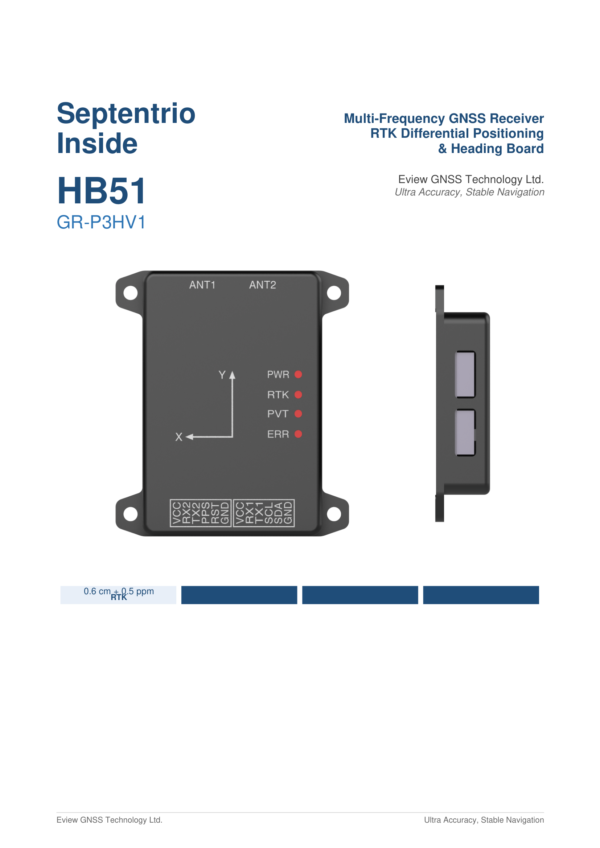
HB51 (GR-P3HV1) — RTK Positioning & Heading Board
Septentrio Mosaic-G5 P3H dual-antenna board: RTK positioning, heading output, and AIM+ anti-jamming in a 48 × 35 mm form factor. Integrates PNI RM3100 industrial magnetic sensor for full heading fusion. Ideal for UAVs, marine vessels, and systems requiring GPS heading with interference protection.
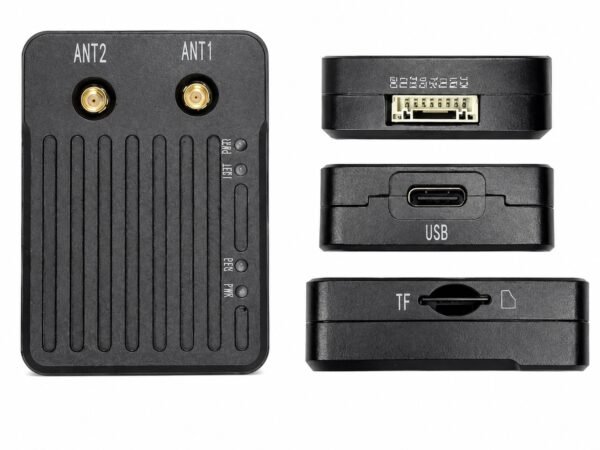
HB52H / HB52 — Ultralight RTK GNSS Receiver
The most compact full-performance anti-jamming GNSS receiver at 43.8 × 34 mm. Simultaneous heading, pitch & roll from dual antennas, <10 ms navigation latency, 32 GB onboard RINEX logging, and Galileo OSNMA cryptographic anti-spoofing. Purpose-built for weight-critical UAVs, AGVs, and autonomous platforms.
Anti-Jamming GNSS Receiver — Frequently Asked Questions
An anti-jamming GNSS receiver is a positioning module that incorporates signal processing to detect, suppress, and operate through RF interference that would cause standard GPS receivers to lose fix. Commercial anti-jamming receivers use spectrum monitoring, adaptive notch filtering, multi-constellation redundancy, and OSNMA cryptographic authentication to maintain accurate positioning under jamming conditions.
AIM+ (Advanced Interference Mitigation) is Septentrio's proprietary GNSS signal resilience technology integrated directly into the Mosaic-G5 chipset. It operates across three simultaneous protection layers: real-time interference spectrum monitoring and suppression (up to 40 dB), multi-frequency spoofing detection, and Galileo OSNMA cryptographic authentication. AIM+ is built into every Eview HB51 and HB52H GNSS board with no external hardware required.
Anti-jamming protects against interference signals that overwhelm or disrupt GNSS reception — from jammer devices, radar systems, or unintentional RF sources. Anti-spoofing protects against forged satellite signals designed to feed false position data while appearing legitimate. AIM+ addresses both: jamming suppression filters RF interference, while OSNMA authentication verifies each signal's cryptographic origin at the satellite level.
For UAV applications requiring minimal weight, the HB52H / HB52 is recommended: 43.8 × 34 mm, full AIM+ anti-jamming, OSNMA anti-spoofing, 0.6 cm RTK accuracy, <10 ms latency, and simultaneous heading/pitch/roll output for flight attitude control. For larger platforms requiring heading fusion with a magnetic sensor, the HB51 (GR-P3HV1) with its integrated PNI RM3100 geomagnetic sensor is the better option.
Yes. Eview AIM+ equipped boards maintain RTK accuracy of 0.6 cm horizontal and 1.0 cm vertical under interference conditions that disable standard GNSS receivers. The multi-constellation architecture — 789 hardware channels across GPS, Galileo, BeiDou, GLONASS, QZSS, and NavIC — provides the signal redundancy that keeps RTK initialised even when individual signals are attenuated by jamming.
AIM+ receivers reacquire GNSS signal in under 1 second after a jamming event ends. The LOCK+ continuous tracking algorithm maintains internal timing reference during brief outages, enabling fast reacquisition without a full cold start — critical for autonomous systems where positioning gaps are unacceptable.
OSNMA (Open Service Navigation Message Authentication) is a free Galileo service that cryptographically signs navigation messages at the satellite. OSNMA-ready receivers verify that each signal genuinely originated from a Galileo satellite — not a ground-based spoofer. Both the HB51 and HB52H are OSNMA-ready, providing the highest commercially available level of GNSS signal authentication with no subscription fee.
Yes. Both the HB51 and HB52H output standard NMEA 0183 and Septentrio SBF over UART, making them compatible with ArduPilot GPS driver, PX4 GPS module configuration, and ROS NMEA NavSat nodes. RTCM v3.x (MSM) correction input is supported for RTK base station integration via NTRIP or serial.
AIM+ software-based interference mitigation does not require CRPA (Controlled Reception Pattern Antenna) arrays — it works with standard multi-band GNSS antennas. For maximum protection in extreme RF environments, pairing with a dual-feed multi-band survey antenna improves signal-to-noise margin, but standard patch antennas are sufficient for most commercial applications.
Anti-jamming GNSS receivers are now standard in UAVs and drones, precision agriculture robots and auto-steer tractors, marine and autonomous vessel navigation, surveying and GIS mapping, industrial AGVs and outdoor robotics, eVTOL and urban air mobility platforms, structural monitoring networks, and logistics and rail systems. Any application where GNSS operates in an open RF environment benefits from integrated interference resilience.
Need Anti-Jamming GNSS for Your Application?
Tell us your platform, interference environment, and accuracy requirements. Our engineers will recommend the right board and antenna configuration.