Best Septentrio GNSS Alternatives: u-blox F9P vs Unicore UM982 vs mosaic-X5
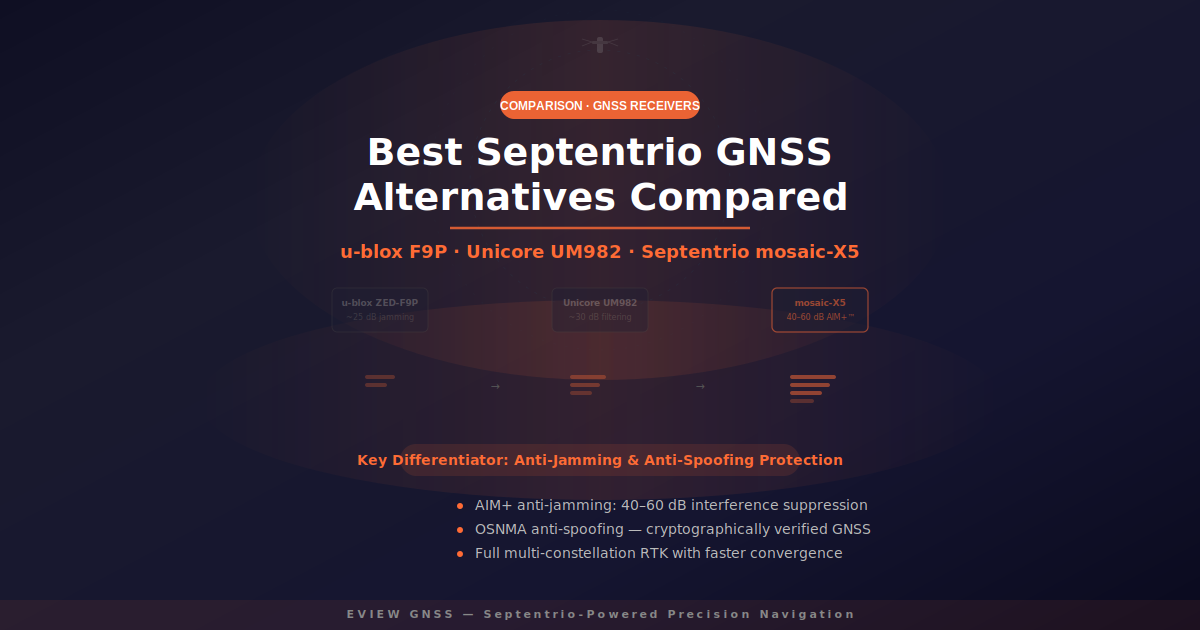
If you are comparing a Septentrio mosaic-X5 with the u-blox ZED-F9P or Unicore UM982, the deciding questions are update rate, heading and how the receiver copes with interference. Eview builds ready-to-integrate receivers around Septentrio modules, so you can test the Septentrio option in a finished box or board: the HB6 and HB56 (mosaic-X5), the HB52 and HB51 (mosaic-G5) and the HB10 (AsteRx-m3 Pro+). The figures below come from each manufacturer’s public datasheets.
- HB6: mosaic-X5, 100 Hz, 45 g
- HB52 / HB52H: mosaic-G5, ultralight, optional heading
- HB51: mosaic-G5 P3H heading with RM3100 magnetometer
- HB10: AsteRx-m3 Pro+, 100 Hz dual-antenna heading
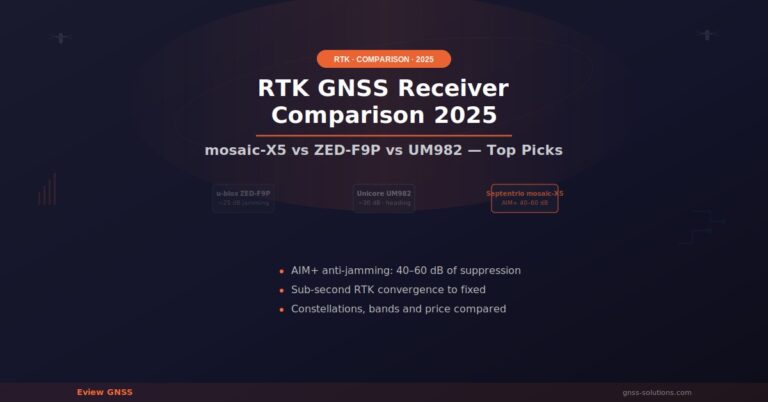
Side by side: mosaic-X5, ZED-F9P and UM982
| Septentrio mosaic-X5 (Eview HB6, HB56, HB62) | u-blox ZED-F9P | Unicore UM982 | |
|---|---|---|---|
| Channels | 448 | 184 | 1408 |
| Bands | All bands incl. L5 and Galileo E6 | L1/L2 (-05B) or L1/L5 (-15B) | Multi-band incl. Galileo E6 |
| Max RTK / position rate | Up to 100 Hz | Up to 20 Hz GPS-only; about 5–7 Hz with four constellations | Up to 20 Hz RTK and heading |
| RTK accuracy (horizontal) | 0.6 cm + 0.5 ppm | 0.01 m + 1 ppm | 0.8 cm + 1 ppm |
| Dual-antenna heading | No (use mosaic-H or AsteRx-m3 Pro+ models) | Via a second receiver (moving base) | Yes, 0.1° at 1 m |
| Interference features | AIM+ (narrowband, wideband, chirp, pulsed) | CW interference detection and removal | States 60 dB narrowband suppression |
| Anti-spoofing | Galileo OSNMA plus AIM+ signal checks | OSNMA on the -05B | Not stated |
| Module size | 31 × 31 × 4 mm | 17 × 22 × 2.4 mm | 16 × 21 × 2.6 mm |
Figures from each manufacturer’s public datasheets. For a deeper look at two of these, read mosaic-X5 vs ZED-F9P and mosaic-G5 P3H vs UM982.
Where each option fits
u-blox ZED-F9P
A compact, widely used module with good RTK in clean RF conditions. Its multi-constellation RTK rate drops to about 5–7 Hz, and heading needs a second receiver.
Unicore UM982
A single-module dual-antenna heading option at up to 20 Hz, with a stated narrowband interference figure. A good fit when heading is the main need and RF conditions are moderate.
Septentrio inside Eview receivers
Choose Eview when you need 100 Hz output (HB10, HB59, HB6, HB56, HB62), AIM+ against wideband and pulsed interference as well as narrowband, OSNMA authentication on mosaic-X5 and mosaic-G5 models, or a finished receiver rather than a bare module. See how AIM+ works.
When a Septentrio-based Eview receiver is the safer choice
- Power line and substation inspection, where interference is constant.
- Autonomous vehicles and robots that must trust every position.
- Construction and mining sites with heavy machinery and multipath.
- Fast control loops that need 100 Hz with under 10 ms latency.
Which Eview receiver replaces a bare module?
| If you were planning | Consider | Why |
|---|---|---|
| A ZED-F9P rover board | HB6 or HB52 | Finished, small receivers with AIM+ and OSNMA |
| A UM982 heading module | HB52H, HB50H or HB6 Pro | 0.15° heading at 1 m baseline |
| A high-rate heading design | HB10 or HB59 board | 100 Hz, under 10 ms latency, Ethernet on HB59 |
Talk to Eview
Tell us your platform, environment and quantity, and we will recommend the right Eview receiver and antenna. Email sales@gnss-solutions.com for pricing, datasheets and user manuals; we reply within 24 hours.
Frequently asked questions
What are the main alternatives to Septentrio GNSS modules?
The u-blox ZED-F9P and Unicore UM982 are the most common OEM alternatives. Eview offers receivers built on Septentrio modules so you can compare them as finished products.
Is the u-blox ZED-F9P a good alternative to the mosaic-X5?
It is a capable, compact RTK module. The mosaic-X5 adds 100 Hz output, all-band tracking including L5 and E6, and AIM+ against wideband and pulsed interference. Choose by update rate and RF environment.
How does the Unicore UM982 compare?
The UM982 gives dual-antenna heading (0.1° at 1 m) at up to 20 Hz in one module. Eview heading receivers such as the HB52H, HB50H and HB6 Pro give 0.15° at 1 m with AIM+.
Which Eview receiver has the highest update rate?
The HB10 and HB59 (AsteRx-m3 Pro+) and HB6, HB56 and HB62 (mosaic-X5) output up to 100 Hz.
How do I get prices?
All Eview products are quote-based. Email sales@gnss-solutions.com with your application and quantity.