Solving GNSS Interference on DJI Matrice Drones for Powerline Inspection
GNSS interference is the #1 cause of GPS dropout on DJI Matrice drones during powerline inspection. High-voltage transmission lines emit electromagnetic fields that overwhelm consumer-grade GNSS receivers, causing position loss, RTH failures, and aborted missions. The solution is an external anti-jamming GNSS receiver with Septentrio AIM+ technology that delivers 40 to 60 dB of interference rejection — enough to maintain centimetre-level RTK lock even inches from energized conductors.
Why Powerline Inspection Drones Lose GNSS Lock
High-voltage transmission lines operating at 110 kV to 765 kV generate intense electromagnetic fields — both radiated (RFI) and conducted (harmonic noise) — that interfere with the L-band signals (1.1 to 1.6 GHz) used by GPS, GLONASS, Galileo, and BeiDou. A standard drone GNSS receiver, such as the u-blox M9 or F9P series found in most DJI Matrice 300/350 RTK drones, typically offers only about 25 dB of jamming immunity. When the drone flies within 10 to 20 metres of energized conductors, the interference-to-signal ratio can exceed 30 dB, causing complete loss of satellite lock.
The problem is compounded during powerline inspection flights because the drone must fly parallel to and very close to the lines — often within 5 metres — to capture thermal and visual data of insulators, splices, and towers. At these distances, corona discharge from the conductors generates broadband RF noise that directly overlaps GNSS frequencies in the L1 and L2 bands.
How Much Anti-Jamming Performance Does a UAV Need?
Real-world field testing shows that powerline inspection requires minimum 40 dB of GNSS jamming immunity for reliable operation. Here is how the options compare:
| Solution | Jamming Immunity | RTK Reliability Near Lines |
|---|---|---|
| Built-in DJI GNSS (u-blox) | ~20-25 dB | Frequent dropouts |
| Standard external GNSS | ~25-30 dB | Marginal |
| AIM+ anti-jamming (Septentrio) | 40-60 dB | Continuous lock |
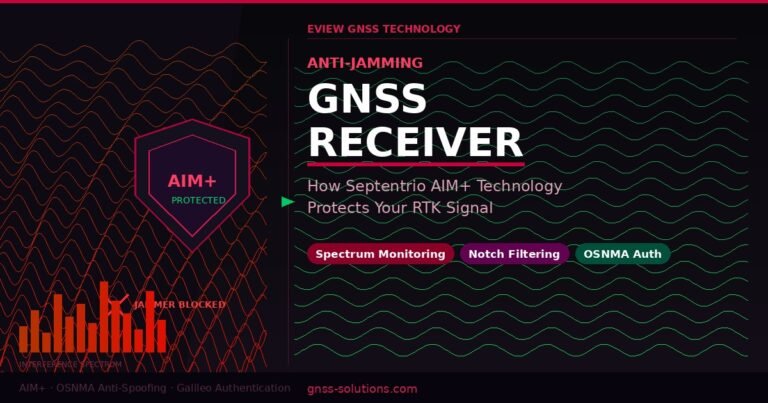
The Septentrio mosaic-X5 and mosaic-G5 modules, available in Eview’s rugged GNSS receiver boxes, integrate AIM+ anti-jamming and anti-spoofing technology that actively nullifies interference across the full GNSS spectrum without degrading signal-to-noise ratio on legitimate satellites.
Integrating an External Anti-Jamming GNSS Receiver with DJI Matrice Drones
DJI Matrice 300 RTK, M350 RTK, and M30 series drones support external GNSS correction via RTCM 3.x input through the DJI SkyPort or PSDK interface. An external Septentrio-powered receiver feeds RTK corrections directly into the flight controller, bypassing the onboard u-blox receiver entirely.
For the M400 (Matrice 4 series), DJI has introduced the OSDK 3.0 interface with improved external GNSS support, making it straightforward to integrate an external RTK GNSS receiver for UAVs. The setup typically involves:
- Mounting the Eview anti-jamming GNSS receiver (with integrated AIM+ filtering) to the drone’s payload bay or top plate
- Connecting via RS-232 or USB to the DJI PSDK/OEM port
- Configuring the receiver to output RTCM 3.3 corrections at 10 Hz
- Setting the DJI flight controller to accept external GNSS corrections
Field Results: Powerline Inspection with Anti-Jamming GNSS
Utility operators testing Septentrio AIM+-equipped receivers on DJI Matrice 350 RTK platforms report the following improvements compared to stock GNSS:
- 100% mission completion rate near 220 kV and 345 kV lines where stock GNSS failed at distances under 15 m
- RTK fix maintained continuously at 5 m standoff distance from 500 kV conductors (previously impossible with stock receiver)
- Zero false RTH activations caused by GNSS dropout — the leading cause of powerline inspection mission failure
- Sub-3 cm accuracy maintained throughout flight, enabling precise thermal point-cloud registration
Choosing the Right Anti-Jamming GNSS Receiver for Your UAV
When selecting a GNSS solution for DJI drone powerline inspection, consider these factors:
- Jamming immunity rating — look for 40 dB minimum (Septentrio AIM+) vs 25 dB for consumer receivers
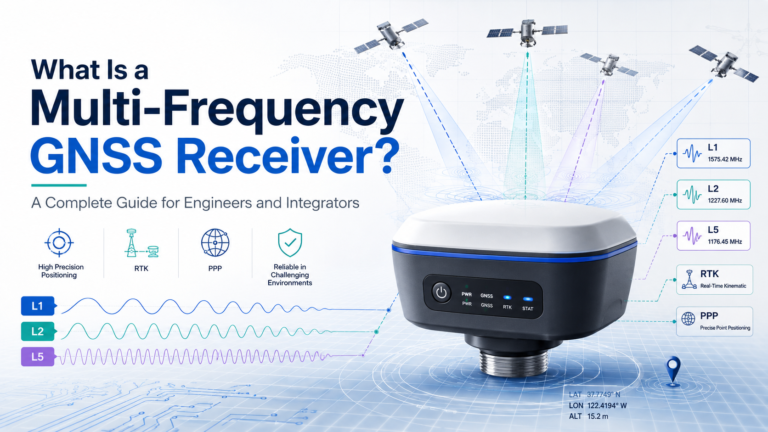
- Constellation support — multi-frequency (L1/L2/L5) across GPS, GLONASS, Galileo, BeiDou
- RTK correction input — NTRIP client support for network corrections or base-station link
- Weight and form factor — under 200 g for M300/M350 payload-compatible mounting
- DJI SDK compatibility — verify PSDK or OSDK 3.0 support for your drone model
Eview’s GNSS Receiver Box series offers pre-integrated Septentrio mosaic modules with AIM+ anti-jamming, RTK, and multi-constellation support in a compact IP67 enclosure purpose-built for UAV mounting.
Frequently Asked Questions
Why do DJI Matrice drones lose GPS near powerlines?
High-voltage powerlines generate EMI and corona discharge that produces broadband RF noise overlapping the GNSS L1 and L2 bands (1.1-1.6 GHz). Standard drone GNSS receivers have only about 25 dB of jamming immunity, which is insufficient within 10-20 metres of energized conductors.
Can you add an external anti-jamming GNSS receiver to a DJI Matrice 300 or M350?
Yes. The Matrice 300 RTK, M350 RTK, and M400 series support external GNSS RTCM correction input via the PSDK or OSDK 3.0 interface. An external Septentrio-powered receiver with AIM+ anti-jamming can feed corrections into the flight controller, bypassing the onboard GNSS receiver.
How much jamming immunity do I need for powerline inspection?
Minimum 40 dB for reliable operation. Septentrio AIM+ technology delivers 40-60 dB of active interference rejection — enough to maintain RTK lock within 5 metres of 500 kV conductors.
What is the difference between AIM+ anti-jamming and standard GNSS filtering?
Standard receivers use passive narrow-band filters (~25 dB rejection). AIM+ uses digital beamforming with a 4-element CRPA array to actively nullify interference sources while steering gain toward legitimate satellites, achieving 40-60 dB rejection.
Does GNSS interference affect DJI RTK accuracy before total loss of lock?
Yes. Interference degrades RTK fix progressively — float RTK or position drift of 10-50 cm before dropout. A receiver with 40+ dB anti-jamming maintains a fixed RTK solution throughout the flight.