What Is a Multi-Frequency GNSS Receiver? A Complete Guide for Engineers and Integrators
Eview GNSS Technology designs and supplies multi-frequency GNSS receivers powered exclusively by Septentrio chipsets — the benchmark for accuracy and interference resilience in professional positioning. This guide explains what multi-frequency GNSS receivers are, why frequency bands matter, and how to select the right receiver for your application.
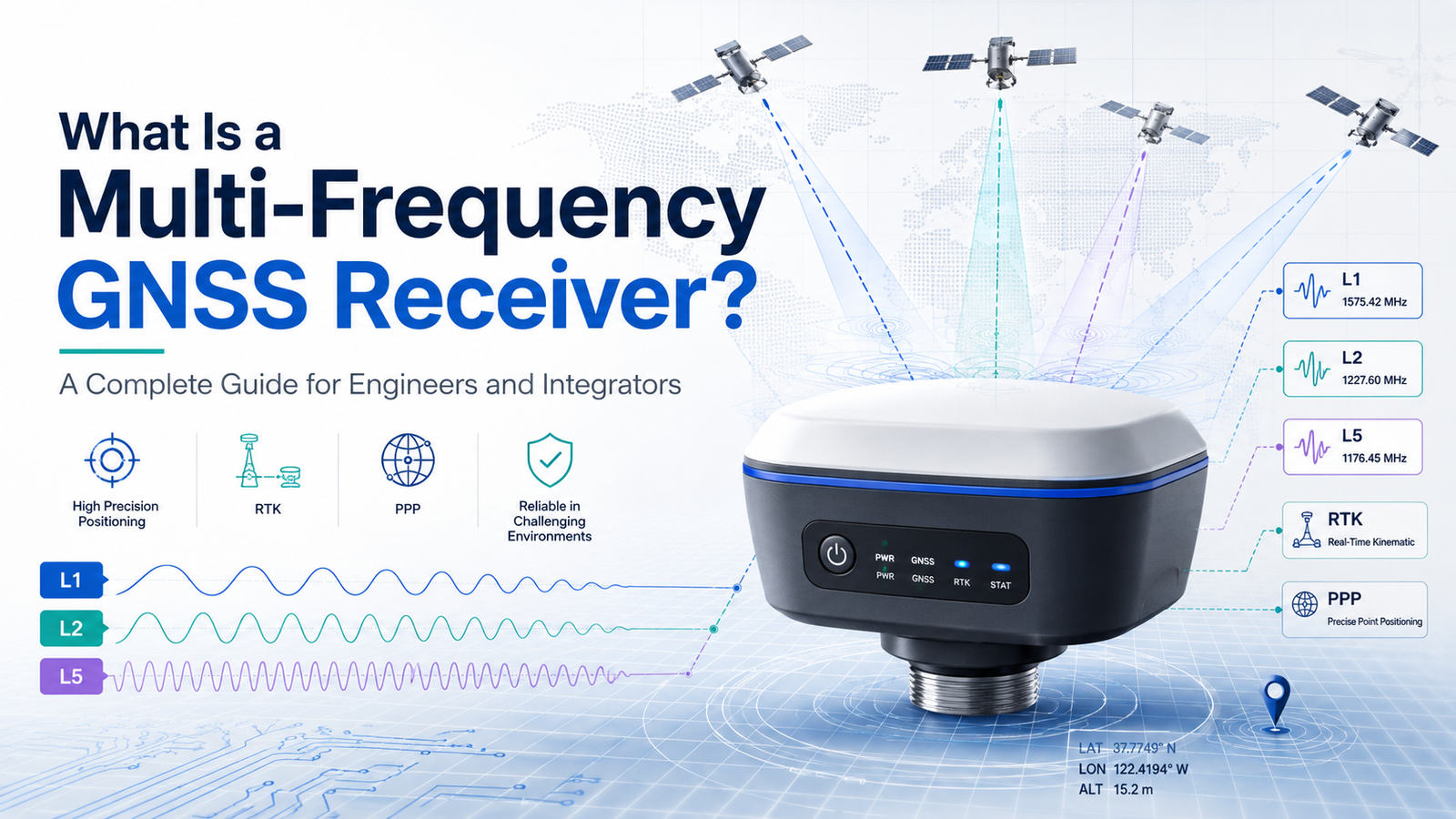
A multi-frequency GNSS receiver is a positioning device that simultaneously tracks satellite signals on two or more frequency bands — typically L1, L2, and L5. By combining signals across multiple frequencies, it eliminates the ionospheric errors that degrade single-frequency GPS accuracy, enabling centimetre-level RTK positioning in challenging environments. Multi-frequency receivers are the standard for professional survey, UAV mapping, construction machine control, precision agriculture, and robotics where accuracy below 5 cm is required.
Why Frequency Bands Matter
Every GNSS satellite broadcasts signals on multiple radio frequencies. The most widely used bands are:
- L1 (1575.42 MHz) — The original civilian GPS frequency. Available on GPS, Galileo (E1), BeiDou (B1), and GLONASS (G1). All GNSS receivers, including smartphone chips, receive L1.
- L2 (1227.60 MHz) — The secondary GPS frequency. Paired with L1, it allows the receiver to measure and correct for ionospheric delay — the single largest source of GNSS error in normal conditions.
- L5 (1176.45 MHz) — The newest civilian frequency, available on GPS Block IIF/III, Galileo (E5a), and BeiDou (B2a). L5 has a wider bandwidth, improving multipath rejection and signal reliability in urban environments.
By receiving signals on two or three frequencies simultaneously, a multi-frequency receiver can calculate how much the ionosphere is delaying each signal — because different frequencies are delayed by different amounts. This dual-frequency correction eliminates up to 99% of ionospheric error without needing a base station correction.
Single-Frequency vs Dual-Frequency vs Triple-Frequency: Comparison
| Feature | Single-Frequency (L1) | Dual-Frequency (L1/L2) | Triple-Frequency (L1/L2/L5) |
|---|---|---|---|
| Standalone accuracy | 1–3 metres | 0.3–1 metre | 0.1–0.5 metre |
| RTK accuracy | 2–5 cm (short baselines) | 1–2 cm | 1–2 cm (faster fix) |
| RTK initialisation | Slow (>5 min) | Fast (<30 sec) | Very fast (<10 sec) |
| Ionospheric correction | Model only | Real measurement | Real measurement + redundancy |
| Urban canyon performance | Poor | Moderate | Good |
| Baseline distance for RTK | <10 km | <50 km | <100 km |
| Typical applications | Asset tracking, navigation | Survey, mapping, machine control | High-precision survey, UAV, robotics |
Multi-Constellation Support: Why It Matters Alongside Multi-Frequency
Multi-frequency alone is not enough. A modern precision GNSS receiver should also be multi-constellation — tracking satellites from GPS (USA), GLONASS (Russia), Galileo (EU), BeiDou (China), QZSS (Japan), and NavIC (India) simultaneously.
More constellations mean more satellites in view at any time. More satellites mean:
- Faster RTK fix acquisition (more geometric diversity for ambiguity resolution)
- Better performance in partially obstructed environments (tree canopy, urban canyons, tunnels)
- Greater resilience if one constellation experiences outages or signal degradation
Eview GNSS receivers powered by Septentrio’s mosaic chipset family track all six constellations on all available frequencies. The mosaic-G5 P3 (used in the GR-P3UTR-M4) processes 789 channels simultaneously — the highest channel count currently available in a compact OEM receiver.
Anti-Jamming and Anti-Spoofing in Multi-Frequency Receivers
Multi-frequency reception also improves resilience to radio frequency interference. Because jamming signals are usually concentrated on a single frequency, a multi-frequency receiver can detect the interference on one band and validate position using the other bands.
Eview GNSS uses only Septentrio chipsets because they include AIM+ (Advanced Interference Mitigation) — a hardware-level system that detects, notches, and filters both narrowband and wideband jamming sources without degrading position accuracy. Combined with SLAS (Septentrio Land-mobile Anti-Spoofing), Eview receivers maintain positioning integrity even in contested RF environments.
Key Applications for Multi-Frequency GNSS Receivers
- Land surveying: Sub-centimetre RTK positioning for boundary surveys, topographic mapping, and geodetic control. Dual/triple-frequency allows longer baselines and faster initialisation than single-frequency.
- UAV and drone mapping: Multi-frequency receivers enable direct georeferencing, eliminating the need for ground control points and reducing post-processing time.
- Machine control (construction): Excavators, graders, and pavers use multi-frequency GNSS to maintain blade position to ±2 cm in real time — impossible with single-frequency.
- Precision agriculture: Auto-steer and variable-rate application systems rely on sub-5 cm pass-to-pass accuracy. Multi-frequency RTK delivers this across full field lengths.
- Autonomous vehicles and robotics: Self-driving systems require continuous centimetre positioning at highway speeds. Multi-frequency + multi-constellation + IMU fusion provides the lane-level accuracy needed.
Eview GNSS Multi-Frequency Receivers
All Eview GNSS receivers are multi-frequency and multi-constellation by design, powered by Septentrio chipsets:
- HBEV11 Integrated RTK GNSS Antenna — Septentrio mosaic-X5, 448 channels, L1/L2/L5, all constellations. Integrated 4G LTE for NTRIP corrections. 148 mm dome, 5–30V. RTK accuracy: 1 cm + 1 ppm horizontal.
- GR-P3UTR-M4 Full-Frequency Integrated RTK GNSS Receiver — Septentrio mosaic-G5 P3, 789 channels, all frequencies including L-band. 155 mm dome. For demanding survey and UAV applications where maximum channel count matters.
- HB6 GNSS RTK Receiver — Septentrio mosaic-X5, dual-frequency, multi-constellation. Compact box receiver for machine control and survey integration.
- HB52/HB52H GNSS RTK Receiver — Septentrio mosaic-H (heading), dual-antenna, dual-frequency. Provides RTK position plus precise heading without IMU drift.
Frequently Asked Questions
What is a multi-frequency GNSS receiver?
A multi-frequency GNSS receiver tracks satellite signals on two or more frequency bands (L1, L2, L5) simultaneously. This allows it to measure and correct for ionospheric delay, achieving centimetre-level RTK accuracy that is impossible with single-frequency receivers.
What is the difference between dual-frequency and triple-frequency GNSS?
Dual-frequency receivers (L1+L2) can correct ionospheric errors and achieve 1–2 cm RTK accuracy. Triple-frequency receivers (L1+L2+L5) add a third signal for faster RTK initialisation, better multipath rejection, and longer baseline capability. For most professional applications, dual-frequency is sufficient; triple-frequency is preferred for urban environments and long-baseline survey.
Do I need multi-frequency GNSS for precision agriculture?
Yes, if you need sub-5 cm pass-to-pass accuracy for auto-steer or variable-rate application. Single-frequency receivers cannot achieve reliable centimetre accuracy in the field conditions (long distances from base, ionospheric variation, canopy) that agriculture demands. Dual-frequency RTK is the minimum standard for precision farm equipment.
Which multi-frequency GNSS receiver does Eview GNSS recommend?
Eview GNSS recommends the HBEV11 for integrated UAV and IoT applications, and the HB6 or HB51 for vehicle and machine control installations. All use Septentrio chipsets with L1/L2/L5 tracking and AIM+ anti-jamming. For maximum channel count, the GR-P3UTR-M4 (789 channels, Septentrio mosaic-G5 P3) is the premium choice.
What is AIM+ anti-jamming in Septentrio chipsets?
AIM+ (Advanced Interference Mitigation) is Septentrio’s hardware-level anti-jamming system built into every mosaic-series chipset. It detects and filters narrowband and wideband RF interference in real time without external hardware. All Eview GNSS receivers include AIM+ as standard — no add-on required.
Can a multi-frequency GNSS receiver work without a base station?
Yes. Multi-frequency receivers achieve 0.1–0.5 metre accuracy in standalone mode using dual-frequency ionospheric correction. For centimetre RTK accuracy, a correction source is required — either a local base station, a CORS network, or an NTRIP service. Eview’s HBEV11 includes an integrated 4G LTE modem for direct NTRIP access without a separate data link.