
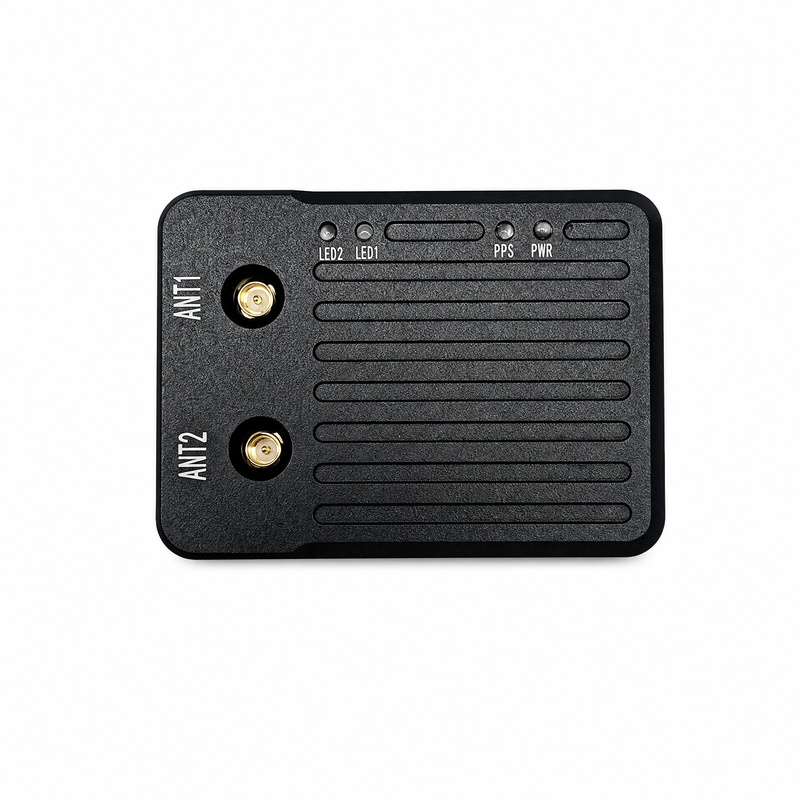
HB52H / HB52 Ultralight RTK GNSS Receiver — Septentrio mosaic-G5
The HB52H / HB52 is an ultralight compact all-constellation, all-frequency RTK GNSS receiver powered by the Septentrio mosaic-G5. With 789 hardware channels, 0.6 cm + 0.5 ppm RTK accuracy and ultra-precise 1.4 ns timing, it supports dual-antenna heading output (HB52H) and single-antenna positioning (HB52). Designed for UAVs, autonomous robots and precision control systems, Septentrio’s AIM+ anti-interference, APME+, IONO+, LOCK+ and RAIM+ technologies ensure reliable performance in complex environments.
Description
The HB52H / HB52 is an ultralight, compact all-constellation all-frequency RTK GNSS receiver powered by the Septentrio mosaic-G5. With 789 hardware channels and support for every current and future GNSS signal, it delivers centimetre-level RTK accuracy with ultra-precise 1.4 ns timing output. The HB52H variant adds dual-antenna heading, pitch and roll — making it ideal for autonomous navigation systems. Designed for UAVs, fully autonomous robots, precision control, autonomous driving and compatible with popular open-source autopilots, it performs exceptionally in complex RF environments. Septentrio’s full suite of AIM+ anti-interference, APME+ multipath mitigation, IONO+ scintillation suppression, LOCK+ robust tracking and RAIM+ integrity monitoring is integrated as standard.
Product Features
- 789 hardware channels — all-in-view, all-constellation, all-frequency tracking
- Supports GPS, GLONASS, BDS, Galileo, QZSS, NavIC and SBAS
- RTK accuracy: 0.6 cm + 0.5 ppm horizontal; 1 cm + 1 ppm vertical
- 20 Hz maximum data update rate with <10 ms latency (99.9%)
- Dual-antenna heading: 0.15° @ 1 m baseline; 0.03° @ 5 m baseline (HB52H)
- Ultra-short baseline heading output supported
- Timing accuracy: xPPS 1.4 ns; Event <3 ns
- Cold TTFF <35 s; Warm <10 s; Reacquisition 1 s
- AIM+, APME+, IONO+, LOCK+ and RAIM+ protection technologies
- OSNMA anti-spoofing; interference indication and spectrum measurement
- Complete raw measurement data output
- Integrated TCXO, LNA and TF card slot up to 32 GB
- Ultra-compact: 43.8 × 34.0 × 11.5 mm ±0.2 mm
Performance Metrics — GNSS, TTFF and Positioning
| Parameter | Description |
|---|---|
| Receivable Satellites | GPS: L1C/A, L1C, L2C, L2PY, L5 BDS: B1I, B1C, B2a, B2I, B2b, B3I GLONASS: L1CA, L2CA, L2P, L3 CDMA Galileo: E1, E5a, E5b, E6 QZSS: L1C/A, L1C/B, L2C, L5, L6 |
| Tracking Sensitivity (C/N₀) | Tracking and Navigation: 20 dB-Hz Acquisition: 30 dB-Hz |
| Time To First Fix (TTFF) | Cold Start: <35 s Warm Start: <10 s Reacquisition: 1 s |
| RTK Horizontal Accuracy | 0.6 cm + 0.5 ppm |
| RTK Vertical Accuracy | 1 cm + 1 ppm |
| RTK Initialization Time | 7 s |
| Standalone Accuracy | Horizontal 1.2 m; Vertical 1.9 m |
| DGNSS Accuracy | Horizontal 0.4 m; Vertical 0.7 m |
Performance Metrics — Timing, Heading and Output
| Parameter | Description |
|---|---|
| Timing Accuracy | xPPS output: 1.4 ns Event accuracy: <3 ns |
| Latency | 99.9% <10 ms |
| Velocity Accuracy | 0.03 m/s (RMS) |
| Heading Accuracy (Dual Antenna) | 1 m spacing: Heading 0.15°, Pitch/Roll 0.25° 5 m spacing: Heading 0.03°, Pitch/Roll 0.05° |
| Baud Rate | 4800–4M bps (default 115200 bps) |
| Maximum Data Update Rate | 20 Hz |
Antenna Modes
| Item | Single Antenna (RF1) | Dual Antenna (RF1 + RF2) |
|---|---|---|
| Function | Positioning only | Positioning + heading, pitch and roll |
| Pre-amplification Range | 15–50 dB | 15–35 dB |
| Antenna Bias Voltage | 3.0–5.5 V (150 mA limit) | 3.0–5.5 V (150 mA limit) |
Supported Protocols
| Protocol Type | Description |
|---|---|
| NMEA 0183 v2.3, v3.03, v4.0 | Input/output, ASCII |
| Septentrio Binary Format (SBF) | Input/output |
| RTCM v3.x (including MSM) | Input |
Pin Definition
| Name | I/O | Description |
|---|---|---|
| VCC | Power | Main power supply |
| GND | Ground | System ground reference |
| RX1 | Input | UART1 Receive |
| TX1 | Output | UART1 Transmit |
| RX2 | Input | UART2 Receive |
| TX2 | Output | UART2 Transmit |
| SCL | Bidirectional | I2C Clock line |
| SDA | Bidirectional | I2C Data line |
| SD | Bidirectional | SD card SPI CS or SDIO interface signal |
| PPS | Input | Pulse Per Second timing signal |
| PWR | I/O | Power control signal |
Mechanical
| Item | Value |
|---|---|
| Dimensions | 43.8 × 34.0 × 11.5 mm ±0.2 mm |
Applications
- UAV and multirotor drones
- Fully autonomous robots
- Precision machine control
- Autonomous driving systems
- Open-source autopilot platforms
Reviews
There are no reviews yet.