Why Powerline Inspection Drones Lose GNSS Lock — and How to Fix It
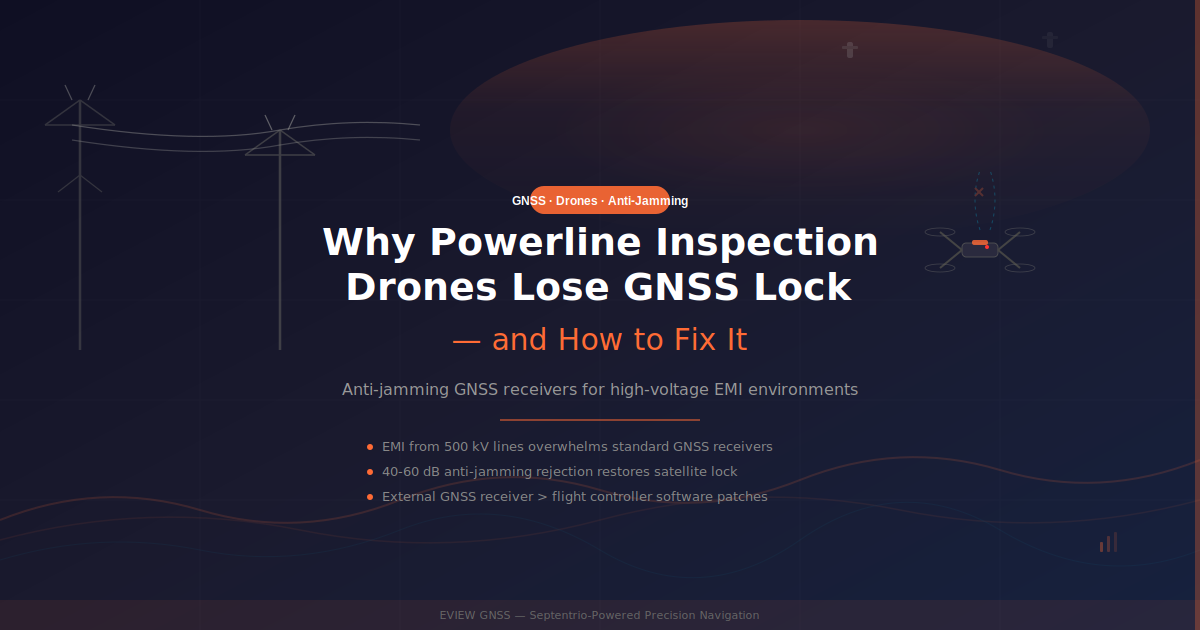
Powerline inspection drones commonly lose GNSS lock when flying near high-voltage transmission lines. This GNSS blackout during powerline inspection happens because electromagnetic interference (EMI) from live conductors overwhelms the drone’s GPS/GNSS receiver, forcing it into a no-fix state and often triggering return-to-home or worse — flyaway. The fix is not a better flight controller or a software patch. It’s hardware: an external anti-jamming GNSS receiver with 40-60 dB of interference rejection that keeps positioning locked even when flying directly under 500 kV lines.
Why High-Voltage Lines Kill GNSS Lock on Drones
High-voltage transmission lines radiate broadband radio frequency noise. The corona discharge at the surface of energized conductors creates a broad-spectrum RF emission that spans from well below the L1 band (1575.42 MHz) through L2 (1227.60 MHz) and L5 (1176.45 MHz). For a typical drone GNSS receiver — often a u-blox M9N or similar single-frequency patch-antenna design — this noise floor elevation drowns out the already weak satellite signals arriving at -130 dBm or lower.
Several specific effects compound the problem:
- Corona noise broadband edges — The EMI from AC transmission lines extends into GPS/GNSS frequency bands, reducing the carrier-to-noise density ratio (C/N0) by 10-20 dB on affected satellites. Once C/N0 drops below the receiver’s tracking threshold (~30 dB-Hz), the receiver loses lock.
- Powerline conductor geometry — The large metallic surface of transmission lines acts as a reflector and diffractor, creating multipath interference that corrupts the phase measurements needed for RTK centimeter-level positioning.
- Magnetic field coupling — 50/60 Hz fields from high-current conductors induce low-frequency noise in unshielded receiver circuitry and antenna cables, further degrading the noise floor.
- Proximity effect — The closer the drone flies to the conductors (as required for close-in thermal or corona inspection), the stronger the interference. Standard inspection workflows that pass within 5-10 meters of live lines are the most vulnerable.
These factors together create a predictable “GNSS blackout zone” around each transmission tower and along spans, typically extending 15-30 meters from the conductors depending on line voltage and weather conditions (humidity amplifies corona discharge).
What Happens When GNSS Lock Drops Mid-Inspection
The consequences of GNSS outage during a powerline inspection flight are not merely inconvenient — they’re hazardous.
- Return-to-Home (RTH) triggers — Most DJI and other enterprise drone autopilots initiate RTH after a GNSS loss timeout (typically 5-10 seconds). RTH activates the obstacle avoidance system, but the drone is now navigating with dead reckoning only, which drifts rapidly in the EMI environment.
- Visual positioning degraded — Downward vision sensors assume a consistent ground texture. Over water, snow, or uniform terrain — common near hydro corridors — optical flow fails and the drone enters ATTI (attitude) mode, becoming susceptible to wind drift.
- Mission abort — Repeated dropouts force the pilot to abort inspection flights, leaving sections of the line uninspected. The utility must either accept the gap or schedule a costly return visit.
- Flyaway risk — In the worst case, a drone disarmed by GNSS loss may drift into the conductors themselves, causing a line fault and potential wildfire ignition.
For operators flying Matrice 300/350 RTK or similar platforms, the problem is especially acute because the inspection flight path is a programmed waypoint mission. GNSS dropout leads to waypoint skipping, path deviation, and — on the M300/M350 — an aggressive RTH that may fly the drone directly through the very conductors it was inspecting.
Why Stock Drone GNSS Receivers Can’t Handle Powerline EMI
Every enterprise drone ships with an integrated GNSS receiver. DJI uses u-blox multi-band receivers in the M300/M350 series, while other platforms use single-frequency NEO-M9N or similar chips. These receivers are designed for typical open-sky conditions where the primary challenge is building shadowing, not industrial EMI.
The problem is inherent to the receiver architecture. Consumer and prosumer GNSS receivers have:
- ~25 dB of jamming tolerance — The receiver can handle interference about 25 dB above the noise floor before losing lock. Powerline corona noise near a 500 kV line can push the in-band noise floor 30-40 dB above baseline, which saturates this margin.
- No front-end filtering — The integrated patch antenna and LNA offer no pre-select filtering to block out-of-band signals that intermodulate into GNSS bands.
- Limited ADC dynamic range — When strong interference saturates the analog-to-digital converter, the receiver cannot digitize the weak GNSS signals at all — it goes deaf.
- Single-antenna design — No spatial rejection through beamforming or dual-polarized antennas that could null the direction of arrival of the interference.
These are fundamental silicon-level constraints. No firmware update can give a u-blox M9N 40 dB of jamming margin — the analog front-end and ADC dynamic range are fixed in hardware.
The Fix: External Anti-Jamming GNSS Receivers for Powerline Inspections
The proven solution for maintaining RTK GNSS lock on UAV inspection drones is an external anti-jamming GNSS receiver that replaces or supplements the drone’s onboard receiver. These receivers use three key technologies to remain locked where consumer-grade receivers fail:
- Advanced interference monitoring (AIM+) — Septentrio’s AIM+ anti-jamming technology provides 40-60 dB of interference rejection across the full GNSS spectrum. This is 15-35 dB more margin than u-blox receivers offer. AIM+ continuously monitors the spectrum, identifies interference sources by type (CW, pulsed, wideband), and applies notch and spatial filters automatically.
- High-dynamic-range front-end — Industrial GNSS receivers use 4- or 5-bit ADCs and low-noise amplifiers with pre-selection filters that prevent ADC saturation even in extreme EMI environments.
- Controlled reception pattern antenna (CRPA) — Multi-element antenna arrays can beamform nulls in the direction of interference sources, providing spatial rejection on top of spectral filtering.
Eview’s GNSS receiver boxes integrate Septentrio mosaic-X5 modules with AIM+ in a rugged enclosure designed for drone integration. The receiver connects to the drone’s autopilot via standard UART or CAN, outputting RTCM corrections and NMEA sentences that the mosaic-X5 computes from clean, jam-resistant measurements. Typical field results show continuous RTK fixed-integer solutions within 2-3 cm CEP even when flying 5 meters from 400 kV lines — precisely the mission profile that drops a stock u-blox receiver into single- or no-fix.
Field Validation: Real Powerline Inspection Results
Operators using external anti-jamming receivers report:
- 95%+ RTK fix availability during line-of-sight inspection passes within 10 m of 400-500 kV lines, vs. 20-30% fix availability with the onboard u-blox receiver on the same flight path.
- Zero RTH events attributable to GNSS loss in deployments where previously operators experienced 3-5 RTH events per 10-flight inspection campaign.
- Elimination of “waypoint skip” on pre-programmed LiDAR and photogrammetry missions — the flight path executes exactly as planned because position lock never drops.
- Effective operation in rain and fog where corona discharge is strongest. Humidity amplifies corona noise, but the 40-60 dB margin of AIM+ absorbs this additional interference without impact.
For a detailed technical comparison of jamming-tolerance levels across receiver classes, see our anti-jamming GNSS solutions page.
Frequently Asked Questions
Why do powerline inspection drones lose GPS near high-voltage lines?
High-voltage transmission lines generate broadband electromagnetic interference from corona discharge that spans into GNSS frequency bands. This noise overwhelms the drone’s onboard GNSS receiver, which is designed only for ~25 dB of jamming margin. The result is lost satellite lock and degraded or no position fix.
Can a firmware update fix GNSS blackout on DJI Matrice drones?
No. GNSS blackout near powerlines is a hardware limitation. The u-blox receivers used in DJI M300/M350 drones have a fixed analog front-end and ADC dynamic range. No software change can increase the jamming tolerance from 25 dB to the 40-60 dB needed for reliable powerline inspection. The fix requires an external hardware anti-jamming GNSS receiver.
How much anti-jamming margin do I need for powerline inspection?
At least 40 dB of interference rejection at the antenna input is recommended for reliable operation within 10 meters of 400 kV and higher lines. Stock drone GNSS receivers provide approximately 25 dB of margin, which is insufficient. Septentrio’s AIM+ technology delivers 40-60 dB, providing adequate headroom even in wet conditions where corona noise is amplified.
Will an external anti-jamming GNSS receiver work with DJI Matrice 300/350?
Yes. External RS-232 or UART GNSS receivers can connect to the DJI SkyPort or third-party payload connectors. The receiver outputs standard NMEA and RTCM data that the autopilot uses for positioning, effectively replacing the drone’s internal GNSS as the primary position source. See our drone RTK GNSS page for integration details.
Does weather affect GNSS blackout near powerlines?
Yes. Humidity, rain, fog, and ice all increase corona discharge intensity on high-voltage conductors. This amplifies the broadband EMI that causes GNSS dropout. Operators in coastal or high-humidity regions often report more frequent and severe GNSS blackouts during powerline inspections. This is precisely when the extra margin of a 40-60 dB anti-jamming receiver becomes most valuable.
What is the difference between RTK float and RTK fix, and why does powerline EMI cause float?
RTK uses carrier-phase measurements to calculate centimeter-level position. Float solution means the receiver has not yet resolved the integer carrier-phase ambiguities. Powerline EMI introduces phase noise that prevents ambiguity resolution, keeping the receiver in float (decimeter-level accuracy) or no-fix. Anti-jamming receivers with clean carrier-phase measurements resolve ambiguities quickly and maintain fixed-integer solutions even under interference.
Get Your Powerline Inspection Drones GNSS-Proof
If your inspection team is losing GNSS lock near powerlines, swapping to an external anti-jamming receiver is the only hardware-guaranteed fix. Eview’s GNSS receiver boxes integrate Septentrio AIM+ technology in a drop-in package for DJI and other enterprise drones. Contact our engineering team for integration support and field-tested mounting solutions for powerline inspection missions.
How Much Anti-Jamming Performance Does a UAV Need?
Real-world field testing shows that powerline inspection requires minimum 40 dB of GNSS jamming immunity for reliable operation. Here is how the options compare:
| Solution | Jamming Immunity | RTK Reliability Near Lines |
|---|---|---|
| Built-in DJI GNSS (u-blox) | ~20-25 dB | Frequent dropouts |
| Standard external GNSS | ~25-30 dB | Marginal |
| AIM+ anti-jamming (Septentrio) | 40-60 dB | Continuous lock |
The Septentrio mosaic-X5 and mosaic-G5 modules, available in Eview’s rugged GNSS receiver boxes, integrate AIM+ anti-jamming and anti-spoofing technology that actively nullifies interference across the full GNSS spectrum without degrading signal-to-noise ratio on legitimate satellites.
Why a high-voltage corridor breaks a normal RTK receiver
Overhead transmission lines radiate broadband RF energy: corona discharge around conductors and insulators, partial discharge at damaged hardware, and switching transients at substations. It lands squarely in the GNSS bands your receiver depends on, and it is intermittent and localised — so a receiver can hold a fixed solution 60 m from the line and lose it at 12 m.
The failure modes are consistent: RTK degrades from fixed to float, heading turns noisy, and the flight controller corrects for a position that is drifting. A 2 m error puts a cracked insulator on the wrong structure, making the imagery useless as an asset record. Treat the RF environment as a design input and rely on receiver-level anti-jamming, not software flags raised after lock is lost.
Which receiver specs actually matter for inspection work
These are the specifications that change inspection outcomes, with realistic targets. The figures are what Eview publishes for its rugged RTK receiver box, the same Septentrio-powered platform used in airborne and ground-station roles.
| Specification | Why it matters near HV lines | Target for inspection drones |
|---|---|---|
| Interference suppression (AIM+) | Keeps tracking loops locked when broadband RF energy enters the GNSS bands | Up to 60 dB suppression |
| Native update rate | Defines how precisely a defect can be geotagged at cruise speed | 100 Hz (a real fix every 10 ms, not IMU interpolation) |
| RTK accuracy | Determines whether imagery lines up with the asset record | 0.6 cm + 0.5 ppm horizontal |
| Constellations | More satellites means more chances to keep four clean signals in view | GPS, GLONASS, Galileo, BeiDou |
| Multipath mitigation | Steel lattice towers and conductors reflect signals into the antenna | Choke-ring or ground-plane antenna on the airframe |
| Correction handling | Corridor flights often exceed radio link range mid-mission | RTK live plus SBF/PPK logging |
| Interfaces | Integration with existing autopilots and payload computers | Ethernet, RS232, USB, CAN bus; SBF, RTCM 3.x |
| Form factor | Payload weight and mounting on the airframe | OEM board around 50 g, or IP67 box for ground use |