mosaic-G5 P3H vs Unicore UM982: Which GNSS OEM Module Is Better?
Both the Septentrio mosaic-G5 P3H and the Unicore UM982 are single-module answers to dual-antenna RTK heading. Eview builds the mosaic-G5 P3H into finished heading receivers, the HB50H, HB51, HB52H and HBEV322H, so you can compare it as integration-ready hardware rather than a bare module. All figures below come from each manufacturer’s public datasheets.
- HB52H: ultralight, 48 × 35 × 12.6 mm, USB-C, microSD
- HB50H: compact, low power (0.60 W)
- HB51: heading plus RM3100 magnetometer
- HBEV322H: smart antenna with compass
Specification comparison
| Septentrio mosaic-G5 P3H | Unicore UM982 | |
|---|---|---|
| Channels | 789 | 1408 |
| Bands | Quad-band GPS, GLONASS, BeiDou, Galileo, QZSS | Multi-band incl. GPS L5 and Galileo E6 |
| RTK accuracy (horizontal) | 0.6 cm + 0.5 ppm | 0.8 cm + 1 ppm |
| Heading at 1 m baseline | 0.15° (pitch or roll 0.25°) | 0.1° |
| Max RTK / heading rate | Up to 20 Hz | Up to 20 Hz |
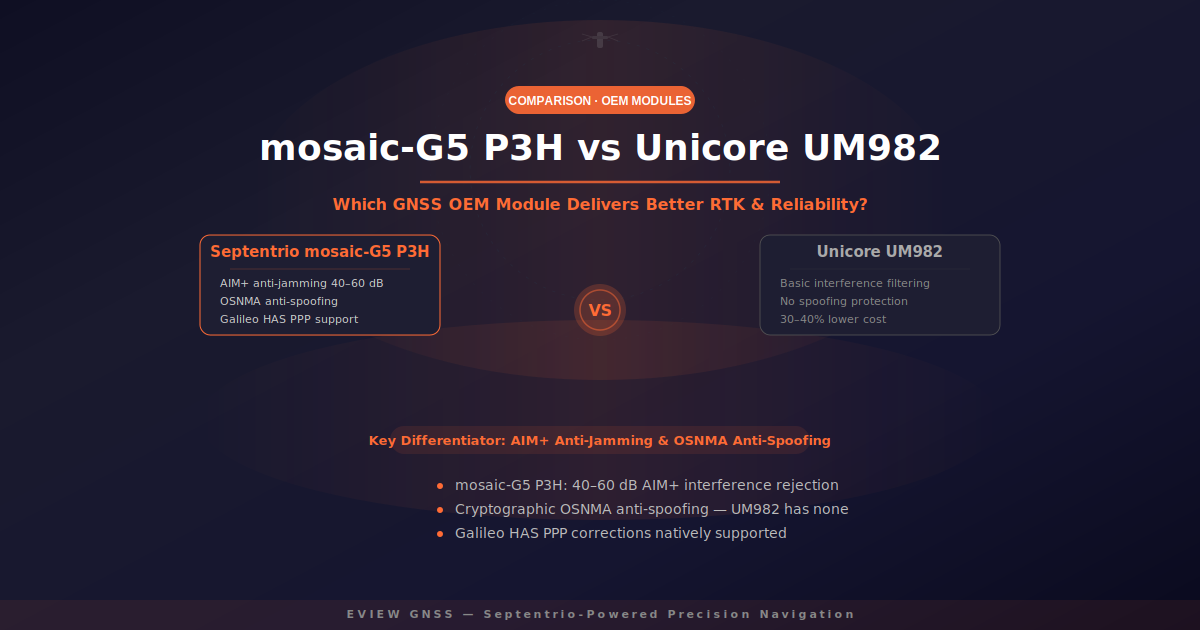
| Interference features | AIM+ (narrowband, wideband, chirp, pulsed) | States 60 dB narrowband suppression |
| Galileo OSNMA | Yes | Not stated |
| Galileo HAS | Supported (software rollout) | Not stated |
| Module size | 22.8 × 16.4 × 2.4 mm, 2.2 g | 16 × 21 × 2.6 mm |
| Typical power | 0.6 W | Not stated |
Figures from each manufacturer’s public datasheets. More on the module: Septentrio mosaic-G5.
Where they differ in practice
- Interference: Septentrio AIM+ covers wideband, chirp and pulsed interference as well as narrowband; Unicore states a narrowband figure. This matters near power lines, radar and busy industrial sites. See AIM+.
- Authentication: the mosaic-G5 P3H supports Galileo OSNMA. See OSNMA anti-spoofing.
- Heading accuracy: the UM982 states 0.1° at 1 m; the mosaic-G5 P3H states 0.15° at 1 m and 0.03° at 5 m.
- Size and power: the mosaic-G5 module is 2.2 g at about 0.6 W, which suits small drones and battery robots.
- Integration: the two use different pinouts and command sets, so moving between them means a new carrier board. A finished Eview receiver avoids that design work.
Which to choose
| If your priority is | Choose |
|---|---|
| Heading in a finished, small receiver with AIM+ and OSNMA | Eview HB52H or HB50H |
| Heading plus a magnetometer backup | Eview HB51 |
| Heading at 100 Hz for fast vehicles | Eview HB10 (AsteRx-m3 Pro+) |
| Evaluating the module before design-in | G5P3H EVK |
Typical uses: marine heading, robots and AMRs, agriculture and drones.
Talk to Eview
Tell us your platform, environment and quantity, and we will recommend the right Eview receiver and antenna. Email sales@gnss-solutions.com for pricing, datasheets and user manuals; we reply within 24 hours.
Frequently asked questions
What is the difference between the mosaic-G5 P3H and the Unicore UM982?
Both give dual-antenna RTK heading at up to 20 Hz. The mosaic-G5 P3H adds Septentrio AIM+ against wideband and pulsed interference, Galileo OSNMA and a 2.2 g module; the UM982 states 0.1° heading at 1 m and 1408 channels.
Which Eview receivers use the mosaic-G5 P3H?
The HB50H, HB51, HB52H and HBEV322H, plus the G5P3H EVK evaluation board.
Is the UM982 a drop-in replacement for the mosaic-G5 P3H?
No. The pinouts and command interfaces differ, so a switch needs a new carrier board.
Which is better for autonomous vehicles?
For heading at 20 Hz, either module can work; for interference resilience and authentication, the mosaic-G5 P3H in an Eview receiver adds AIM+ and OSNMA. For 100 Hz, choose the Eview HB10.
How do I get pricing?
Email sales@gnss-solutions.com with your application and quantity.