What Is AIM+ GNSS Technology? Septentrio Advanced Interference Mitigation Explained
If your GNSS receiver loses lock near power lines, industrial machinery, or radio towers, you are experiencing radio frequency interference (RFI). Septentrio AIM+ (Advanced Interference Mitigation) is a hardware-software technology that suppresses jamming and interference by up to 60 dB — enough to maintain centimetre-level RTK positioning even when consumer-grade receivers completely fail. This guide explains what AIM+ is, how it works, and why it matters for professional UAV, robotics, and survey applications.
What Is AIM+ GNSS Technology?
AIM+ (Advanced Interference Mitigation) is Septentrio’s proprietary real-time interference suppression engine, integrated directly into the receiver firmware of mosaic-X5, mosaic-H, and AsteRx series GNSS modules. Unlike simple software filters that track a single narrowband tone, AIM+ uses an array of parallel processing techniques — including multi-notch filtering, pulse blanking, and adaptive beamforming — to isolate and cancel multiple interference sources simultaneously without degrading the underlying satellite signal.
Where earlier mitigation systems could handle one or two CW (continuous wave) interferers, AIM+ monitors the entire GNSS spectrum in real time and can suppress dozens of simultaneous interferers across GPS, GLONASS, Galileo, and BeiDou bands. The result is a receiver that stays locked and outputs usable RTK corrections in environments where standard receivers output nothing but noise.
How Does AIM+ Suppress GNSS Interference?
AIM+ operates on three complementary layers:
- Multi-Notch Filtering. Each incoming signal is swept across the GNSS bands (L1, L2, L5, E1, E5a, E5b, E6, B1I, B2a, etc.). When AIM+ detects a continuous-wave interferer at a specific frequency, it places a programmable notch filter — typically only a few kilohertz wide — centred on that frequency. This removes the jammer while leaving the spread-spectrum satellite signal intact. Unlike fixed hardware filters, these notches move dynamically as interference changes.
- Pulse Blanking. Radar systems, DME (Distance Measuring Equipment), and nearby radio transmitters produce short, high-power pulses that can saturate the receiver’s front end. AIM+ detects these pulses at sub-microsecond latency and blanks the affected samples before they reach the correlator. The technique is particularly valuable for UAVs flying near airports or military radar installations.
- Adaptive Beamforming (AIM+ Advanced). In dual-antenna configurations, AIM+ can use carrier-phase differences between antennas to steer a spatial null toward the interference source. This provides an additional 10–20 dB of rejection beyond what notch filtering alone achieves. Beamforming requires two physically separated antennas and proper calibration, but it is the most effective defence against high-power jammers located in a known direction.
Together, these three layers give AIM+ a 40–60 dB interference rejection ratio. By comparison, consumer GNSS chipsets (u-blox, MediaTek, Broadcom) typically offer 20–25 dB of passive rejection — enough for open-sky conditions but insufficient near 4G towers, power substations, or electric fences.
AIM+ vs AIM: What Changed?
Earlier Septentrio receivers shipped with AIM (the original Advanced Interference Mitigation) which handled up to six narrowband interferers across a single constellation band. AIM+ expanded this to:
- Unlimited concurrent narrowband interferers across all GNSS bands
- Wideband chirp jamming rejection — swept-frequency jammers that earlier AIM could not track
- Galileo E6 band protection — critical for HAS (High Accuracy Service) users
- Improved pulse blanking thresholds for better sensitivity recovery after high-power events
In practice, AIM+ turns a Septentrio receiver into a resilient PNT sensor that keeps providing accurate position data through conditions that cause other receivers to drop lock entirely. This is the difference between a drone completing an autonomous powerline inspection and one returning to home with “No GNSS” warnings.
Real-World Performance: What 40–60 dB Actually Means
Interference rejection is measured in decibels relative to the noise floor. A 40 dB rejection ratio means the receiver can tolerate an interferer 10,000 times more powerful than the thermal noise baseline before losing lock. At 60 dB, that figure rises to 1,000,000 times.
To put this in real terms:
- A 25 dB receiver (typical u-blox F9P) loses lock within approximately 20 metres of a 1 W 4G LTE base station operating in the L1 band.
- A 45 dB receiver (AIM-enabled) maintains lock at the same distance with marginal degradation.
- A 55–60 dB receiver (AIM+-enabled) maintains full RTK fix at ranges where standard receivers fail completely.
For drone operators performing powerline inspections — one of the most GNSS-hostile environments in commercial aviation — this difference is the difference between reliable autonomy and constant pilot intervention.
Which Receivers Include AIM+?
AIM+ is standard on all current-generation Septentrio products:
- mosaic-X5 — compact OEM module with full AIM+, GPS/Galileo/BeiDou, and RTK
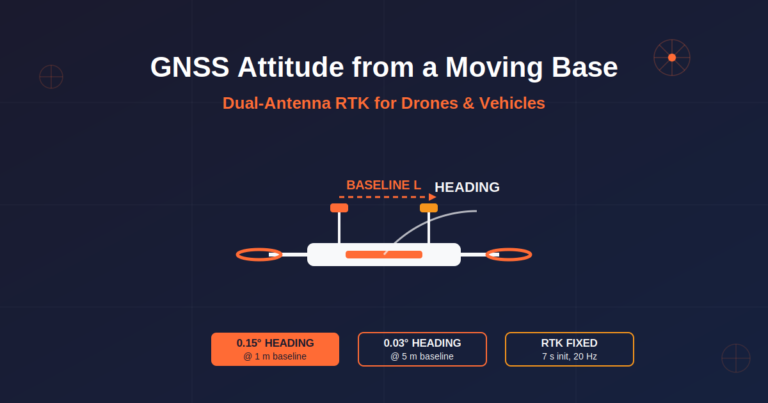
- mosaic-H — dual-antenna heading module with AIM+ Advanced beamforming
- AsteRx-m3 Pro+ — rugged enclosure with full AIM+ and industrial I/O
- Eview GNSS receivers — our RTK GNSS Receiver Box and anti-jamming solutions bundle Septentrio mosaic modules with AIM+ enabled by default in a rugged IP67 enclosure
If you are integrating a GNSS receiver into a UAV, robot, or autonomous vehicle, choosing a module with AIM+ onboard eliminates the most common field failure mode: GNSS dropout from radio interference that has nothing to do with satellite visibility.
AIM+ vs Anti-Spoofing: Two Separate Protections
AIM+ focuses exclusively on interference and jamming — unintentional or intentional RF energy that overwhelms the GNSS signal. Anti-spoofing, which Septentrio implements through signal authentication (OSNMA, Galileo Commercial Service), protects against fake GNSS signals that trick the receiver into calculating a false position. The two technologies are complementary. AIM+ ensures you can see the real satellites through noise; anti-spoofing ensures that what you lock onto is legitimate.
For full protection in high-risk deployments, look for receivers that include both AIM+ and OSNMA support. The Eview GNSS Receiver Box supports both, making it suitable for surveying, construction, and drone applications where signal integrity is non-negotiable.
Frequently Asked Questions
Can AIM+ stop all GNSS jamming?
No technology can stop all jamming at every power level. AIM+ provides 40–60 dB of rejection, which handles most commercial-grade jammers and all unintentional RFI sources. Against military-grade directional jammers at close range, physical shielding or terrain masking is still required.
Does AIM+ consume extra power?
The additional DSP processing adds approximately 50–100 mW depending on the number of active notches. For battery-powered drones and robots, this is negligible compared to propulsion and payload power draw.
Is AIM+ available in the u-blox ZED-F9P?
No. The u-blox F9 platform has basic interference monitoring (detect-and-report only) but no active mitigation. It can tell you a jammer is present, but it cannot suppress it. This is the primary reason users upgrade from u-blox to Septentrio for interference-prone deployments.
Does AIM+ require a special antenna?
No. AIM+ works with standard survey-grade GNSS antennas. Dual-antenna beamforming (AIM+ Advanced) requires a second antenna port and physical separation of at least 30 cm, but the basic multi-notch and pulse-blanking functions use a single antenna.
Can AIM+ be disabled?
Yes, though there is no reason to. AIM+ processing is transparent to the user — it is always running in the background and only activates when interference is detected. Disabling it reduces power by a few milliwatts at the cost of losing all jamming protection.
Does AIM+ work on all GNSS frequency bands?
AIM+ operates across all bands supported by the receiver hardware: L1/L2/L5 (GPS), E1/E5a/E5b/E6 (Galileo), B1I/B2a (BeiDou), and G1/G2 (GLONASS). Band-specific performance depends on the antenna and front-end filter, not on AIM+ itself.
This article was brought to you by Eview GNSS, a Septentrio partner providing rugged, anti-jamming GNSS receivers for UAV, robotics, construction, and industrial applications.