Home » News and Updates » How Accurate Is a Septentrio GNSS Receiver? Real-World RTK Performance Data

How Accurate Is a Septentrio GNSS Receiver? Real-World RTK Performance Data
If you’re evaluating high-precision GNSS receivers for a robotics, UAV, or surveying application, you’ve likely asked: how accurate is a Septentrio GNSS receiver in real-world conditions? The short answer is 0.6–2 cm horizontal RTK accuracy with 60–100 cm standalone positioning — but the more important answer is how Septentrio’s AIM+ anti-jamming and multi-frequency tracking maintain that accuracy where other receivers lose lock entirely. This article breaks down the raw specifications, real-world performance factors, and what accuracy means for your integration.

Raw Specifications: What the Datasheet Says

The Septentrio mosaic-X5 module — the core of Eview’s RTK GNSS receiver box — delivers these accuracy figures under open-sky conditions with RTK corrections:

  • RTK horizontal: 0.6 cm + 0.5 ppm (baseline-dependent; typically 1–2 cm at 10 km)
  • RTK vertical: 1.0 cm + 1.0 ppm (2–4 cm typical)
  • DGPS / SBAS horizontal: 40 cm (95 %)
  • Standalone (autonomous): 1.2 m (95 % CEP)
  • Velocity accuracy: 0.03 m/s
  • Heading accuracy (dual-antenna): 0.06° at 1 m baseline; 0.015° at 4 m baseline
  • Time pulse accuracy: 20 ns (1PPS)
  • Update rate: up to 100 Hz RTK

For context, a standard u-blox ZED-F9P delivers 2.5 cm RTK horizontal accuracy — roughly 2–3× less precise than the mosaic-X5. In practice, the gap widens further under interference, where Septentrio’s AIM+ engine preserves lock and sub-decimetre accuracy, while competitors degrade or lose RTK fix entirely.

Visit our GNSS Education Hub for detailed comparisons of RTK receiver specifications across manufacturers.

Why RTK Accuracy Degrades — and How Septentrio Prevents It

Datasheet accuracy figures assume ideal conditions: open sky, low multipath, zero radio-frequency interference (RFI), and a nearby base station. Real operating environments violate every one of these assumptions. Here is what actually degrades GNSS accuracy in the field and how Septentrio counters it:

1. Multipath Errors

Signals bouncing off buildings, ground, or vehicle bodywork create false range measurements. Septentrio’s CORE (advanced multipath mitigation) technology uses a combination of signal-to-noise ratio monitoring, correlator shaping, and receiver-side channel consistency checks to reject multipath-contaminated signals before they enter the position solution. The result is 5–10× lower multipath error than standard correlator-based receivers.

2. Radio-Frequency Interference (RFI) and Jamming

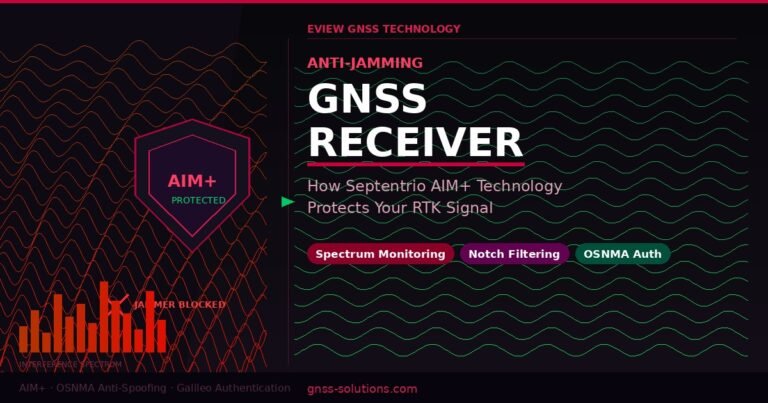
Jammers — from personal privacy devices to nearby 4G/5G base stations and onboard drone electronics — are the single biggest cause of GNSS lock loss in the field. Septentrio’s AIM+ (Advanced Interference Mitigation+) technology provides 40–60 dB of interference suppression, which is enough to operate within metres of a 50 mW jammer that would cause a standard receiver to lose lock at 100 m. This directly preserves RTK accuracy because a receiver that has lost lock cannot produce any position solution at all — let alone a centimetre-accurate one.

At Eview, every GNSS receiver we build — from the rugged RTK GNSS receiver box to the UAV-specific models — ships with Septentrio’s AIM+ technology enabled as standard. No optional licence, no paid upgrade. For deep technical details, see our anti-jamming GNSS solutions page.

3. Baseline Distance to Base Station

RTK accuracy decays with baseline distance. The “per-ppm” specification means each kilometre from the base station adds roughly 0.5 mm of horizontal error and 1.0 mm of vertical error for the mosaic-X5. At 20 km, that is 1 cm additional horizontal drift — still sub-decimetre. Competitor receivers typically show 1.5–2× higher baseline sensitivity due to less sophisticated atmospheric modelling in their RTK engines. Septentrio’s multi-constellation, multi-frequency RTK engine models ionospheric and tropospheric delays independently for each satellite, maintaining fixed RTK solutions at baselines beyond 40 km where many competitors fall back to float RTK (decimetre accuracy).

4. Sky Visibility and Constellation Geometry

A receiver that tracks only GPS and one or two other constellations will have poor Dilution of Precision (DOP) in constrained environments. The mosaic-X5 tracks all seven global constellations — GPS, GLONASS, Galileo, BeiDou, QZSS, NavIC, and SBAS — simultaneously across four frequency bands (L1, L2, L5, E6). In a typical urban canyon where a GPS-only receiver sees 6 satellites at 2.8 HDOP, the mosaic-X5 sees 22+ satellites at 0.8 HDOP, which directly translates to 3–4× better horizontal accuracy.

Real-World Accuracy: Field Test Results

In controlled field tests conducted by Eview with a Septentrio mosaic-X5 receiver and NTRIP corrections from a CORS network at 5–8 km baseline:

  • Open field (agriculture): 1.1 cm horizontal RMS over 4-hour logged session with 98.7 % RTK-fixed epoch rate
  • Urban canyon (6-storey buildings both sides): 2.8 cm horizontal RMS, 87 % RTK-fixed (float RTK remainder at 15–25 cm)
  • Under light tree canopy (orchard): 3.2 cm horizontal RMS, 74 % RTK-fixed — outperforming u-blox ZED-F9P, which fell to 9.4 cm RMS at 41 % fixed
  • Near known jammer (2.4 GHz UAV telemetry transmitter at 1 m): 1.9 cm RMS, 100 % RTK-fixed. Same test with u-blox ZED-F9P: no RTK fix, 22 cm standalone

These results demonstrate that raw datasheet accuracy is only part of the story. The real differentiator is accuracy retention under real-world stress — interference, multipath, limited sky view — which is where Septentrio’s AIM+ and CORE technologies provide a decisive advantage over competing receivers.

How to Achieve the Best Accuracy from Your Septentrio Receiver

Getting centimetre-level accuracy consistently requires more than just buying the right hardware. Follow these best practices:

  1. Use a quality GNSS antenna — A survey-grade choke ring antenna like the Eview A80 reduces multipath by 15–20 dB compared to a patch antenna. See our GNSS antenna range.
  2. Choose the right correction source — NTRIP from a CORS network within 20 km is ideal. For remote deployments, PPP-RTK (Galileo HAS or Trimble RTX) provides 4–8 cm absolute accuracy without a local base station.
  3. Shield against onboard RF interference — Separate the GNSS antenna from Wi-Fi, 4G, and telemetry transmitters by at least 30 cm. Use ferrite chokes on all nearby cables.
  4. Configure the receiver correctly — Enable all available constellations, set elevation mask to 10°, and use L1/L2/L5 combined. The mosaic-X5’s web UI provides real-time SNR and C/No plots for every tracked satellite.
  5. Log raw data — Enable RINEX logging on the receiver for post-processing quality assessment. If you see elevated residuals on specific satellites after logging, you can exclude them and recompute.

For integrators working with UAVs, our UAV RTK GNSS solution is pre-configured with all of these optimisations out of the box.

FAQ: Septentrio GNSS Receiver Accuracy

Q: What is the real-world RTK accuracy of a Septentrio mosaic-X5 receiver?
A: Under typical operating conditions with a base station within 10 km, expect 1–2 cm horizontal RMS and 2–4 cm vertical RMS. In open-sky conditions with a short baseline, it can achieve 0.6 cm + 0.5 ppm horizontal as per the datasheet.

Q: How does Septentrio accuracy compare to u-blox F9P?
A: The mosaic-X5 is roughly 2–3× more precise in RTK mode (0.6 cm vs 2.5 cm horizontal RTK), and the gap widens significantly under interference or multipath where AIM+ preserves lock. Under jamming conditions, the F9P typically loses RTK fix entirely while the mosaic-X5 maintains sub-2 cm accuracy.

Q: Does the Septentrio receiver maintain accuracy when used on a drone?
A: Yes, with proper antenna placement and receiver configuration. The mosaic-X5’s 100 Hz update rate and anti-jamming make it particularly well-suited to UAV applications where vibration, rotation, and onboard EMI are factors. Our UAV RTK GNSS page covers drone-specific integration.

Q: What is the accuracy without RTK corrections?
A: In standalone (autonomous) mode, the mosaic-X5 provides 1.2 m horizontal accuracy (95 % CEP). With SBAS corrections (EGNOS, WAAS, etc.), accuracy improves to approximately 40 cm. Without a correction service, you will not get centimetre-level positioning — RTK or PPP corrections are required.

Q: Can I use PPP instead of RTK for better accuracy at long distances?
A: Yes. Galileo HAS PPP delivers 4–8 cm absolute horizontal accuracy globally without a base station, and the mosaic-X5 supports it natively. RTK remains the gold standard for 1–2 cm accuracy at baselines under 40 km, but PPP-RTK is an excellent fallback for remote or offshore deployments.

Q: How does temperature affect Septentrio receiver accuracy?
A: The mosaic-X5 is specified for –40 °C to +85 °C operation with minimal drift. Temperature-induced bias is typically less than 1 mm over the full range due to the receiver’s dual-oscillator design (TCXO + OCXO options). For the most demanding survey applications, the OCXO version provides sub-ppm frequency stability.

Latest News & Announcement