What Is the Best Anti-Jamming GNSS Receiver? A Technical Buyer’s Guide
If you need centimeter-level positioning in areas where jammers, RF interference, or spoofing signals are known to be present, the best anti-jamming GNSS receiver on the market today is a Septentrio-based receiver equipped with AIM+ (Advanced Interference Mitigation) technology. The Septentrio mosaic-X5 and mosaic-H receivers deliver 40–60 dB of jamming suppression across multiple frequency bands, outperforming consumer-grade solutions like the u-blox ZED-F9P by a wide margin. For engineers evaluating options, the real question isn’t which receiver can handle interference — it’s how much protection your application actually requires.
What Makes a GNSS Receiver “Anti-Jamming”?
Not all GNSS receivers handle interference equally. A standard receiver assumes a clean RF environment: open sky, no nearby transmitters, no intentional jammers. An anti-jamming receiver, by contrast, combines three layers of protection:
- Pre-correlation filtering: Band-pass and notch filters at the RF front-end strip out-of-band interference before the signal reaches the baseband processor. The wider the filter bank and the more agile its tuning, the better it handles swept or pulsed jammers.
- Digital interference detection: The receiver continuously monitors the spectrum for anomalous energy. When a jammer is detected, the receiver can switch to narrow-band tracking or shift to clean PRN codes.
- Adaptive nulling (AIM+ level): Septentrio’s AIM+ goes a step further by analyzing the interference pattern in real time and applying adaptive spatial or temporal filtering. This allows the receiver to maintain lock on genuine satellite signals while nulling the interference vector — even when the jammer is stronger than the GNSS signals by 40 dB or more.
Consumer-grade receivers like the u-blox ZED-F9P typically achieve around 25 dB of jamming suppression — sufficient for mild urban interference but inadequate near transmission towers, power lines, or intentional jammers. Septentrio’s AIM+ technology pushes that to 40–60 dB, making it the clear leader among compact multi-band receivers.
Septentrio mosaic-X5: The Benchmark for Anti-Jamming GNSS
The Eview GNSS Receiver Box, powered by the Septentrio mosaic-X5 module, represents the state of the art in compact anti-jamming GNSS. Here’s why it stands out:
- Multi-band reception: GPS L1/L2/L5, GLONASS L1/L2/L3, Galileo E1/E5a/E5b/E6, BeiDou B1I/B2I/B3I/B1C/B2a — all simultaneously. This gives the receiver maximum redundancy: even if a jammer knocks out L1, the receiver continues tracking on L5, E6, or B3I.
- AIM+ interference mitigation: 40–60 dB suppression against CW, wideband, and pulsed jammers. Real-time adaptive filtering maintains centimeter-level RTK accuracy even under active jamming.
- RAIM and FDE: Receiver Autonomous Integrity Monitoring and Fault Detection & Exclusion ensure that spoofed or corrupted signals are discarded before they affect the position solution.
- RTK and PPP-RTK: Centimeter accuracy with RTK corrections via NTRIP, with support for Galileo HAS PPP for autonomous convergence to 20 cm.
For UAV applications, the Drone/UAV RTK GNSS solution packages this same anti-jamming capability in a lightweight enclosure suitable for DJI Matrice, Pixhawk, and PX4-based platforms.
Anti-Jamming GNSS Receivers for Different Applications
The “best” receiver depends on your operating environment and performance requirements:
UAV and Drone Operations
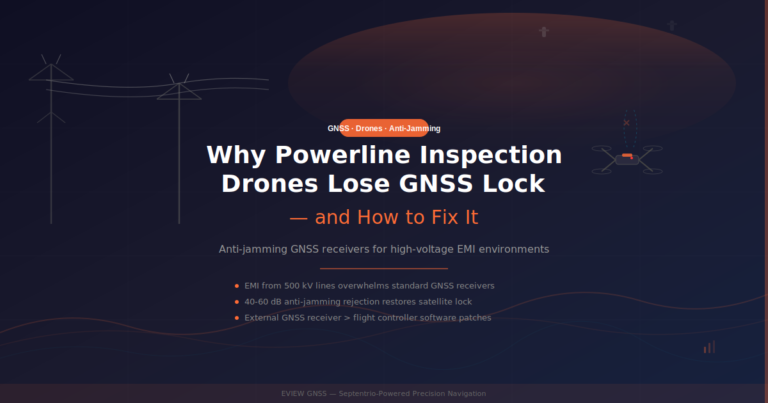
Drones operating near power lines, cell towers, or urban infrastructure face the highest risk of GNSS interference. The Eview drone-grade receiver with AIM+ ensures continuous RTK lock even when flying within 50 meters of high-voltage transmission lines — a scenario where standard receivers commonly lose lock entirely. For DJI Matrice operators, an external anti-jamming GNSS receiver connected via serial or CAN bus provides professional-grade protection that the stock DJI GPS cannot match.
Autonomous Robotics and Construction
Construction machine control and autonomous agricultural robots operate in environments with heavy machinery, motor drives, and radio transmitters that generate broadband interference. A Septentrio-based receiver’s ability to maintain RTK fix under these conditions is why leading OEMs in these sectors specify AIM+ as a requirement rather than an option.
Marine and Port Automation
Port environments combine metal containers (multipath), radar systems (pulsed interference), and potential jamming devices. The anti-jamming and anti-spoofing GNSS receiver family from Eview provides the dual protection these environments demand.
Comparing Anti-Jamming Performance: Real Numbers
To understand why 40–60 dB matters, consider the math. GNSS signals arrive at Earth’s surface at approximately −125 dBm. A 1-watt jammer at 100 meters can produce a signal of −30 dBm at the receiver antenna — a power difference of 95 dB. Without mitigation, that jammer completely overwhelms the GNSS signal. With 40 dB of suppression (AIM+), the effective jammer power at the correlator drops to −70 dBm, and the receiver maintains lock. With 60 dB suppression, the jammer is effectively invisible to the tracking loops.
By contrast, a receiver with only 25 dB suppression (u-blox F9P class) sees an effective jammer power of −5 dBm — still 120 dB above the noise floor, and well beyond what the tracking loops can tolerate. The difference between “can operate near jammers” and “loses lock at the first sign of interference” is exactly this 15–35 dB gap in suppression capability.
Frequently Asked Questions
What is the best anti-jamming GNSS receiver for drones?
The Septentrio mosaic-X5-based Eview receiver is the top choice for professional drones. It provides 40–60 dB AIM+ jamming suppression, multi-band tracking, and RTK accuracy in a compact form factor compatible with DJI, Pixhawk, and ArduPilot autopilots.
How much anti-jamming protection does the u-blox ZED-F9P offer?
The ZED-F9P provides approximately 25 dB of jamming suppression, which handles mild interference but is insufficient for high-interference environments like power line inspection or cell tower proximity. For those applications, a Septentrio-based receiver is strongly recommended.
Can an anti-jamming GNSS receiver also detect spoofing?
Yes. The Septentrio mosaic-X5 includes RAIM and signal authentication features that detect spoofing attempts. When combined with multi-constellation tracking, it becomes extremely difficult to successfully spoof the receiver — the attacker would need to replicate signals across all tracked bands and constellations simultaneously.
Does AIM+ work against all types of jammers?
AIM+ is effective against continuous wave (CW) jammers, wideband noise jammers, and pulsed jammers. It uses a combination of notch filtering, adaptive temporal cancellation, and spatial nulling techniques to handle diverse interference profiles in real time.
Do I need both anti-jamming and anti-spoofing protection?
If your application operates in a contested or monitored environment (power lines, ports, military-adjacent zones, critical infrastructure), yes. Jamming and spoofing are often deployed together, and a receiver with only one layer of protection leaves you vulnerable. The Eview anti-jamming receiver handles both threats.
Where can I buy a Septentrio-based anti-jamming GNSS receiver?
Eview GNSS Solutions offers commercial-grade Septentrio-powered receivers with AIM+ interference mitigation. Visit our GNSS Receiver Box product page for specifications and ordering information.