Can GNSS Be Jammed by Interference? What Every Engineer Needs to Know About GNSS Jamming
Yes, GNSS signals can absolutely be jammed by interference — and it is far easier than most engineers realize. GNSS satellites orbit roughly 20,000 km away, transmitting signals so weak they arrive at Earth’s surface with a power density of approximately −160 dBW/m², comparable to a 50-watt light bulb seen from 10,000 km. Any radio transmitter operating near the GNSS frequency bands — civilian GPS L1 at 1575.42 MHz, L2 at 1227.60 MHz, or Galileo E1 at 1575.42 MHz — can overwhelm these faint signals, causing a receiver to lose lock entirely or report dangerously inaccurate positions.
The Physics of GNSS Vulnerability
A GNSS receiver works by correlating the satellite’s known PRN (pseudo-random noise) code against the incoming signal. The receiver can lock onto a signal as weak as −167 dBW under ideal conditions — roughly 0.02 attowatts. This extraordinary sensitivity is what makes GNSS so useful indoors and under foliage, but it is also the root of its vulnerability. A 1-watt jammer 10 km away can produce a signal at the receiver that is 10–100 times stronger than the satellite signal, completely masking it.
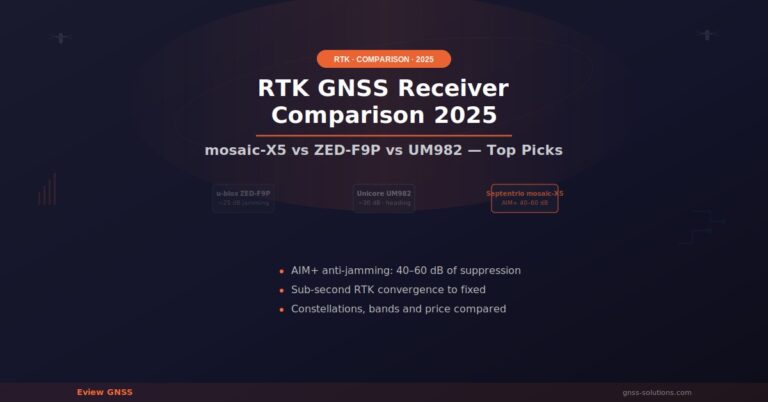
The key metric is the J/S ratio (jammer-to-signal ratio). A receiver needs approximately 25–35 dB of J/S margin before it loses lock entirely. Consumer-grade receivers (smartphone chipsets, low-cost GPS modules) typically have only 20–25 dB of jamming immunity. Industrial-grade receivers with SAW-filter front-ends improve this to 30–40 dB. Septentrio’s AIM+ technology pushes that margin to 40–60 dB, which is why Eview GNSS receivers based on Septentrio silicon are the preferred choice for mission-critical applications.
Six Common Sources of GNSS Interference
Understanding what causes GNSS interference is the first step to preventing it:
- Deliberate jammers: Small, inexpensive devices (often cigarette-lighter plug types used illegally in vehicles to evade fleet tracking) transmit broadband noise across GPS L1. Power output ranges from 10 mW to several watts.
- Personal privacy devices (PPDs): These low-power (1–100 mW) jammers are widely available online. At short range (under 100 m), they can completely disable a standard GNSS receiver.
- Harmonic emissions from other electronics: Camera flashes, switching power supplies, USB 3.0 data lines, and LED drivers can radiate harmonics that fall within GNSS bands. This is a common problem on UAVs where high-current ESCs and camera gimbals share space with the GNSS antenna.
- Spurious emissions from mobile and Wi-Fi equipment: LTE Band 13 (uplink 777–787 MHz) and 5G C-band can produce intermodulation products that alias into L-band GNSS frequencies.
- Solar radio bursts and ionospheric scintillation: Natural phenomena that can degrade or block GNSS signals over large geographic areas, particularly during solar maximum (2024–2026).
- Adjacent-band interference: Radars, satellite communications, and other services in bands adjacent to GNSS (e.g., 1559–1610 MHz for L1) can bleed into the GNSS passband through receiver front-end non-linearity.
How AIM+ Technology Defeats Jamming
Septentrio’s AIM+ (Advanced Interference Mitigation) is a suite of digital signal processing techniques implemented in silicon, not software. Unlike simple notch filtering, AIM+ works across three complementary domains:
- Spectral filtering: Continuously monitors the RF spectrum and applies adaptive notch filters to remove narrowband interferers. Can handle up to 80 simultaneous jamming signals.
- Pulse blanking: Detects and removes high-power pulsed interference (radar, DME, TACAN) on a per-pulse basis, recovering the underlying GNSS correlation peaks.
- Adaptive antenna processing: When paired with a dual-polarized or controlled-reception-pattern antenna (CRPA), AIM+ can null the jammer’s spatial direction while maintaining gain toward satellites — the most effective technique against mobile jammers.
The result: Eview GNSS receivers with AIM+ can maintain position lock in environments where standard receivers (including u‑blox F9P, which offers approximately 25 dB of jamming immunity) fail entirely. Real-world field tests show AIM+ maintaining sub-metre RTK accuracy with a 5-watt jammer only 50 m from the receiver.
Testing Whether Your GNSS Receiver Is Being Jammed
If your GNSS receiver is losing lock or showing erratic positions, you can diagnose jamming with these steps:
- Check C/N₀ values: Healthy GNSS satellites show carrier-to-noise-density ratios of 40–50 dB-Hz. If all satellites are below 35 dB-Hz, interference is likely present. If some are normal and others drop simultaneously, a narrowband jammer on a specific frequency is the culprit.
- Monitor the AGC (automatic gain control): A sudden drop in AGC indicates the front-end is compressing gain in response to a strong in-band signal — a hallmark of jamming.
- Spectrum analyser scan: Sweep the L1 band (1559–1610 MHz) and L2 band (1215–1240 MHz) while the receiver is operating. Any carrier or noise floor elevation above the thermal noise floor (−174 dBm/Hz) indicates interference.
- Run a Septentrio RxTools log: Eview’s Septentrio-powered receivers output detailed SBF (Septentrio Binary Format) files that include jammer indicators, AGC levels, and real-time interference reports.
For a full diagnostic kit, consider the Eview GNSS Receiver Box, which exposes all these telemetry fields through its COM interface and web dashboard.
Choosing a Jammer-Resistant GNSS Receiver for Your Application
The level of anti-jamming protection you need depends on your operating environment:
| Application | Threat Level | Recommended Solution |
|---|---|---|
| Surveying / GIS | Low (rural areas) | Standard RTK receiver with basic filtering |
| Drone powerline inspection | Medium (HV lines radiate) | Septentrio AIM+-equipped receiver |
| UAV operations near urban areas | Medium–High | Eview anti-jamming GNSS with AIM+ |
| Defence / public safety | High (deliberate attack) | Eview receiver with AIM+ + CRPA antenna |
| Robotics / autonomous vehicles | Medium | Septentrio-based receiver with AIM+ |
Eview’s anti-jamming and anti-spoofing GNSS receivers integrate Septentrio’s AIM+ technology into rugged, IP67-rated enclosures ready for field deployment. For drone-specific applications, the UAV RTK GNSS receiver weighs under 120 g while delivering full AIM+ protection.