Anti-Jamming GNSS Receiver: How AIM+ Technology Protects Your RTK Signal
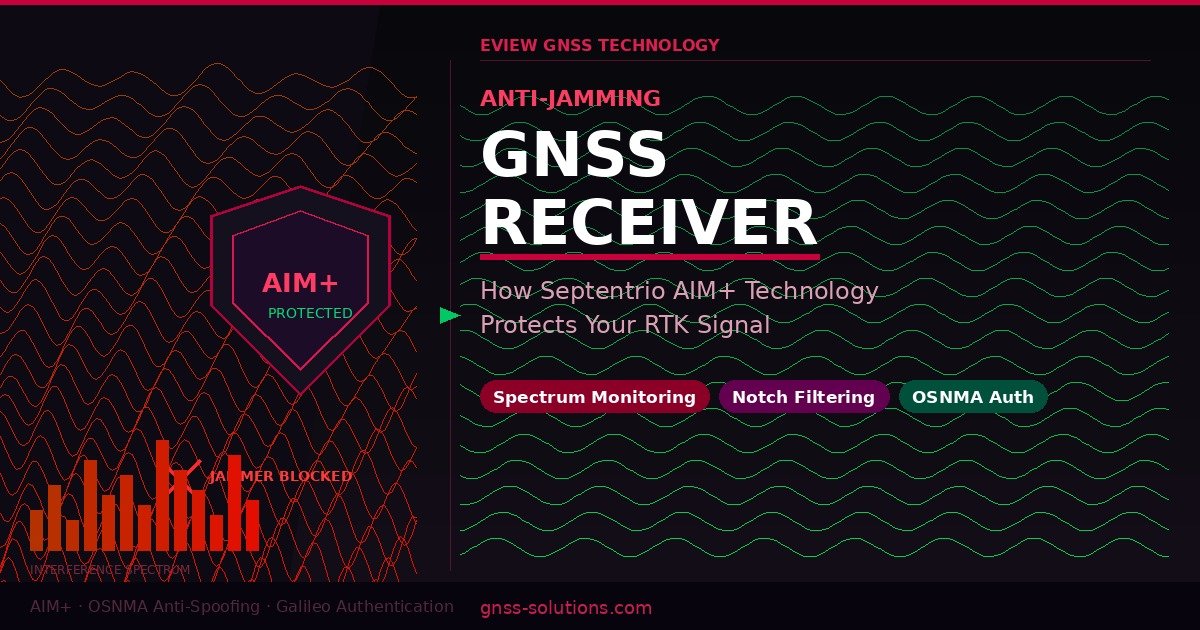
GNSS jamming is no longer an edge case. Cheap jammers available online can knock out unprotected receivers within hundreds of metres. Construction sites, port terminals, urban surveying environments, and industrial drone corridors all carry real interference risk — and a receiver without active mitigation will simply lose lock and output bad position data without warning.
This page explains how Septentrio’s AIM+ (Advanced Interference Mitigation) technology works, what sets it apart from basic filtering, and which Eview GNSS receivers bring AIM+ protection to your application.
What Is GNSS Jamming and Why Does It Matter?
GNSS satellites transmit at extremely low power levels — the signal at ground level is roughly 20 dB below the thermal noise floor. A nearby jamming signal does not need to be powerful to overwhelm it. A small jammer in a passing vehicle can disrupt receivers within a 500 m radius. Continuous wave jammers, pulse jammers, and swept-frequency jammers all affect GNSS signals differently, but the result is the same: position output becomes unreliable or drops entirely.
GNSS spoofing is a related but distinct threat: instead of blocking the signal, a spoofer transmits a false GNSS signal that causes the receiver to report an incorrect position without triggering a lock-loss alert. Spoofing is harder to execute but increasingly documented in commercial drone and maritime environments.
What Is AIM+? Septentrio’s Advanced Interference Mitigation
AIM+ is Septentrio’s proprietary interference monitoring and mitigation system built directly into the GNSS chipset — not added as a separate hardware module. It operates in real time and applies several complementary techniques simultaneously:
Continuous spectrum monitoring: AIM+ monitors the full received spectrum across all GNSS bands at all times. It identifies interference signals by their spectral signature — narrowband continuous wave (CW), broadband noise, or pulsed interference — without needing prior knowledge of the threat.
Adaptive notch filtering: When an interference source is detected, AIM+ applies a narrowband notch filter that removes the interfering frequency component from the received signal. The filter tracks the jammer if it sweeps across frequencies and adjusts in real time. The satellite signals in adjacent frequency bands are unaffected.
Pulse blanking: For pulsed interference sources (such as those from aeronautical distance measurement equipment or radar), AIM+ applies pulse blanking — suppressing the received signal during the pulse and interpolating across the gap. This eliminates the spreading effect that pulsed interference causes in the correlators.
Interference logging: AIM+ logs detected interference events with timestamps, allowing post-mission analysis of interference exposure. This is particularly useful for audit trails in commercial survey or infrastructure inspection workflows.
AIM+ vs. Standard GNSS Receivers — Performance Comparison
| Capability | Standard GNSS Receiver | Eview Receiver with AIM+ |
|---|---|---|
| Continuous spectrum monitoring | No | Yes — all GNSS bands, real time |
| Narrowband CW jamming rejection | No | Yes — adaptive notch filtering |
| Swept-frequency jamming | Position loss | Tracking maintained, notch follows sweep |
| Pulse interference rejection | No | Yes — pulse blanking |
| Spoofing detection (OSNMA) | No | Yes (mosaic-G5 and AsteRx M3 Pro+) |
| Interference event logging | No | Yes — timestamped log |
| Performance impact | — | Negligible — sub-millisecond latency |
OSNMA: Galileo-Native Anti-Spoofing Authentication
OSNMA (Open Service Navigation Message Authentication) is a Galileo signal feature that cryptographically signs the navigation message broadcast by each satellite. A receiver with OSNMA support can verify that the navigation data it received was genuinely transmitted by the Galileo satellite and has not been modified or replicated by a ground-based spoofer.
OSNMA authentication is built into Eview’s mosaic-G5-based receiver (HBEV11) and the AsteRx M3 Pro+-based RB3. For applications where spoofing is a genuine risk — such as urban UAV operations, precision timing infrastructure, or port automation — OSNMA provides a hardware-level authentication guarantee that no software-only approach can match.
Eview Anti-Jamming GNSS Receivers — Product Range
Every Eview receiver includes AIM+ as standard. The models below are recommended for environments with confirmed or expected GNSS interference.
| Model | Chipset | AIM+ Level | OSNMA | Best Interference Scenario |
|---|---|---|---|---|
| HB6 | mosaic-X5 | Full AIM+ | No | General survey, UAV, urban environments |
| HB6 Pro 4G | mosaic-X5 | Full AIM+ | No | Mobile survey with NTRIP in RF-noisy cities |
| HB52H | mosaic-H | Full AIM+ | No | Machine control near industrial interference |
| HBEV11 | mosaic-G5 | Full AIM+ | Yes | UAV and eVTOL with spoofing concern |
| RB3 | AsteRx M3 Pro+ | Maximum AIM+ | Yes | Port automation, critical infra, highest-risk deployments |
Where Anti-Jamming GNSS Receivers Are Essential
Urban Construction and Infrastructure Survey
Urban environments concentrate RF sources — cellular towers, radar, Wi-Fi, and vehicle jammers in traffic. Survey teams operating near major roads, airports, or industrial zones routinely encounter interference that causes standard receivers to lose RTK fix without warning. AIM+ keeps the fix and logs the event for post-mission review. The HB6 Pro 4G is the recommended model for urban survey rover use.
Commercial UAV and Drone Operations
Commercial drones flying Beyond Visual Line of Sight (BVLOS) or in congested airspace face interference from both accidental and deliberate sources. A drone whose GNSS receiver loses lock mid-flight relies on fallback navigation — which may cause deviation from the planned path or trigger failsafe behaviour. AIM+ maintains lock through interference events. For applications requiring spoofing protection (urban BVLOS, infrastructure inspection near critical sites), the HBEV11 with OSNMA is recommended.
Port Automation and Logistics
Port terminals are among the most RF-challenging environments for GNSS: steel structures, high-powered crane systems, ship-mounted radar, and deliberate jammers carried by vehicles. Automated guided vehicles (AGVs), reach stackers, and container cranes that rely on GNSS positioning need the highest level of AIM+ available. The RB3 with AsteRx M3 Pro+ is the receiver specified for port automation at Eview.
Precision Agriculture
Agricultural machinery operating near rural roads encounters vehicle-mounted jammers with increasing frequency. Autopilot systems that lose GNSS fix revert to manual control or stop — neither is acceptable during time-critical field operations. AIM+ ensures continuous positioning through these events. The HB52H (dual-antenna heading for autonomous machines) and HBEV11 (remote fields with free PPP) both include full AIM+ protection.
Frequently Asked Questions
Does AIM+ work against all types of GNSS jamming?
AIM+ handles narrowband CW jammers, swept-frequency jammers, and pulsed interference — the three most common jammer types encountered in commercial environments. Broadband noise jammers (which flood the entire GNSS band with noise) are more difficult for any receiver to handle, but AIM+ provides better tolerance than standard receivers even in those conditions by maximising signal-to-noise through the mitigation pipeline.
Does AIM+ affect RTK accuracy or output rate?
No. AIM+ operates in the signal processing chain before the positioning engine and adds sub-millisecond latency. RTK accuracy remains 1 cm + 1 ppm and output rate remains up to 100 Hz with AIM+ active. When no interference is detected, AIM+ is transparent — it has no impact on normal operation.
What is the difference between anti-jamming and anti-spoofing?
Anti-jamming (AIM+) detects and removes interference signals that block or degrade genuine GNSS signals. Anti-spoofing (OSNMA) detects and rejects false GNSS signals that mimic real satellite transmissions. Jamming causes loss of lock; spoofing causes incorrect position without loss of lock. Both threats require different countermeasures. Eview’s HBEV11 and RB3 address both with AIM+ and OSNMA together.
How do I know if my site has GNSS interference?
Common signs: unexplained RTK fix drops in specific locations, position jumps without atmospheric cause, or difficulty achieving fix in areas where open sky is good. Eview receivers with AIM+ log interference events with timestamps and signal characteristics, allowing you to identify sources and pattern. Contact the Eview team for site-specific interference assessment guidance.
Is OSNMA available globally?
OSNMA is a feature of the Galileo satellite navigation system and is available wherever Galileo signals are receivable — which covers most of the globe except high polar latitudes. It requires a receiver with OSNMA support (available in Eview’s HBEV11 and RB3) and the current Galileo signal broadcast. OSNMA authentication adds no cost and requires no subscription.
What Eview receiver is best for anti-jamming in a drone?
For most commercial UAV applications, the HBEV11 is the recommended choice — it combines full AIM+ anti-jamming, OSNMA anti-spoofing, Galileo E6 HAS free PPP, and an integrated smart antenna form factor that minimises installation complexity and weight. For fixed-wing BVLOS or high-risk urban drone operations, the RB3 provides the maximum level of AIM+ from the AsteRx M3 Pro+ chipset.
Protect Your GNSS Signal — Browse Eview Anti-Jamming Receivers
All Eview receivers include AIM+ as standard. Select the model that matches your interference environment and application requirements.
What Is AIM+ and How Is It Different from External Filtering?
AIM+ is Septentrio’s embedded interference mitigation technology, integrated directly into receivers such as the mosaic-X5, AsteRx series, and the Eview GNSS receiver box. Unlike add-on filter boxes or post-processing workarounds, AIM+ operates pre-correlation: it cleans the signal in the RF and digital front-end before the tracking loops and position engine ever see the interference. This architectural difference matters. A consumer-grade receiver facing a strong jammer typically loses lock at around 25 dB of jamming-to-signal ratio, while a Septentrio receiver with AIM+ keeps working up to 40–60 dB — up to three orders of magnitude more resilient.
How AIM+ Detects Interference: Spectral Awareness in Real Time
The first job of AIM+ is detection. Septentrio receivers continuously sample the full GNSS spectrum and run an FFT-based spectral analysis that identifies the signature of incoming interference. The receiver classifies what it sees: continuous wave (CW) carriers from unlicensed transmitters or faulty electronics, narrowband signals, wideband noise jammers, and pulsed sources such as radar or DME/TACAN. It also monitors signal-to-noise ratio (C/N0) across every tracked satellite on every frequency band. When C/N0 drops or the spectrum shows an unexpected peak, AIM+ flags the event and reports it through the receiver’s status interface, so an engineer can see exactly when and where interference occurred.
AIM+ vs AIM: What Changed?
Earlier Septentrio receivers shipped with AIM (the original Advanced Interference Mitigation) which handled up to six narrowband interferers across a single constellation band. AIM+ expanded this to:
- Unlimited concurrent narrowband interferers across all GNSS bands
- Wideband chirp jamming rejection — swept-frequency jammers that earlier AIM could not track
- Galileo E6 band protection — critical for HAS (High Accuracy Service) users
- Improved pulse blanking thresholds for better sensitivity recovery after high-power events
In practice, AIM+ turns a Septentrio receiver into a resilient PNT sensor that keeps providing accurate position data through conditions that cause other receivers to drop lock entirely. This is the difference between a drone completing an autonomous powerline inspection and one returning to home with “No GNSS” warnings.