What Is the Difference Between GPS and GNSS Receiver? A Complete Technical Guide
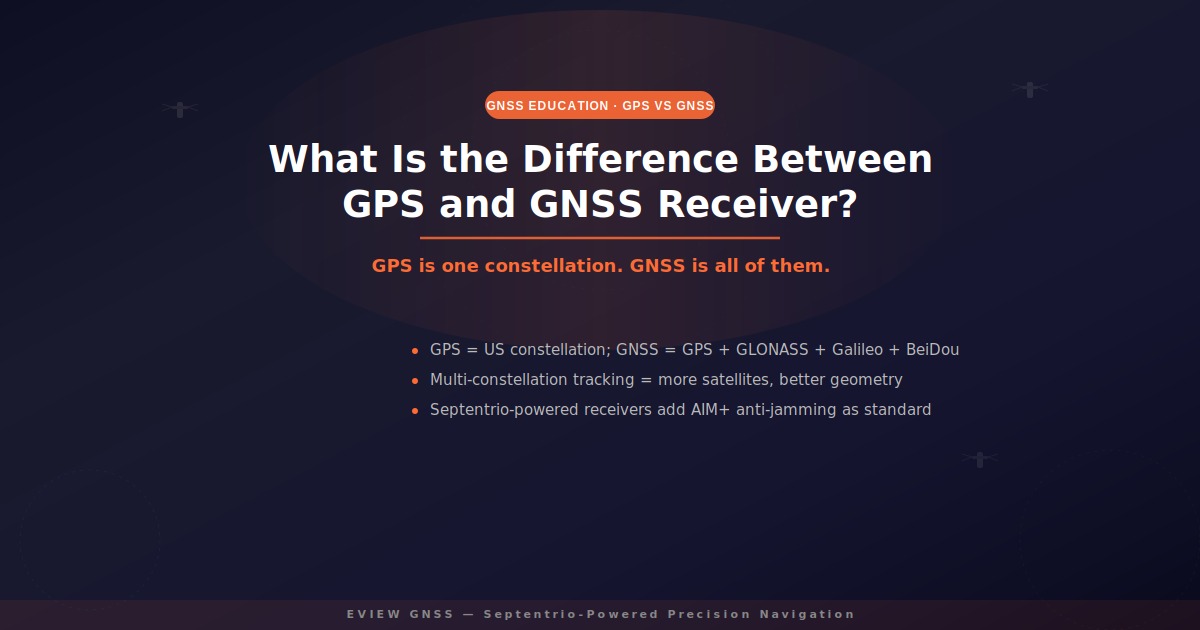
The short answer: GPS is a single satellite constellation operated by the United States, while GNSS (Global Navigation Satellite System) is the umbrella term for all satellite navigation constellations — GPS, GLONASS, Galileo and BeiDou. A GNSS receiver tracks satellites from several constellations at once, whereas a GPS-only receiver can only use US satellites. For engineers, that difference decides availability, accuracy and interference resilience in the field.
GPS Is One Constellation — GNSS Is the Whole System
GPS (Global Positioning System) was the first operational GNSS, declared fully functional in 1995. It consists of roughly 31 operational satellites in medium Earth orbit at about 20,200 km, broadcasting on L1 (1575.42 MHz), L2 (1227.60 MHz) and L5 (1176.45 MHz). When someone says “GPS receiver”, they historically mean a device that tracks only these US satellites.
GNSS is the generic term for every satellite-based positioning system. Today that includes GPS (US), GLONASS (Russia, ~24 satellites), Galileo (EU, ~28 satellites launched) and BeiDou (China, global since 2020). Regional systems such as Japan’s QZSS and India’s NavIC add extra signals over their coverage areas. A GNSS receiver can use all of them simultaneously — which is why “multi-constellation GNSS” is the modern engineering standard.
The confusion is understandable: phones and car satnavs are labelled “GPS” even though they track several constellations. Colloquially “GPS” just means satellite positioning, but on a spec sheet the two terms are not interchangeable.
What a Multi-Constellation GNSS Receiver Actually Does
A receiver computes position by measuring the time-of-flight of signals from satellites in view, then solving for position and clock error — a minimum of four satellites is required for a 3D fix. A GPS-only receiver is limited to the GPS satellites above the horizon at that moment (typically 6–11). A multi-constellation GNSS receiver might see 25–40 satellites, and that surplus translates directly into engineering value:
- Better geometry: more satellites spread across the sky lowers the dilution of precision (DOP), tightening the position solution.
- Higher availability: signals keep coming in urban canyons, tree cover, open-pit mines and other obstructed sites where a single constellation drops out.
- Faster RTK fixes: extra observations speed integer-ambiguity resolution, cutting time-to-centimetre fix after power-up or signal loss.
- Redundancy: if one constellation is degraded or interfered with, the receiver still navigates on the others.
GPS Receiver vs GNSS Receiver: Reading the Spec Sheet
When evaluating hardware, check two lines on the datasheet: supported constellations and frequency bands. A genuine GNSS receiver lists multiple constellations (e.g. “GPS + GLONASS + Galileo + BeiDou”) and is typically multi-frequency, tracking L1/L2/L5, E1/E5, B1/B2 and similar. A GPS-only receiver lists a single constellation and one or two frequencies.
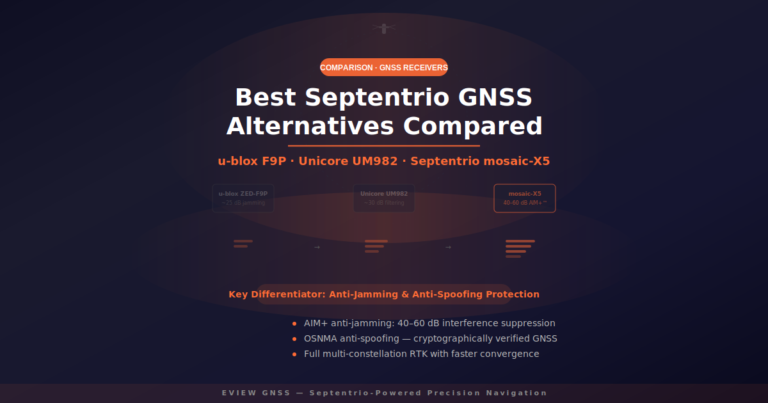
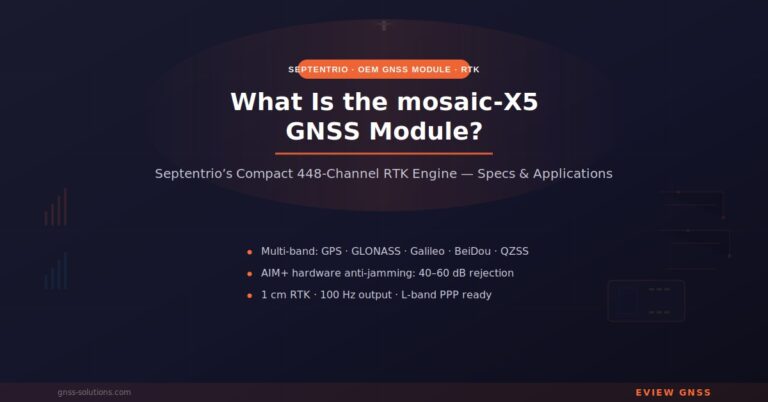
There is a second, subtler spec: interference mitigation. In RF-dense industrial environments — near power infrastructure, 4G/5G sites, or other emitters — a receiver’s ability to filter jamming depends on its front-end and signal-processing, not its constellation count. Septentrio-powered receivers such as the Eview GNSS Receiver Box combine quad-constellation, multi-frequency tracking with AIM+ anti-jamming technology that withstands 40–60 dB of interference, versus roughly 25 dB for typical consumer-grade GNSS chips.
Why the GPS vs GNSS Distinction Matters in Practice
For drone RTK, machine control and robotics, the difference is not academic. Surveyors flying near powerlines or operators running autonomous vehicles in cluttered industrial yards cannot afford a fix dropout when a single constellation geometry degrades. Multi-constellation tracking plus anti-jamming is what keeps centimetre-level RTK locked through the working day.
That is why Eview builds its receivers — from the rugged receiver box to OEM GNSS boards — around Septentrio’s mosaic chipset, which tracks all four global constellations on multiple frequencies and adds AIM+ anti-jamming and anti-spoofing as standard. If your application needs dependable precision in difficult RF environments, the question is not “GPS or GNSS?” — it is which GNSS receiver has the constellation support, frequency plan and interference margin your job demands.
FAQ: GPS vs GNSS Receivers
Is GPS the same thing as GNSS?
No. GPS is one specific constellation (the US system). GNSS is the umbrella term covering GPS, GLONASS, Galileo and BeiDou. Every GPS receiver is a GNSS receiver in the broad sense, but not every GNSS receiver is GPS-only.
Why do engineers prefer GNSS receivers over GPS-only receivers?
Because multi-constellation tracking means more satellites in view, which improves geometry, availability in obstructed areas, and speed to an RTK centimetre fix — all with built-in redundancy.
Do GNSS receivers still work if GPS is jammed?
Only if they can maintain lock on other constellations and have effective interference mitigation. A GNSS receiver with AIM+ anti-jamming technology keeps positioning through interference that would overwhelm a standard receiver.
How many satellites does a GNSS receiver use?
A modern quad-constellation receiver typically tracks 25–40 satellites simultaneously, depending on sky view and antenna, compared with 6–11 for GPS alone.
Is “GPS receiver” wrong terminology?
In consumer contexts it is shorthand for satellite positioning and harmless. On an engineering datasheet, “GPS-only” means exactly that, and “GNSS receiver” means multi-constellation capability — read the spec, not the marketing label.
Does Eview GNSS sell receivers that support all constellations?
Yes. Every Eview receiver is powered by Septentrio and tracks GPS, GLONASS, Galileo and BeiDou on multiple frequencies, with AIM+ anti-jamming and anti-spoofing included as standard.