RxTools Software: 4 Core Advantages for UAV GNSS Receiver Configuration & Diagnostics
— For UAV High-Precision Positioning Scenarios —
RxTools is the professional configuration and diagnostics software that accompanies Septentrio high-precision GNSS receivers — and an indispensable tool in UAV high-precision positioning system integration. Compared with other GNSS receiver software on the market, four core advantages stand out: native Linux support, integrated spectrum analysis (no external hardware required), an ASCII text command system, and message-level differential data link monitoring. For UAV engineers working with PX4, ArduPilot, ROS, and MAVLink development toolchains, RxTools significantly lowers the receiver configuration barrier and shortens fault-troubleshooting time. Eview GNSS offers RxTools software and high-precision GNSS product selection and technical support.
1. Native Linux Support: Built for UAV Development Toolchains
UAV development toolchains (PX4, ArduPilot, ROS, MAVLink) all run primarily on Linux. Among current mainstream high-precision GNSS companion software, Competitor A and Competitor B ship Windows-only versions; users in Linux environments must fall back on virtual machines or Wine, risking serial-port detection failures, performance loss, and compatibility issues.
RxTools was designed with a cross-platform architecture from the start: Windows and Linux versions are feature-synchronized and released on the same day. RxControl runs natively on Ubuntu — not through a compatibility layer. It also provides 13 command-line tools (sbf2rin, sbf2asc, sbf2sbf, posconv, timeconv, and more) that support headless servers, Docker containers, and CI/CD pipeline integration. Batch SBF-to-RINEX conversion can be automated with shell scripts, with no GUI interaction required — especially valuable for UAV mapping and inspection teams that need automated post-processing and batch receiver calibration.
2. Integrated Spectrum Analysis: Real-Time Interference Detection Without External Hardware
In one sentence: competitors tell you the positioning result; RxTools tells you one more thing — whether the place you are standing is “clean,” and whether someone is jamming your signal.
What RF Spectrum does: open the View menu → Spectrum View and select a frequency band; the horizontal axis is frequency, the vertical axis is power. Normally you see a flat noise floor. When interference is present, a spike appears at the corresponding frequency — the spike’s position tells you which band is contaminated, and its height tells you how strong the interference is.
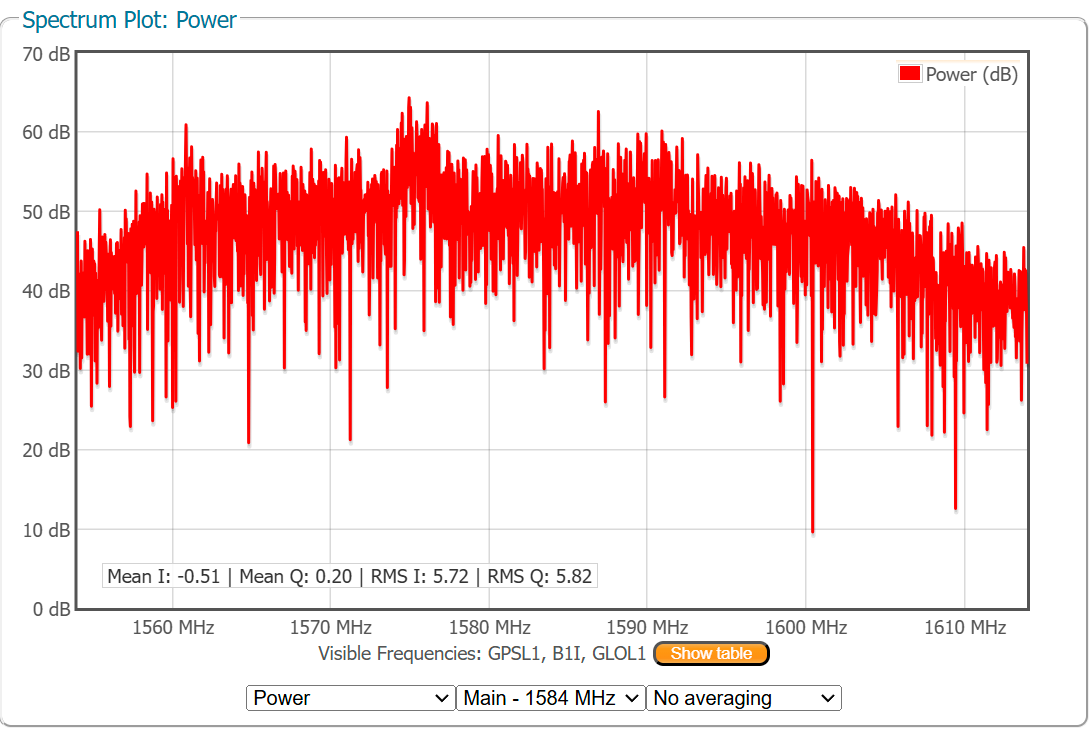
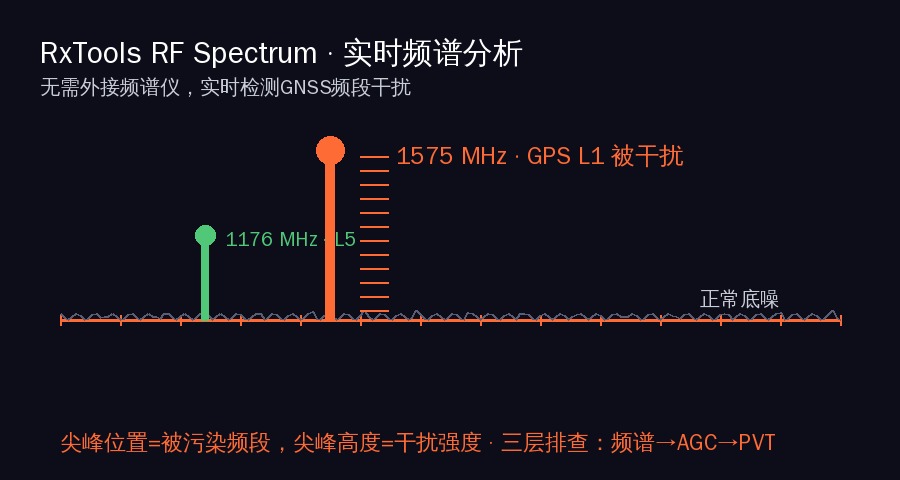
1575 MHz spike → GPS L1 is jammed. 1176 MHz spike → L5 is jammed. Spikes across all bands → wideband jamming — this flight site cannot be flown.
| Capability | RxTools | Competitor A | Competitor B |
|---|---|---|---|
| Integrated RF spectrum analysis | ✅ Real-time spectrum | ⚠️ Basic spectrum on some high-end models | ❌ |
| Band selection | All GNSS bands (L1/L2/L5/E5a/E5b/E6/B1/B2/B3/G1/G2/G3) | ⚠️ Limited | — |
| AGC gain table (antenna diagnostics) | ✅ | ❌ | ❌ |
| External hardware required | None | None (if available) | Needs separate spectrum analyzer |
| Correlated analysis in the same window as positioning data | ✅ Spectrum + carrier-to-noise + Sky Plot linked | ❌ | — |
Practical comparison — Scenario: arrive at the flight site, pre-takeoff check.
| RxTools | Competitor A | Competitor B | |
|---|---|---|---|
| Check the spectrum | View → Spectrum View, scan the band | Cannot check, or specific models only | Cannot check |
| GPS L1 spike found | Immediately know 1575 MHz is jammed | — | — |
| Decision | Change site or track down the jammer | Only know after takeoff when RTK drops | Only know after takeoff when RTK drops |
Practical comparison — Scenario: after returning, you find poor accuracy on one segment of the trajectory.
| RxTools | Competitor A | Competitor B | |
|---|---|---|---|
| Troubleshoot | Replay SBF file → check carrier-to-noise for the time window → check spectrum → check AGC | See the accuracy curve, no idea why | See the accuracy curve, no idea why |
| AGC gain deviates >3 dB from nominal | Antenna cable loose | — | — |
| Decision | Tighten the antenna connector | Guess | Guess |
One spectrum view replaces an external device: spectrum analyzers sell for 30,000–300,000 RMB. RxTools’ RF Spectrum costs nothing extra. What is more, an external spectrum analyzer measures the signal in the air, while RxTools measures the signal actually received by the antenna — hardware problems such as a disconnected antenna, loose cabling, and oxidized connectors are invisible to an external analyzer but visible in the AGC table.
Three-layer troubleshooting: when positioning is abnormal — RF Spectrum → is the spectrum clean? (external interference); AGC table → is the antenna/cable healthy? (hardware connection); PVT error codes + carrier-to-noise → positioning algorithm/satellite geometry? (software layer). This three-step method cuts troubleshooting time from hours to minutes.
Business value:
- Pre-deployment site assessment: scan all GNSS bands with the spectrum view before takeoff and confirm there is no strong interference, avoiding RTK lock loss and non-RTK mode risks caused by on-site jamming.
- Fault localization efficiency: for positioning anomalies, check the spectrum first to rule out external interference, then the AGC to rule out antenna hardware, and finally PVT error codes to pinpoint software problems.
- Hardware cost savings: field crews no longer need separate portable spectrum analyzers (priced at tens to hundreds of thousands of RMB); basic interference assessment is done in software.
3. ASCII Text Command System: No More Binary Frame Assembly
The same operation, three approaches — operation: make the receiver output NMEA GGA position 10 times per second.
RxTools: one English command, and the name says it all: setNMEAPeriod, GGA, 100 — set = set, NMEA = NMEA message, Period = period, GGA = GGA sentence, 100 = 100 ms = 10 Hz. Press Enter, the receiver replies OK instantly. If you make a mistake — for example setNMEAPeriod, GGA, 1000 — the receiver replies “Invalid parameter: period too large,” telling you exactly what went wrong. All command history is retained and traceable.
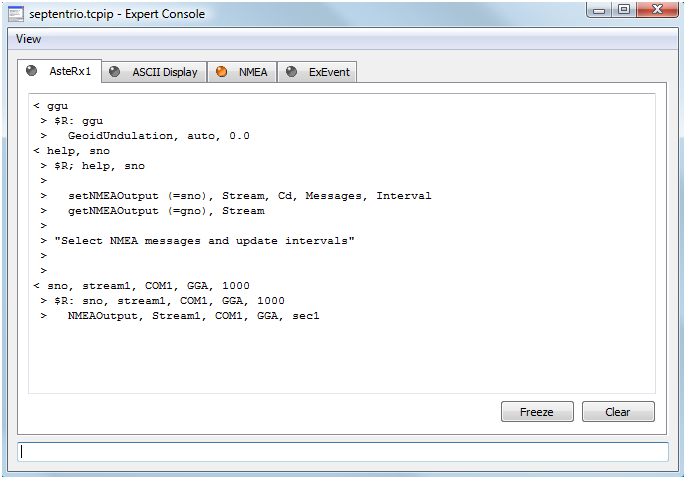
Competitor A: no byte assembly, but you need to: open Configuration View; find Messages → NMEA → GGA in the left tree menu; find the Rate field; enter 10; click Send; switch to another view to confirm. It is not byte assembly — it is menu digging. A simple rate change means hunting through dozens of configuration items. Change another parameter and you dig through the tree again. There is no history; you have to remember what you changed yourself.
Competitor B: consult the datasheet → find message ID 0xF1 0x03 → assemble frame header A0 A1 → assemble message length 00 03 → assemble parameters → compute checksum → send via a hex serial terminal → receive 0xB0 0x62 acknowledgement → you do not know whether it succeeded or errored → switch to another view to confirm. You are not configuring the receiver; you are hand-writing a communications protocol.
It is not “a little simpler” — it is a design from a different era.
| Aspect | RxTools | Competitor A | Competitor B |
|---|---|---|---|
| Interaction style | Type English commands | Click through menus | Assemble hex frames |
| What a command looks like | setNMEAPeriod, GGA, 100 | Graphical configuration tree | A0 A1 00 03 F1 03 64 F7 0D 0A |
| When something goes wrong | The receiver tells you what is wrong | Clicking Send does nothing | Guess from the hex acknowledgement |
| 10 minutes later, forgot what you changed | Check command history | Remember it yourself | Remember it yourself |
| Batch-deploying 100 receivers | Export history → one-click script | Import config files one by one | Hand-assemble per unit |
Business value: UAV industry integrators and end users typically do not have GNSS receiver protocol knowledge. The ASCII text command system lowers the operational barrier from “consulting the datasheet and assembling hex frames” to “typing human-readable commands,” directly reducing field support needs and training costs. For batch deployment, one exported command history becomes a script that configures dozens of receivers at once, while competitors require per-unit manual operation.
4. Differential Data Link Monitoring: Message-Level Real-Time Diagnostics
In one sentence: competitors tell you “the differential link dropped.” DiffCorr Info tells you “which message dropped, at which second, and why.”
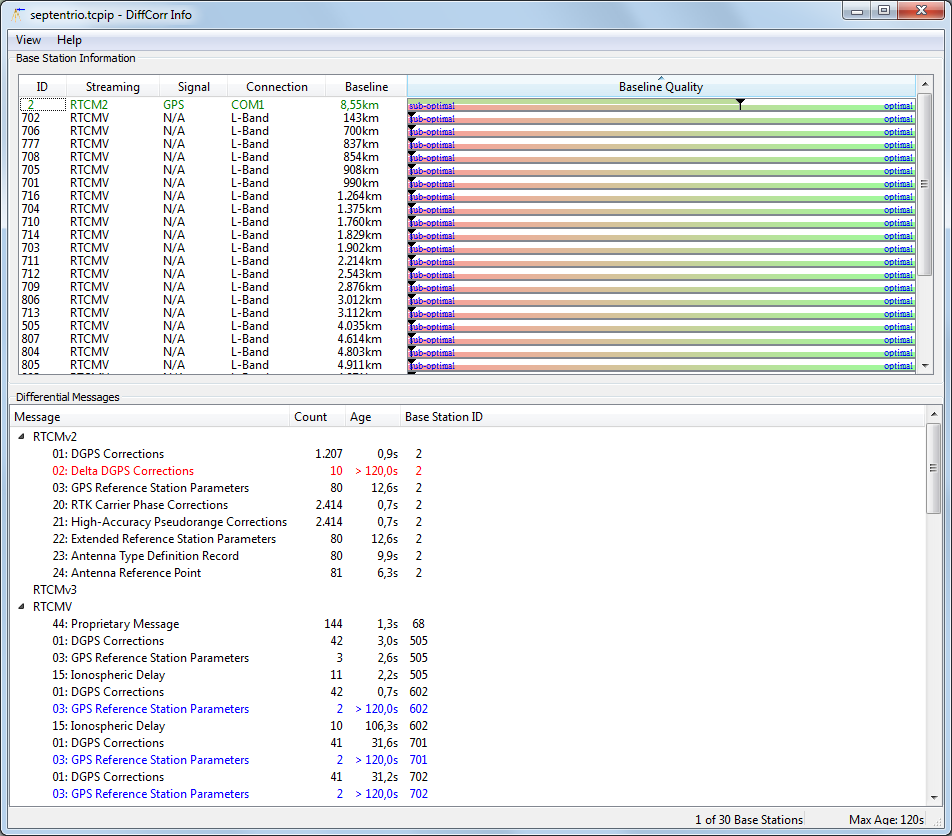
The essential difference: Competitor A’s and Competitor B’s differential monitoring has only one layer of information — whether RTK is fixed. It is a binary signal: 0 or 1. RxTools provides three layers:
- Base station layer: which base station is in use, how far away it is, and how good its quality is
- Message layer: when each RTCM message arrived, its age, and whether it timed out
- Link layer: which port the data came in on, and what protocol it uses
Practical comparison — Scenario: RTK positioning suddenly drops from Fixed to Float. RxTools shows the 1004 message age climbing stepwise from 0.5 s to 21.3 s and turning red (ages above 20 s trigger a red highlight alert), from which you determine that GPS observation latency is accumulating and the data link lacks bandwidth; the next step is to adjust the radio baud rate or filter out unnecessary messages. Competitors only show the RTK status light turning from green to orange, leaving you to guess: is the base station down? Is the network lagging? Is the hardware broken?
| RxTools | Competitor A | Competitor B | |
|---|---|---|---|
| What you see | 1004 message age climbing 0.5 s → 21.3 s, turning red | RTK status light green → orange | RTK flag changes from 4 to 5 |
| What you can conclude | GPS observation latency accumulating → data link bandwidth insufficient | Differential link down, cause unknown | Differential link down, cause unknown |
| Next step | Adjust radio baud rate or filter unnecessary messages | Guess: base station down? network lag? hardware broken? | Guess: base station down? network lag? hardware broken? |
In addition, RxTools supports parallel monitoring of multiple base stations, with each row showing the base station ID, protocol, port, baseline length, and quality indicator (baseline under 25 km = good; over 250 km = poor). The base station in use is highlighted green, expired ones appear gray, and the status bar shows live statistics of in-use/total counts — enabling remote differential fault diagnosis. The full capability comparison for differential monitoring:
| Capability | RxTools | Competitor A | Competitor B |
|---|---|---|---|
| RTK fixed/float/single status | ✅ | ✅ | ✅ |
| Differential data age (seconds) | ✅ | ❌ | ❌ |
| Per-RTCM-message independent age | ✅ | ❌ | ❌ |
| Age refresh precision | 0.1 s | — | — |
| Timeout red highlight alert | ✅ Ages >20 s turn red | ❌ | ❌ |
| Non-decaying messages marked blue | ✅ | ❌ | ❌ |
| Base station list | ✅ Each row: ID/protocol/port/baseline length/quality | ❌ | ❌ |
| In-use base station highlighted | ✅ Green = in use, gray = expired | ❌ | ❌ |
| Parallel multi-base-station comparison | ✅ Monitor multiple differential sources at once | ❌ | ❌ |
| Baseline quality indicator | ✅ <25 km good / >250 km poor | ❌ | ❌ |
| Status bar statistics | ✅ In-use/total counts + current age threshold | ❌ | ❌ |
Summary
| Differentiator | Competitor status | Core value |
|---|---|---|
| Spectrum view (three modes + AGC) | Competitor A: basic spectrum on some high-end models; Competitor B: none | No external hardware; interference troubleshooting cut from hours to minutes |
| ASCII text command system | Competitor A: graphical menus over binary underneath; Competitor B: hex frames | Extremely low operational barrier; history traceability and batch deployment |
| Differential link message-level diagnostics | Competitors provide only binary RTK fixed/float status | Pinpoint differential fault root cause; remote diagnostics |
These three differentiators point to the same goal: turning the GNSS receiver from a “black box” into a “white box,” so engineers can see clearly, diagnose accurately, and adjust quickly at every stage of deployment, debugging, and operations.
FAQ
Which operating systems does RxTools support?
RxTools ships both Windows and Linux versions, feature-synchronized and released on the same day. The Linux version runs natively on mainstream distributions such as Ubuntu, with 13 command-line tools for headless servers and automated scripts.
Can RxTools detect GNSS interference?
Yes. RxTools includes an RF Spectrum view that detects interference on all GNSS bands in real time without an external spectrum analyzer. Combined with the AGC gain table, it can also diagnose hardware connection issues such as antenna cabling.
How does RxTools differ from Competitor A’s software?
Competitor A’s software is menu-driven and Windows-only. RxTools uses an ASCII text command system, supports native Linux operation, command-history rollback, and batch deployment, and adds unique capabilities such as spectrum analysis and message-level differential link monitoring.
What advantage does RxTools offer for batch deployment of many receivers?
RxTools command history can be exported as a script and executed with one click, configuring dozens of receivers in batch, while competitors typically require manual per-unit operation.
Where can I get RxTools software and technical support?
Eview GNSS provides Septentrio-powered high-precision GNSS receivers and RxTools support. In China, Nanjing Hongcheng Intelligent Technology Co., Ltd. is an official Septentrio distributor offering RxTools licensing, receiver selection, system integration, and on-site technical support.
About Eview GNSS
Eview GNSS supplies Septentrio-powered high-precision GNSS receivers engineered for UAV, robotics, survey, and industrial applications, with AIM+ anti-jamming technology as standard. Related reading: UAV and Drone RTK GNSS, Anti-Jamming and Anti-Spoofing GNSS, GNSS Receiver Box, GNSS Boards and OEM Modules. For more on RxTools and high-precision GNSS solutions, contact us.
Sources & References
Published: August 17, 2026
External references:
- Septentrio official website: https://www.septentrio.com/
- Septentrio RxTools product page: https://www.septentrio.com/en/products/software/rxtools
- Nanjing Hongcheng Intelligent Technology Co., Ltd. (official Septentrio distributor)