RTK GNSS Receiver Comparison 2025: Top Picks for Precision Positioning
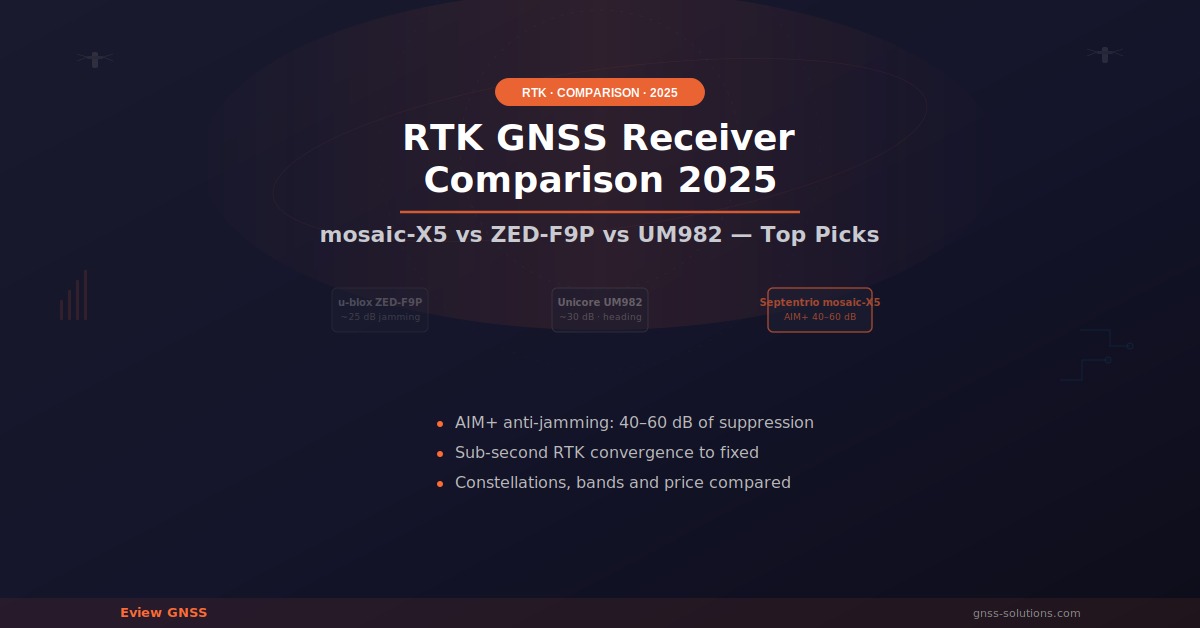
In the 2025 RTK GNSS receiver comparison, three receivers dominate engineering conversations: the Septentrio mosaic-X5, the u-blox ZED-F9P and the Unicore UM982. The right pick depends on one question: do you need raw value, or RTK that survives interference? u-blox wins on cost, Unicore on dual-antenna heading, Septentrio on AIM+ anti-jamming that holds fix where others drop lock. This guide compares the leading RTK GNSS receivers of 2025 on convergence time, jamming resistance, multipath handling and total cost of ownership.
What to Compare in an RTK GNSS Receiver in 2025
When engineers ask for an RTK GNSS receiver comparison, they rarely mean sticker price alone. The specs that decide field performance are: channel count and constellations (a 400+ channel receiver tracking GPS, GLONASS, Galileo and BeiDou fixes faster in obstructed environments); frequency bands (L1/L2/L5 support gives robust RTK and faster convergence); interference mitigation, measured in dB of jamming suppression; interfaces (USB, UART, SPI, CAN); and dual-antenna heading for platforms that need yaw. A 2025 comparison that skips anti-jamming is incomplete: RF environments are getting noisier, not quieter.
The 2025 Contenders at a Glance
| Receiver | Constellations / Bands | RTK Convergence | Anti-Jamming | Best For |
|---|---|---|---|---|
| Septentrio mosaic-X5 | 4 constellations, L1/L2/L5, 448 ch | <1 s typical | AIM+ 40–60 dB | UAV, robotics, harsh RF |
| u-blox ZED-F9P | 4 constellations, L1/L2, 184 ch | 5–10 s | ~25 dB | Cost-sensitive builds |
| Unicore UM982 | 4 constellations, L1/L2/L5, 1400+ ch | ~5 s | ~30 dB | Dual-antenna heading on budget |
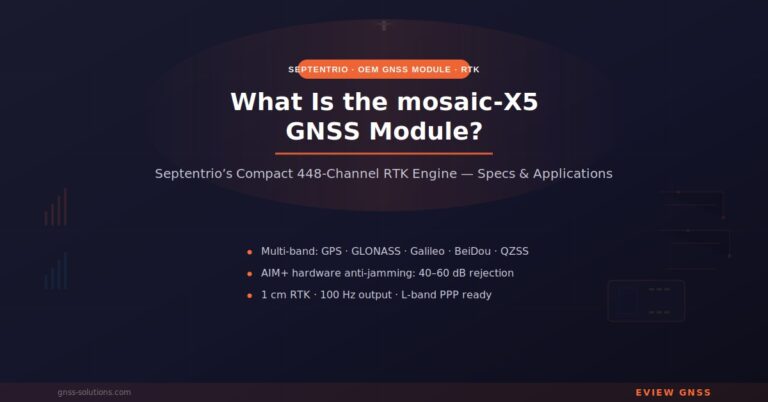
The mosaic-X5 is the only module of the three with ASIC-level AIM+ mitigation, OSNMA anti-spoofing and Galileo HAS PPP built in. The ZED-F9P remains the budget benchmark most light-commercial projects start from. The UM982 delivers the most channels per dollar and native dual-antenna heading. For a deep dive on migrating between platforms, see our comparison of Septentrio alternatives: u-blox F9P vs Unicore UM982 vs mosaic-X5.
Anti-Jamming: The Spec Most RTK Comparisons Overlook
u-blox and Unicore both quote basic interference filtering that tops out around 25–30 dB. Septentrio’s AIM+ delivers 40–60 dB of continuous jamming suppression while keeping the full constellation tracked. Near power infrastructure, mining machinery or urban RF noise, a 25 dB receiver drops from fixed to float or loses lock; a 40–60 dB receiver keeps centimeter output. Eview packages AIM+ into ready-to-run enclosures in the anti-jamming and anti-spoofing GNSS range, so field teams get the same core without board-level integration.
Real-World RTK Performance: Convergence and Availability
Convergence time separates good RTK from great RTK. With corrections applied, the mosaic-X5 typically reaches a fixed solution in under a second after a cold start, while F9P-class receivers commonly need 5–10 seconds and re-converge more slowly after signal loss. Multipath rejection is the second differentiator: receivers tracking more bands with advanced correlators hold centimeter accuracy near reflective surfaces, key for surveying in built-up areas. Our real-world RTK performance data article includes measured fixed-availability figures in jamming conditions.
Which RTK GNSS Receiver Should You Choose in 2025?
For UAV and robotics platforms, weight, interfaces and interference resilience dominate: a mosaic-X5-based receiver keeps centimeter position in RF-dense flight corridors, and the UAV and drone RTK GNSS solution is built for exactly that. For surveying, look for RTK and PPK support plus strong multipath rejection. For construction machine control, uptime is everything, so anti-jamming margin beats raw price. If the budget is fixed and the environment is clean, the ZED-F9P or UM982 still deliver solid RTK. Eview’s GNSS receiver box integrates the Septentrio core with AIM+, survey-grade antenna and RTK-ready setup in one unit.
FAQ
What is the best RTK GNSS receiver in 2025?
For professional work, the Septentrio mosaic-X5 is the strongest choice thanks to AIM+ anti-jamming (40–60 dB), sub-second convergence and OSNMA anti-spoofing. The u-blox ZED-F9P is the best budget pick in clean RF environments, and the Unicore UM982 offers the best value for dual-antenna heading.
How does the Septentrio mosaic-X5 compare with the u-blox ZED-F9P?
The mosaic-X5 tracks more constellations and bands (L1/L2/L5, 448 channels), converges in under a second versus 5–10 seconds, and suppresses jamming at 40–60 dB versus roughly 25 dB. The ZED-F9P is cheaper and simpler, attractive for hobbyist and cost-sensitive projects.
Is the Unicore UM982 a good RTK GNSS receiver?
Yes, for its price. It offers multi-band RTK, a very high channel count and dual-antenna heading, with basic interference mitigation around 30 dB. It lacks the anti-jamming and anti-spoofing layers of the Septentrio core, suiting cleaner RF environments.
Does anti-jamming affect RTK accuracy?
Indirectly, yes. When a jammer saturates the front end, a receiver without enough mitigation margin loses lock or drops to float. A receiver with 40–60 dB of AIM+ suppression keeps the fixed solution and centimeter accuracy.
How fast should an RTK receiver converge to a fixed solution?
Modern high-end receivers such as the mosaic-X5 converge in under a second with good corrections. Mid-range receivers like the ZED-F9P take 5–10 seconds, and re-convergence after an outage is slower.
Which RTK receiver supports dual-antenna heading?
The Unicore UM982 supports dual-antenna heading natively at a competitive price. Septentrio offers it through the mosaic-X5 and mosaic-G5 family with a second antenna, adding robust heading with the same AIM+ protection.
Not sure which RTK GNSS receiver fits your platform? Contact Eview GNSS with your environment, payload and accuracy budget for a Septentrio-powered configuration with the anti-jamming margin you need.