What Is the mosaic-X5 GNSS Module? A Complete Technical Guide
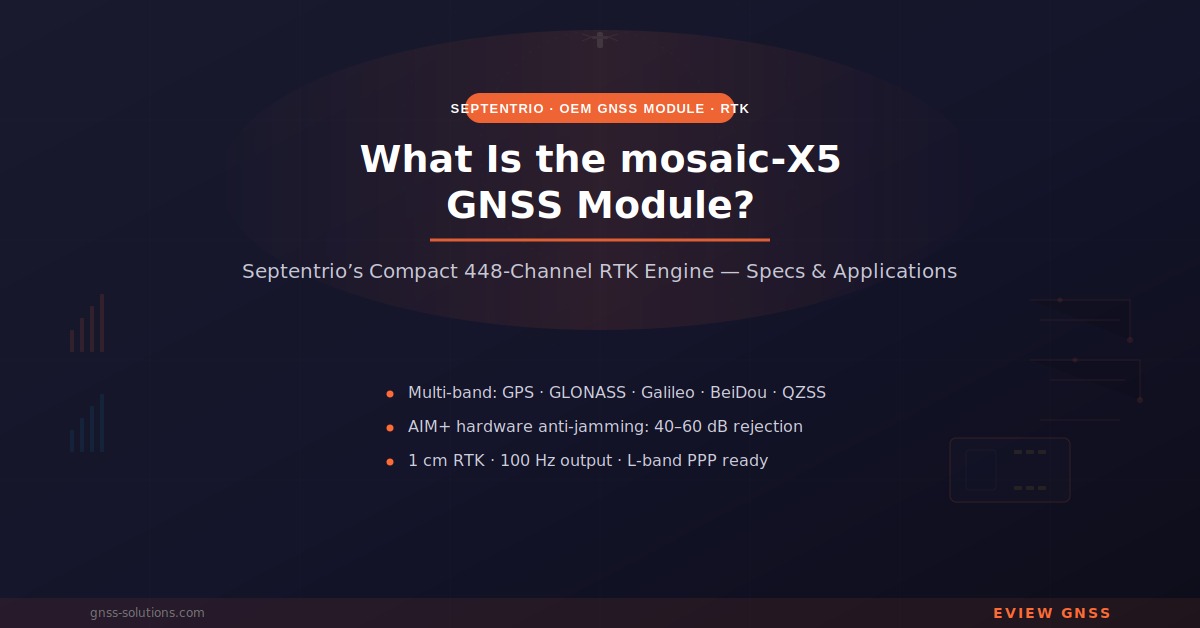
The Septentrio mosaic-X5 is a compact OEM GNSS receiver module that packs 448 hardware channels of multi-constellation, multi-band tracking, centimetre-level RTK, and Septentrio’s AIM+ anti-jamming into a board measuring just 71 × 59 × 12.7 mm. In short: it is a complete high-precision positioning engine built to be embedded in UAVs, robots, survey instruments and machine-control systems — and it is the module inside Eview’s professional GNSS receiver box range.
mosaic-X5 Key Specifications
The mosaic-X5 tracks GPS, GLONASS, Galileo, BeiDou, QZSS and NavIC on L1, L2 and L5. Its 448 channels process every constellation and frequency concurrently, so it never trades satellites on one band to watch another — a decisive advantage for RTK robustness in obstructed, interference-heavy environments.
Key datasheet figures: RTK accuracy of 1 cm + 1 ppm horizontal and 2 cm + 1 ppm vertical, with typical initialisation under 10 seconds via Septentrio’s FAST6 engine; update rates to 100 Hz; ~1.1 W power draw; an operating range of −40 °C to +85 °C; SBAS support; and an L-band input for satellite-delivered PPP corrections such as Galileo HAS and TerraStar.
What Makes the mosaic-X5 Different from a Standard GNSS Chipset
Most GNSS modules treat interference as a software problem. Septentrio’s AIM+ (Advanced Interference Mitigation) operates in the RF hardware front-end, before signals reach the correlator: narrowband jammers are notch-filtered, wideband industrial noise is attenuated in real time, and radar-style pulses are blanked. AIM+ suppresses interference by 40–60 dB — versus roughly 25 dB for typical u-blox modules — the difference between holding RTK fix next to a transmitter and losing lock entirely.
Anti-spoofing is built in too: the module monitors for spoofing with Septentrio’s SLAS technology and is Galileo OSNMA-ready. For integrators on industrial and commercial sites, that combination of hardware-level jamming rejection and signal authentication is rare — see our anti-jamming and anti-spoofing GNSS solutions.
Interfaces, Data Outputs and OEM Integration
The module exposes USB, four UARTs, SPI, CAN and 100Base-T Ethernet and outputs NMEA 0183, RTCM 3.x, SBF (Septentrio’s raw format) and RINEX 3. SBF carries raw measurements for tight sensor-fusion work, and RINEX logging enables post-processing in Leica Infinity, Trimble Business Centre or RTKLIB.
Ethernet and CAN matter on machines: CAN connects directly to most machine-control ECUs, while Ethernet carries 100 Hz positions and raw data to autopilots and autonomy stacks. For ROS developers, see our guide to connecting the mosaic-X5 to ROS 1 and ROS 2.
The mosaic-X5 Inside Eview GNSS Products
Eview integrates exclusively Septentrio chipsets, and the mosaic-X5 sits at the core of the receiver range. The HB6 GNSS RTK receiver box packages it in a rugged IP67 enclosure with RS232/RS422, USB and CAN for vehicle mounting, machine control and survey; the HB6 Pro 4G adds an LTE modem for direct NTRIP connection to CORS networks; the HB52 dual-antenna variant adds precise heading (±0.1° at 1 m baseline); and the HBEV11 integrated antenna combines the module with a high-gain antenna and 4G in a single dome for UAV and IoT applications.
For design-in work, the GNSS boards and OEM modules range exposes the mosaic-X5 on carrier boards with the Septentrio SDK for custom firmware — the same 448-channel core and AIM+ protection in every form factor.
Is the mosaic-X5 the Right GNSS Module for Your Project?
Choose the mosaic-X5 when the application needs continuous centimetre accuracy near interference sources: UAVs benefit from 1.1 W power and a compact footprint (see our RTK GNSS for drones and UAVs page); robots and autonomous vehicles fuse its raw measurements with IMUs; construction and mining systems rely on sub-10-second re-initialisation after signal blockage; and survey rovers and agricultural autosteer work against VRS/FKP/MAC networks near structures and overhead lines.
If your current receiver loses lock near jammers or lacks the interfaces your autopilot needs, the mosaic-X5 is the upgrade path — available as a ready-built Eview receiver or an OEM module for your own enclosure.
FAQ: mosaic-X5 GNSS Module
What is the Septentrio mosaic-X5? The mosaic-X5 is a compact OEM GNSS receiver module with 448 hardware channels, multi-band and multi-constellation tracking, centimetre-level RTK, and AIM+ hardware anti-jamming. Eview builds it into professional GNSS receivers for UAV, robotics, survey, construction and agriculture applications.
What constellations and frequencies does the mosaic-X5 track? It tracks GPS, GLONASS, Galileo, BeiDou, QZSS and NavIC on L1, L2 and L5, plus Galileo E6, BeiDou B3 and L-band for PPP corrections — all concurrently thanks to its 448-channel engine.
How accurate is the mosaic-X5 with RTK? The module delivers 1 cm + 1 ppm horizontal and 2 cm + 1 ppm vertical accuracy in RTK mode, with typical initialisation under 10 seconds on multi-frequency signals.
Does the mosaic-X5 really resist jamming? Yes. AIM+ works in the RF front-end and suppresses narrowband, wideband and pulsed interference by 40–60 dB — roughly 2–3× more than typical u-blox modules manage — so RTK remains usable in environments where standard receivers lose lock.
What interfaces does the mosaic-X5 GNSS module have? USB, four UARTs, SPI, CAN and 100Base-T Ethernet, with NMEA 0183, RTCM 3.x, SBF and RINEX 3 output formats and update rates up to 100 Hz.
Where can I buy a receiver built on the mosaic-X5? Eview GNSS supplies mosaic-X5-based receivers worldwide, from the rugged HB6 receiver box to OEM carrier boards and the HBEV11 integrated smart antenna — see the Septentrio mosaic-X5 receiver page for the full integration guide.
mosaic-X5 Frequency Bands at a Glance
The Septentrio mosaic-X5 processes all four global constellations plus regional and augmentation systems concurrently. Signal list from the official datasheet:
| System | Bands / Signals Tracked |
|---|---|
| GPS | L1 C/A, L1C, L2C, L2P, L5 |
| GLONASS | L1 C/A, L2 C/A, L2P, L3 (CDMA) |
| Galileo | E1, E5a, E5b, E5 AltBOC, E6 |
| BeiDou | B1I, B1C, B2I, B2a, B2b, B3I |
| QZSS | L1 C/A, L1C, L2C, L5, L6 |
| SBAS | L1 C/A, L5 (WAAS, EGNOS, MSAS, GAGAN, SDCM) |
| L-band | PPP corrections (Galileo HAS, TerraStar) |
That covers the full civilian spectrum: 1575.42 MHz (L1/E1/B1C), 1227.60 MHz (L2), 1176.45 MHz (L5/E5a/B2a), 1207.14 MHz (E5b/B2b), 1268.52 MHz (B3I), 1278.75 MHz (E6/L6) and 1525–1559 MHz for L-band PPP. Few modules in its class match that coverage without sacrificing channels.
Why Multi-Band Matters: L1, L2 and L5
Single-frequency receivers correct the ionosphere with broadcast models, leaving residual errors of metres during solar activity. A dual- or triple-band receiver measures ionospheric delay directly across L1/L2 or L1/L5, removing almost all of it — which is why the mosaic-X5 reaches centimetre-level RTK with typical convergence under one second.
The L5/E5a band (1176.45 MHz) matters most: it is a modern civil signal with higher power and wider bandwidth than L1 C/A, so multipath rejection improves. GPS L5, Galileo E5a and BeiDou B2a share the centre frequency, so one front-end covers three constellations — a key reason the mosaic-X5 holds RTK fix under canopy and in urban canyons. For how band choice interacts with jamming resistance, see our anti-jamming and anti-spoofing GNSS solutions.