
From Firefighting to Precision Agriculture: Industrial Drones Navigate Confidently with Septentrio mosaic-G5
Eview GNSS Technology supplies the GR-P3UTR-M4 — a full-frequency integrated RTK GNSS receiver powered by the Septentrio mosaic-G5 P3 chipset — to industrial UAV manufacturers operating in the world’s most demanding environments. This case study examines how AGR’s B100P multifunctional drone platform uses Septentrio mosaic-G5 technology to maintain centimetre-level positioning accuracy in conditions that defeat conventional GNSS systems.
The Challenge: GNSS in the Harshest UAV Environments
Industrial UAVs are no longer confined to open farmland or calm skies. Today’s multifunctional drones operate in high-rise urban corridors, on mountainsides, inside electromagnetic interference zones, and at altitude in extreme weather — missions where a momentary loss of positioning accuracy can have serious consequences.
As UAV applications expand into urban infrastructure inspection, emergency response, and complex terrain logistics, traditional single-frequency GNSS navigation increasingly falls short. The problems are well-known among drone engineers:
- Multipath interference near tall buildings distorts GNSS signals and degrades positioning accuracy
- Electromagnetic interference from dense 5G networks, industrial parks, and counter-UAV systems disrupts navigation
- Signal blockages in mountainous terrain reduce satellite availability and weaken the geometric solution
- Ionospheric disturbance during high solar activity degrades standard single-frequency RTK accuracy
This is the operational reality that AGR’s B100P platform was designed for, and where the Septentrio mosaic-G5 — integrated by Eview GNSS into the GR-P3UTR-M4 receiver — delivers a decisive performance advantage.
Why Septentrio mosaic-G5 for Industrial UAV Applications
The Septentrio mosaic-G5 is a full-frequency, all-constellation GNSS chipset that processes 789 channels simultaneously — tracking every current and planned GNSS signal from GPS, GLONASS, Galileo, BeiDou, QZSS, and NavIC on L1, L2, L5, and additional frequencies including E6 (Galileo HAS) and B2b (BeiDou PPP).
For industrial UAV applications, the mosaic-G5 offers three critical advantages over competing chipsets:
1. AIM+ Anti-Jamming: Hardware-Level RF Interference Mitigation
Septentrio’s AIM+ (Advanced Interference Mitigation Plus) system uses notch filtering, pulse blanking, and wideband interference detection at the hardware level — in the RF front-end, before signals reach the correlator. This means:
- Narrowband jammers (such as those used in urban security systems) are detected and filtered without loss of position accuracy
- Wideband interference from radar systems, 5G towers, and industrial equipment is attenuated in real time
- Spoofing attacks are detected using Galileo OSNMA signal authentication, validated at the signal level
In independent testing, Septentrio mosaic-series chipsets maintained centimetre RTK accuracy under interference conditions that caused complete position loss in competing receivers.
2. 789-Channel Architecture: Maximum Satellite Availability
With 789 simultaneous tracking channels, the mosaic-G5 P3 tracks every visible satellite on every available frequency simultaneously. In an urban canyon or mountainous terrain, where only a subset of the sky is visible, this translates to:
- Faster RTK fix acquisition — more satellites provide stronger geometric diversity for ambiguity resolution
- Continuous fixed RTK solution through momentary signal blockages
- No need to prioritise constellations or frequencies — all signals contribute to the position solution
3. Full-Frequency RTK: Sub-10-Second Fix Times
The mosaic-G5 P3 tracks L1, L2, L5, E6, B2b, and other frequencies. This multi-frequency capability enables RTK ambiguity resolution in under 10 seconds from a cold start — compared to 30–60 seconds for dual-frequency receivers and 5+ minutes for single-frequency. For an industrial drone that may need to re-initialise RTK after a brief signal blockage, fast re-acquisition is operationally critical.
The GR-P3UTR-M4: Eview GNSS’s mosaic-G5 Integration
Eview GNSS Technology integrates the Septentrio mosaic-G5 P3 into the GR-P3UTR-M4 Full-Frequency Integrated RTK GNSS Receiver — a 155 mm dome form factor that combines:
- Septentrio mosaic-G5 P3 chipset (789 channels)
- Full-frequency patch antenna array optimised for UAV mounting
- M12-4P connector with 10 m cable for clean drone integration
- 5–12V power input, 200 mA nominal draw
- NMEA 0183, RTCM 3.x, SBF, and RINEX output
- AIM+ anti-jamming and SLAS anti-spoofing active by default
The GR-P3UTR-M4 is available from Eview GNSS Technology for direct integration into industrial UAV platforms.
AGR B100P: Operational Results with Septentrio mosaic-G5
AGR’s B100P multifunctional platform is used for firefighting support, precision agriculture, emergency logistics, and infrastructure inspection across mountainous and urban terrain in Asia. Integrated with the Septentrio mosaic-G5 chipset, the B100P achieves:
- 1–2 cm RTK horizontal accuracy in open environments and 3–5 cm in partial urban obstruction
- RTK fix maintained through electromagnetic interference zones where competing GNSS systems lose fix
- Sub-10 second RTK re-acquisition after signal blockage in mountainous terrain
- Continuous position output during 5G interference without accuracy degradation
Applications for Industrial UAV RTK GNSS
Firefighting and Emergency Response
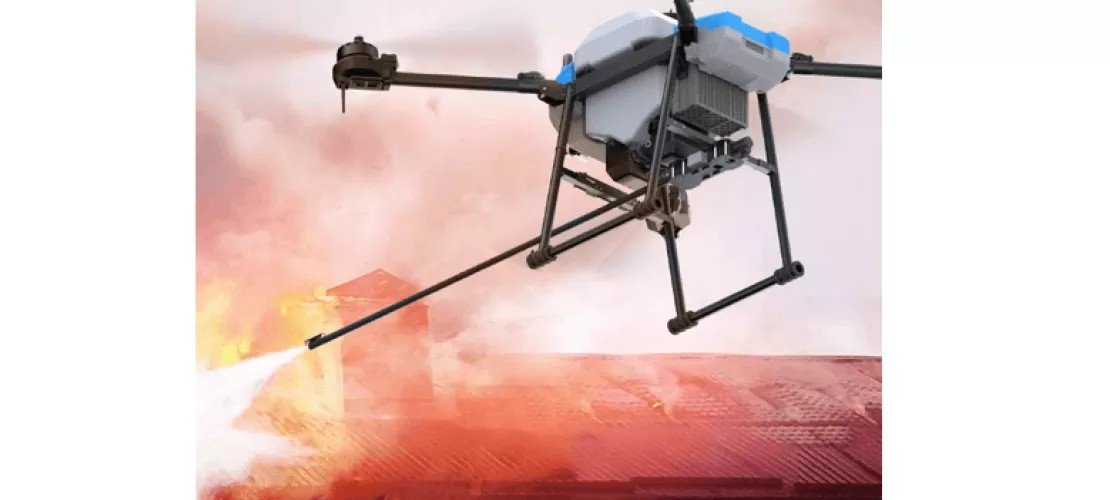
Firefighting drones operate in smoke-filled environments near burning structures — peak conditions for GNSS multipath and RF interference. Septentrio AIM+ maintains navigation integrity when standard GNSS fails, allowing the B100P to deliver fire retardant and monitor fire spread with precise autonomous positioning.
Precision Agriculture
Variable-rate spraying and seeding over large agricultural areas requires the drone to know its position to within 5 cm continuously across the entire field. The mosaic-G5’s 789-channel architecture maintains RTK fix even at field edges where satellite geometry degrades.
Infrastructure Inspection
Power line inspection, pipeline monitoring, and bridge surveys require the drone to maintain a precise standoff distance from the asset. Centimetre RTK positioning is the safety-critical minimum standard. With Septentrio AIM+, the drone maintains positioning accuracy even near high-voltage power lines that generate strong electromagnetic fields.
Urban Logistics and Delivery
Urban drone corridors require centimetre-level positioning for conflict deconfliction and landing zone accuracy. The mosaic-G5’s anti-spoofing protection via Galileo OSNMA ensures the drone cannot be deceived by spoofed GNSS signals — a growing threat in urban airspace.
Eview GNSS UAV Receiver Range
| Model | Chipset | Channels | Form Factor | Best For |
|---|---|---|---|---|
| GR-P3UTR-M4 | Septentrio mosaic-G5 P3 | 789 | 155 mm dome | Industrial UAV, demanding survey payloads |
| HBEV11 | Septentrio mosaic-X5 | 448 | 148 mm dome + 4G LTE | UAV with integrated NTRIP, IoT applications |
Frequently Asked Questions
What is the Septentrio mosaic-G5 chipset?
The Septentrio mosaic-G5 is a full-frequency, all-constellation GNSS chipset that tracks 789 channels simultaneously across GPS, GLONASS, Galileo, BeiDou, QZSS, and NavIC on all available frequencies including L1, L2, L5, E6 (Galileo HAS), and B2b. It includes AIM+ anti-jamming and OSNMA spoofing detection as standard. Eview GNSS integrates the mosaic-G5 P3 into the GR-P3UTR-M4 integrated RTK receiver.
What makes Septentrio AIM+ different from software anti-jamming?
AIM+ operates in the RF hardware front-end — before signals enter the digital correlator. This means it removes interference before it can corrupt the GNSS measurements, rather than trying to correct corrupted measurements in software. The result is maintained centimetre RTK accuracy under interference conditions that cause complete position loss in receivers using software-only interference mitigation.
Which Eview GNSS receiver is best for industrial UAV applications?
For industrial UAV platforms requiring maximum satellite availability and interference resilience, Eview GNSS recommends the GR-P3UTR-M4 (Septentrio mosaic-G5 P3, 789 channels). For UAV platforms with integrated 4G LTE NTRIP connectivity requirements, the HBEV11 (Septentrio mosaic-X5, 448 channels, integrated LTE modem) is the preferred solution.
Does the Septentrio mosaic-G5 support Galileo HAS (High Accuracy Service)?
Yes. The Septentrio mosaic-G5 P3 tracks the E6 frequency, which carries the Galileo High Accuracy Service (HAS) signal. Galileo HAS provides globally distributed PPP corrections broadcast directly from Galileo satellites — enabling decimetric accuracy without a subscription service or internet connection. This is available on all GR-P3UTR-M4 receivers from Eview GNSS.
Can the GR-P3UTR-M4 be integrated with ArduPilot or PX4 autopilots?
Yes. The GR-P3UTR-M4 outputs NMEA 0183 sentences (GGA, VTG, GSA, GSV) and RTCM 3.x at configurable baud rates, compatible with ArduPilot, PX4, and all major open-source and commercial UAV autopilot systems. Eview GNSS provides integration documentation and technical support for UAV manufacturers.