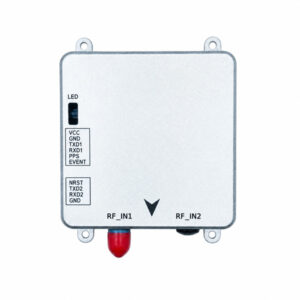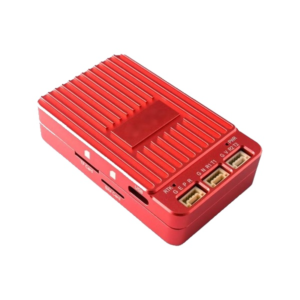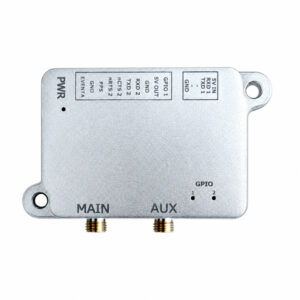
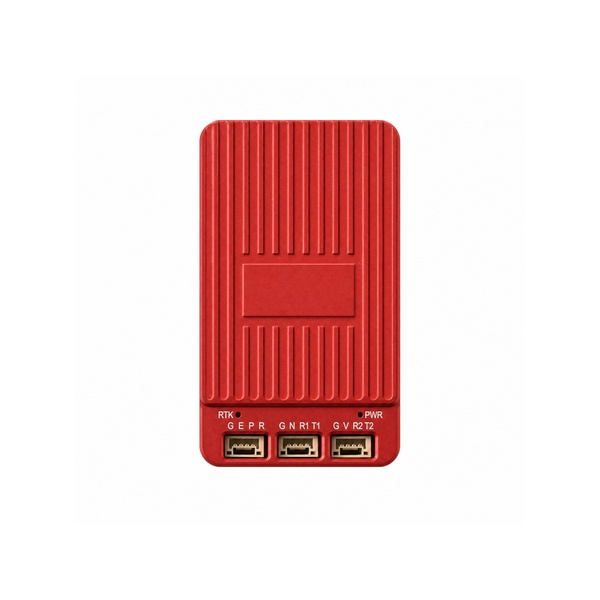
HB6 Pro Dual-Antenna RTK Heading Receiver — Septentrio mosaic-H
Compact dual-antenna RTK receiver for position, heading and pitch or roll
- Septentrio mosaic-H, multi-constellation, dual-frequency, 448 channels
- Dual-antenna heading 0.15° and pitch/roll 0.25° (1 m spacing)
- Centimetre-level RTK: 0.6 cm + 0.5 ppm, 7 s initialization
- Heading without vehicle motion, from standstill
- AIM+ anti-jamming, LOCK+, IONO+, APME+ and RAIM+
- 2 × UART, USB Type-C and microSD logging (up to 32 GB)
- Small box: 68.4 × 41.8 × 13.5 mm, 45 g
No forms to fill in — we reply within one business day.
Compact dual-antenna RTK heading receiver with Septentrio mosaic-H
The Eview HB6 Pro is a mosaic-H dual-antenna RTK receiver in a 45 g box. With two antennas it gives centimetre-level RTK positioning plus true heading and pitch or roll, so UAVs, unmanned boats and robots know their direction even when stationary. The HB6 Pro is the dual-antenna heading version; for positioning only with one antenna, choose the HB6 with Septentrio mosaic-X5. It is part of our mosaic-H box receivers.
Dual-antenna heading, pitch and roll
Connect antennas to ANT1 and ANT2. With 1 m between the antennas the HB6 Pro gives 0.15° heading and 0.25° pitch or roll; with 5 m it gives 0.03° and 0.05°. Heading does not depend on a magnetometer or on vehicle movement, so it is not affected by magnetic disturbance from motors and steel. See how dual-antenna GNSS heading works.
AIM+ anti-jamming and GNSS+ technologies
Septentrio AIM+ shows an interference indicator and spectrum view, and suppresses narrowband and wideband interference so heading and position stay available near radio links and on-board electronics. LOCK+ keeps tracking stable under vibration, IONO+ protects RTK during ionospheric scintillation, APME+ reduces multipath and RAIM+ monitors integrity. Learn more about anti-jamming GNSS receivers.
Signals and update rates
The mosaic-H tracks GPS L1C/A, L2C and L2P(Y), GLONASS L1 and L2, Galileo E1 and E5b, BeiDou B1I, B2I and B3I, QZSS and SBAS on 448 hardware channels. Measurements are available at up to 100 Hz; combined position and attitude output runs at up to 20 Hz in RTK and 50 Hz in standalone, SBAS or DGNSS mode.
Easy integration and logging
Two UARTs (115200 bps to 4 Mbps) and USB Type-C connect the HB6 Pro to autopilots, vessel computers and PCs. It accepts RTCM and CMR/CMR+ corrections, outputs NMEA 0183 (including heading messages) and Septentrio SBF, and logs raw data to a microSD card of up to 32 GB. It runs from 4.5 to 12 V and works from -40 °C to +85 °C. Firmware and manuals are on our firmware downloads page.
Applications
- UAVs and drones: GNSS heading for crop-spraying and inspection drones without compass errors.
- Unmanned surface vessels: GNSS compass heading for autonomous boats and survey vessels.
- Robots and AGVs: position and heading from standstill for outdoor autonomous robots.
- Precision agriculture: heading for auto-steering, implements and field robots.
- Vehicles and logistics: lane-level position and heading for driverless vehicles.
- Construction and mining: orientation for machine guidance and site vehicles.
Frequently asked questions
What is the difference between the HB6 Pro and the HB6?
The HB6 Pro uses the Septentrio mosaic-H with two antennas and outputs position plus heading and pitch or roll (0.15° heading at 1 m antenna spacing). The HB6 uses the Septentrio mosaic-X5 with one antenna for positioning only, with a wider signal set (L5, E5a, E6, B2a). Both share the same box, interfaces and RTK accuracy.
What antenna spacing should I use for heading?
Accuracy improves with spacing: 0.15° heading at 1 m and 0.03° at 5 m. On small drones 0.5–1 m is typical; on boats and vehicles use the longest rigid baseline available. See GNSS attitude from a moving base.
Can the HB6 Pro replace a magnetic compass on a vessel or drone?
Yes. Dual-antenna GNSS heading is not affected by magnetic fields from motors, batteries or steel hulls. Read about the GNSS compass for vessels.
Does the HB6 Pro work with ArduPilot and PX4?
Yes. It connects over UART and outputs NMEA and Septentrio SBF with position and heading, which popular open-source autopilots support for GPS yaw.
How do I get the full HB6 Pro datasheet or a quote?
Email sales@gnss-solutions.com for the complete datasheet, or ask a quote with your application and quantity.
Related reading
HB6 specifications
| GNSS engine | Septentrio mosaic-H, 448 hardware channels |
|---|---|
| Version | HB6 Pro: dual antenna, RTK positioning + heading and pitch/roll (single-antenna version: HB6) |
| GNSS signals | GPS L1C/A, L2C, L2P(Y) · GLONASS L1C/A, L2C/A · Galileo E1, E5b · BeiDou B1I, B2I, B3I · QZSS L1C/A, L1C/B, L2C · SBAS L1 |
| Heading / pitch-roll accuracy | 0.15° / 0.25° (1 m spacing); 0.03° / 0.05° (5 m spacing) |
| RTK accuracy (RMS) | 0.6 cm + 0.5 ppm horizontal, 1 cm + 1 ppm vertical |
| Standalone / SBAS / DGNSS accuracy | 1.2 m / 0.6 m / 0.4 m horizontal; 1.9 m / 0.8 m / 0.7 m vertical |
| RTK initialization | 7 s |
| Velocity accuracy | 0.03 m/s |
| Update rate | Measurements up to 100 Hz; position + attitude up to 20 Hz (RTK), 50 Hz (standalone/SBAS/DGNSS) |
| Latency | <10 ms |
| Time to first fix | Cold <45 s, warm <20 s, reacquisition 1 s |
| Data formats | RTCM and CMR/CMR+ input, NMEA 0183, Septentrio SBF, RINEX (via converter) |
| Interfaces | 2 × UART (115200 bps–4 Mbps), USB Type-C, microSD up to 32 GB, 2 × antenna (ANT1, ANT2) |
| Power | 4.5–12 V; 185 mA at 5 V |
| Operating temperature | -40 °C to +85 °C |
| Dimensions / weight | 68.4 × 41.8 × 13.5 mm, 45 g |
| Complete datasheet | On request: sales@gnss-solutions.com |
Product datasheet
The complete datasheet (GNSS signals, interfaces, pin-out, electrical and environmental specifications) is available on request. Email sales@gnss-solutions.com with the product name and your application.
Support documentation
Ask a quote or contact our engineers for integration support.