HB10 Dual-Antenna RTK GNSS Receiver — Septentrio AsteRx-m3 Pro+
Compact dual-antenna RTK receiver for drones and unmanned systems
- All-in-view, multi-constellation, multi-frequency tracking
- Centimetre-level RTK positioning
- Dual-antenna heading, pitch and roll
- Up to 100 Hz output with <10 ms latency
- AIM+ anti-jamming and Galileo OSNMA anti-spoofing
- Small size: 71.8 × 20.5 × 12.5 mm
- Easy integration: 3 × UART, USB Type-C, microSD logging
No forms to fill in — we reply within one business day.
Dual-antenna RTK receiver with anti-jamming protection
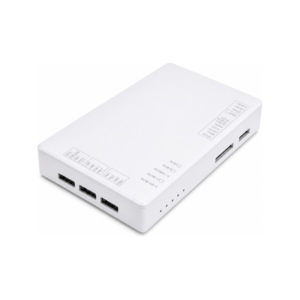
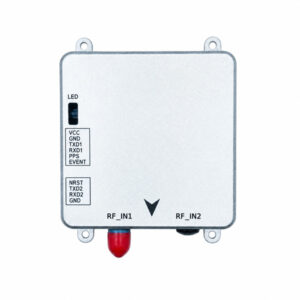
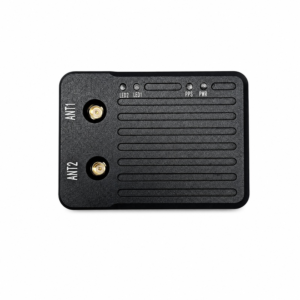
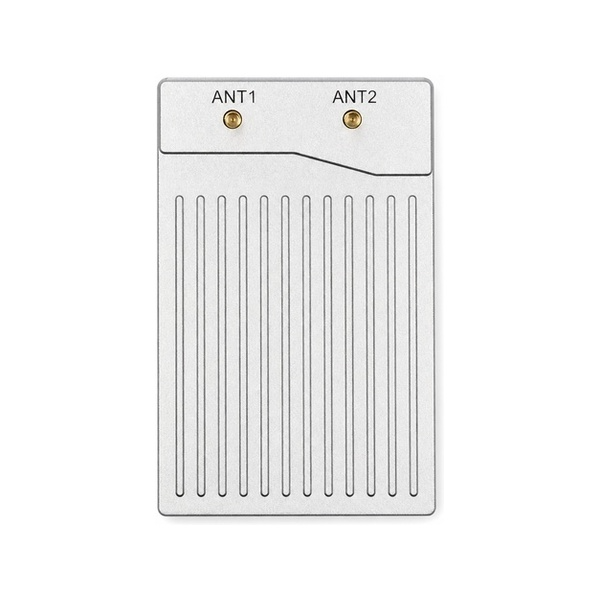
The Eview HB10 combines centimetre-level RTK positioning and dual-antenna heading in a receiver of only 71.8 × 20.5 × 12.5 mm. Built around the Septentrio AsteRx-m3 Pro+, it tracks all major constellations on multiple frequencies and delivers position and attitude at up to 100 Hz with less than 10 ms latency, making it a strong fit for industrial drones, autonomous vehicles and precision control. It belongs to our AsteRx-m3 Pro+ box receivers.
AIM+ anti-jamming and OSNMA anti-spoofing
Septentrio AIM+ monitors the RF spectrum and suppresses narrowband and wideband interference, so the HB10 keeps a reliable fix near radio links, power lines and other noisy equipment. Galileo OSNMA authenticates satellite signals to protect against spoofing. Learn more about anti-jamming GNSS receivers and OSNMA anti-spoofing.
Accurate position and heading in a small package
Two antenna inputs give true heading, pitch and roll without a magnetometer: 0.15° heading accuracy with a 1 m baseline and 0.03° with 5 m. The compact, low-weight design suits platforms where size, weight and power are limited. See how dual-antenna GNSS heading works.
GNSS+ technologies
LOCK+ keeps tracking stable during high vibration, shocks and fast manoeuvres. IONO+ protects accuracy during ionospheric scintillation. APME+ reduces multipath errors from nearby reflecting surfaces.
Easy integration
Three UARTs, USB Type-C, PPS output and event input connect the HB10 to flight controllers, companion computers and data loggers. Standard NMEA and RTCM correction input work with common CORS networks and base stations, and a microSD slot allows onboard logging for post-processing. Firmware and manuals are on our firmware downloads page.
Applications
- UAVs and drones: RTK position and heading for mapping, survey and industrial drones, including flights near interference.
- Inspection and patrol drones: reliable navigation along power lines and pipelines where jamming and RF noise are common.
- Robotics, AMRs and AGVs: centimetre positioning and heading for outdoor autonomous robots.
- Construction and machine control: fast, low-latency position and attitude for guided machinery.
- Hazard and deformation monitoring: precise, continuous positioning for landslide, earthquake and structural monitoring.
- Logistics and vehicles: robust positioning for intelligent logistics and vehicle tracking.
Frequently asked questions
What heading accuracy does the HB10 achieve?
With two antennas 1 m apart the HB10 provides 0.15° heading accuracy; with a 5 m baseline it reaches 0.03°.
Does the HB10 work under GNSS jamming and spoofing?
Yes. Septentrio AIM+ detects and mitigates interference, and Galileo OSNMA authenticates signals to protect against spoofing.
How fast is the HB10’s output?
The HB10 outputs position and heading at up to 100 Hz with latency below 10 ms, which suits fast-moving drones and vehicles.
What is the difference between the HB10 and the HB59?
Both use the Septentrio AsteRx-m3 Pro+. The HB10 is a compact 71.8 × 20.5 mm box receiver; the HB59 is an OEM board that adds Ethernet for system integration.
How do I get the full HB10 datasheet or a quote?
Email sales@gnss-solutions.com for the complete datasheet, or ask a quote with your application and quantity.
Related reading
HB10 specifications
| GNSS engine | Septentrio AsteRx-m3 Pro+ |
|---|---|
| GNSS signals | GPS L1 C/A, L1C, L2C, L2P(Y), L5 · GLONASS L1, L2, L3 · Galileo E1, E5a, E5b · BeiDou B1I, B1C, B2a, B2I, B3I · QZSS L1 C/A, L1C, L2C, L5 · NavIC L5 · SBAS |
| RTK accuracy (RMS) | 0.6 cm + 0.5 ppm horizontal, 1 cm + 1 ppm vertical |
| Standalone / SBAS / DGNSS accuracy | 1.2 m / 0.6 m / 0.4 m horizontal; 1.9 m / 0.8 m / 0.7 m vertical |
| RTK initialization | 7 s |
| Heading / pitch-roll accuracy | 0.15° / 0.25° (1 m baseline); 0.03° / 0.05° (5 m baseline) |
| Velocity accuracy | 0.03 m/s |
| Maximum update rate | 100 Hz position and attitude |
| Latency | <10 ms (99.9%) |
| Time to first fix | Cold <45 s, warm <20 s, reacquisition 1 s |
| Timing accuracy | xPPS 5 ns, event <20 ns |
| Interfaces | 3 × UART, USB Type-C, microSD, xPPS output, event input |
| Dimensions | 71.8 × 20.5 × 12.5 mm |
| Complete datasheet | On request: sales@gnss-solutions.com |
Product datasheet
The complete datasheet (GNSS signals, interfaces, pin-out, electrical and environmental specifications) is available on request. Email sales@gnss-solutions.com with the product name and your application.
Support documentation
Email sales@gnss-solutions.com for a quote, user manuals or integration support.