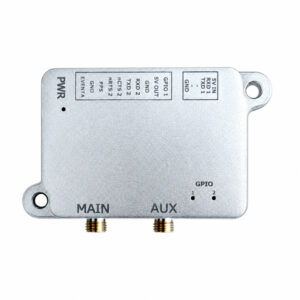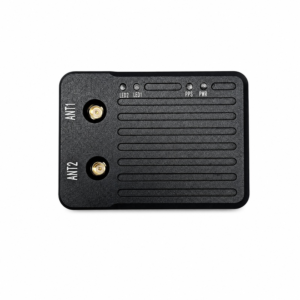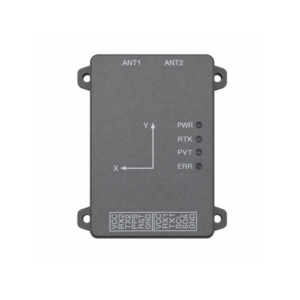
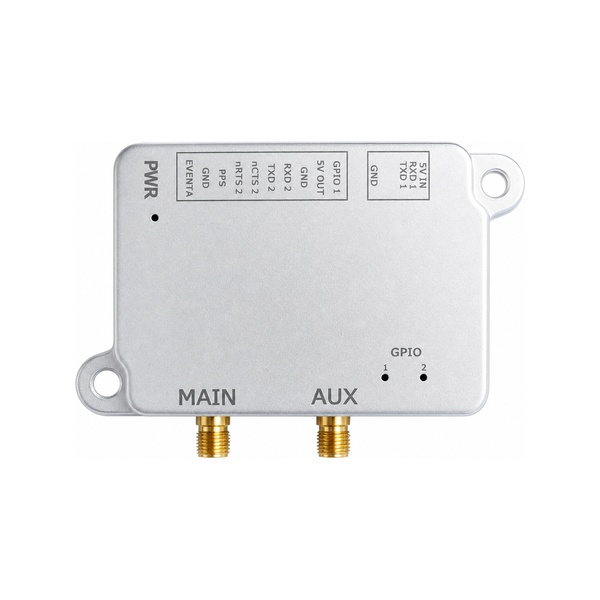
HB50 Compact Multi-Frequency GNSS Receiver — Septentrio mosaic-G5 P3
Compact multi-frequency RTK GNSS receiver for drones, robots and machines
- Septentrio mosaic-G5 P3, all-constellation, multi-frequency
- Centimetre-level RTK: 0.6 cm + 0.5 ppm horizontal
- 20 Hz position and velocity output
- AIM+ anti-jamming and Galileo OSNMA anti-spoofing
- LOCK+, IONO+, APME+ and RAIM+ for reliable tracking
- Low power: 0.44 W typical
- Compact aluminium housing: 59 × 44 × 12 mm, 50 g
No forms to fill in — we reply within one business day.
Compact multi-frequency GNSS receiver with centimetre RTK
The Eview HB50 is a compact multi-frequency GNSS receiver built around the Septentrio mosaic-G5 P3 module. It tracks GPS, GLONASS, Galileo, BeiDou and QZSS on multiple frequencies and gives centimetre-level RTK positioning at up to 20 Hz in a 50 g housing. The HB50 is the single-antenna version; the HB50H uses the mosaic-G5 P3H and adds dual-antenna heading. Both belong to our mosaic-G5 box receivers.
Multi-frequency RTK in a small box
With RTCM v3.x or CMR corrections from a CORS network or your own base, the HB50 reaches 0.6 cm + 0.5 ppm horizontal and 1 cm + 1 ppm vertical accuracy (RMS). A cold start takes under 35 s and signal reacquisition 1 s. Velocity accuracy is 3 cm/s, and the receiver keeps tracking signals down to 20 dB-Hz.
AIM+ anti-jamming and OSNMA anti-spoofing
Septentrio AIM+ detects and suppresses narrowband and wideband interference, so the HB50 keeps its fix near radio links, motors and other noisy electronics. Galileo OSNMA authenticates satellite navigation messages to protect against spoofing. Learn more about anti-jamming GNSS receivers and OSNMA anti-spoofing.
GNSS+ technologies
LOCK+ keeps tracking stable under vibration and shock. IONO+ protects accuracy during ionospheric scintillation. APME+ reduces multipath near buildings and metal structures. RAIM+ monitors position integrity.
Interfaces, timing and logging
Two UARTs, USB Type-C, GPIO, an event marker input and a PPS output (1.4 ns) make the HB50 easy to connect to flight controllers, robot computers and data loggers. It outputs NMEA 0183 and Septentrio SBF, and logs raw measurements to an SD card for post-processing. Power consumption is 0.44 W typical. Firmware and manuals are on our firmware downloads page.
Applications
- UAVs and drones: light, low-power RTK positioning for mapping and industrial drones.
- Robots and AGVs: centimetre positioning for outdoor autonomous robots.
- Precision agriculture: guidance for tractors, sprayers and field robots.
- Surveying and GIS: compact RTK rover with raw data logging.
- Construction and mining: positioning for machines working near multipath and interference.
- Inspection and patrol: reliable positioning for inspection drones and patrol robots.
Frequently asked questions
Which Septentrio module is inside the HB50?
The HB50 uses the Septentrio mosaic-G5 P3, with a maximum update rate of 20 Hz. It is not a mosaic-X5 receiver. See the mosaic-X5 vs mosaic-G5 comparison to choose between the two.
What is the difference between the HB50 and the HB50H?
Both share the same housing, signals and RTK accuracy. The HB50 has one antenna input for positioning. The HB50H uses the mosaic-G5 P3H with two antenna inputs and adds heading and pitch or roll (0.15° heading at 1 m baseline).
Does the HB50 work with ArduPilot and PX4?
Yes. The HB50 connects over UART and outputs standard NMEA and Septentrio SBF, which popular open-source autopilots support. See our ArduPilot GNSS guide.
Can the HB50 log raw data for post-processing?
Yes. It records raw GNSS measurements to an SD card. Septentrio SBF files can be converted to RINEX for PPK and other post-processing software.
How do I get the full HB50 datasheet or a quote?
Email sales@gnss-solutions.com for the complete datasheet, or ask a quote with your application and quantity.
Related reading
HB50 specifications
| GNSS engine | Septentrio mosaic-G5 P3, 789 hardware channels |
|---|---|
| Antenna | Single antenna input (positioning); dual-antenna heading version: HB50H |
| GNSS signals | GPS L1C/A, L1C, L2C, L2P(Y), L5 · GLONASS L1, L2, L3 CDMA · Galileo E1, E5a, E5b, E6 · BeiDou B1I, B1C, B2a, B2I, B2b, B3I · QZSS L1C/A, L1C/B, L2C, L5, L6 · NavIC · SBAS |
| RTK accuracy (RMS) | 0.6 cm + 0.5 ppm horizontal, 1 cm + 1 ppm vertical |
| RTK initialization / TTFF | Cold start <35 s, warm start <10 s, reacquisition 1 s |
| Velocity accuracy | 0.03 m/s |
| Maximum update rate | 20 Hz |
| Timing accuracy | xPPS 1.4 ns, event <3 ns |
| Data formats | RTCM v3.x (incl. MSM) and CMR v2.0 / CMR+ input · NMEA 0183 (v2.3, v3.03, v4.0) and Septentrio SBF output |
| Interfaces | 2 × UART, USB Type-C, GPIO, event marker input, PPS output, SD/MMC logging |
| Tracking sensitivity (C/N0) | Tracking 20 dB-Hz, acquisition 30 dB-Hz |
| Power consumption | 0.44 W typical, 0.57 W maximum |
| Dimensions / weight | 59 × 44 × 12 mm, 50 g |
| Operating temperature | −40 °C to +85 °C (storage −55 °C to +85 °C), 5–95% RH non-condensing |
| Complete datasheet | On request: sales@gnss-solutions.com |
Product datasheet
The complete datasheet (GNSS signals, interfaces, pin-out, electrical and environmental specifications) is available on request. Email sales@gnss-solutions.com with the product name and your application.
Support documentation
Email sales@gnss-solutions.com for a quote, user manuals or integration support.