Septentrio mosaic-X5 vs mosaic-G5 P3H: What Is the Difference and Which Should You Choose?
The mosaic-X5 is the all-band, 100 Hz choice; the mosaic-G5 P3H is the smaller, lower-power choice that adds dual-antenna heading. In Eview receivers that means: HB6, HB56 and HB62 for mosaic-X5, and HB50H, HB51, HB52H and HBEV322H for mosaic-G5 P3H (with HB50, HB52 and HBEV11 on the single-antenna mosaic-G5). This guide compares the two modules using Septentrio’s published figures.
- HB6 / HB56 / HB62: mosaic-X5, up to 100 Hz
- HB51: mosaic-G5 P3H heading plus RM3100 magnetometer
- HB52 / HB52H: mosaic-G5, ultralight; HB52H adds heading
- HB50H: mosaic-G5 P3H, low-power heading
Specification comparison
| Specification | mosaic-X5 | mosaic-G5 P3H |
|---|---|---|
| Channels | 448 | 789 |
| Bands | All bands: GPS L1/L2/L5, Galileo E1/E5a/E5b/E6, GLONASS L1/L2/L3, BeiDou B1I/B1C/B2a/B2I/B2b/B3I, QZSS, NavIC L5 | Quad-band GPS, GLONASS, BeiDou, Galileo, QZSS |
| Max position rate | Up to 100 Hz | Up to 20 Hz |
| Latency | Under 10 ms | Under 10 ms |
| RTK accuracy | 0.6 cm + 0.5 ppm H, 1 cm + 1 ppm V | 0.6 cm + 0.5 ppm H, 1 cm + 1 ppm V |
| RTK initialisation | About 7 s | About 7 s |
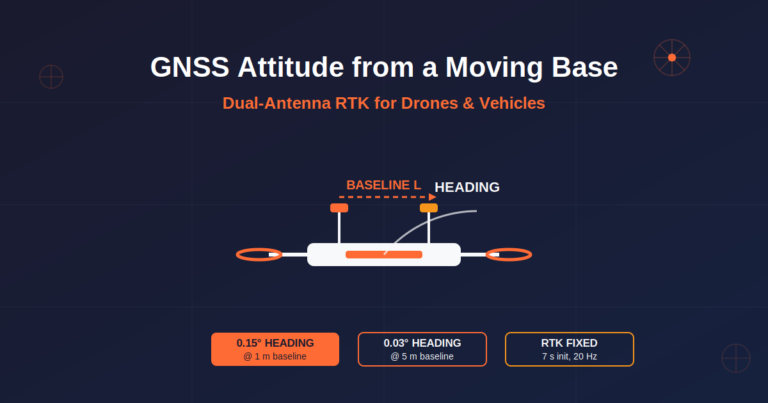
| Dual-antenna heading | No | Yes: 0.15° heading, 0.25° pitch or roll at 1 m |
| Anti-jamming | AIM+ | AIM+ |
| Galileo OSNMA | Yes | Yes |
| Galileo HAS | Not stated by Septentrio | Supported (software rollout) |
| Typical power | About 0.6 W | About 0.6 W (P3: 0.44 W) |
| Size and weight | 31 × 31 × 4 mm, 6.8 g | 22.8 × 16.4 × 2.4 mm, 2.2 g |
| Interfaces | 4 UART, USB, Ethernet, SD logging | 2 UART, USB |
Module figures from Septentrio. See the mosaic-X5 and mosaic-G5 technology pages for detail.
The differences that decide your choice
- Update rate: the mosaic-X5 reaches 100 Hz; the mosaic-G5 P3H runs at up to 20 Hz. Choose X5 for fast control loops. See 100 Hz GNSS.
- Heading: only the P3H gives dual-antenna heading. With the X5 family, heading comes from the mosaic-H receivers (HB6 Pro, HB56H) instead.
- Size, weight and power: the G5 module is 2.2 g and about 40% lower power than the X5, which matters on small drones and battery robots.
- Interfaces and logging: the X5 adds Ethernet and SD logging at module level, used in the HB62 base station.
- Protection: both have AIM+ anti-jamming and Galileo OSNMA, so the choice is not about security.
Which one for your application?
| Application | Choose | Eview receiver |
|---|---|---|
| Drones and UAVs | mosaic-G5 (weight and power) | HB52 / HB52H |
| Robots and AMRs | mosaic-G5 P3H (heading, low power) | HBEV322H, HB50H |
| Survey base station | mosaic-X5 (Ethernet, logging) | HB62 |
| Fast vehicles and control loops | mosaic-X5 (100 Hz) | HB6, HB56 |
| Marine heading | mosaic-G5 P3H or mosaic-H | HB50H, HB6 Pro |
Talk to Eview
Tell us your platform, environment and quantity, and we will recommend the right Eview receiver and antenna. Email sales@gnss-solutions.com for pricing, datasheets and user manuals; we reply within 24 hours.
Frequently asked questions
What is the main difference between mosaic-X5 and mosaic-G5 P3H?
The mosaic-X5 tracks all bands at up to 100 Hz on 448 channels. The mosaic-G5 P3H has 789 channels, adds dual-antenna heading, runs at up to 20 Hz and is much smaller and lower power.
Do both have anti-jamming and OSNMA?
Yes. Both include Septentrio AIM+ anti-jamming and Galileo OSNMA authentication.
Which supports dual-antenna heading?
The mosaic-G5 P3H, with 0.15° heading and 0.25° pitch or roll at a 1 m baseline. The mosaic-X5 is single antenna.
Which Eview products use each module?
mosaic-X5: HB6, HB56, HB62. mosaic-G5: HB50, HB50H, HB51, HB52, HBEV11, HBEV322 and the G5P3H EVK.
Can I evaluate the mosaic-G5 P3H first?
Yes. The G5P3H EVK lets you test the module before you design it in.