Tractor GPS Retrofit Kit: Adding RTK Autosteer to an Older or Compact Tractor
Updated November 2026
Short answer: a tractor GPS retrofit kit is a receiver, an antenna, a correction source and a steering interface fitted to a machine that left the factory without autosteer. No new tractor and no factory guidance package are involved. An RTK receiver powered by Septentrio on the cab roof, a steering motor and a guidance display give an older or compact tractor centimetre-level repeatability in an afternoon.
Retrofit kits sell because the mechanics of a tractor outlive its electronics. A fifteen-year-old machine still pulls a drill straight; what it lacks is a receiver that knows where the row is. Our guide to RTK GPS for tractors covers the accuracy decision. This article is the parts list and the installation.
What a tractor RTK retrofit needs
Every retrofit comes down to five parts. Miss one and the system tracks a line in the yard and wanders in the field.
- Receiver. Computes position from satellites and corrections. The only part where the choice changes what the machine can do: single-antenna gives position, dual-antenna also gives true heading.
- Antenna. On the cab roof, clear sky view. Two on a dual-antenna system, on a rigid baseline.
- Correction source. Your own base, network RTK over NTRIP, or a satellite correction service. Without corrections you have metre-level GPS, not autosteer.
- Guidance display or controller. Runs the A-B line, implement width and section control, and issues the steering command.
- Steering motor or interface. A wheel motor on the steering column, or a CAN interface where the tractor has a steer-ready valve.
Buyers underestimate the receiver. A single-antenna unit holds a straight line on flat ground, then loses the plot on a side slope, at 3 km/h, or during a headland roll-back. That is a heading problem, not a position problem — which is why the kits below are separated by heading rather than price.
Which Eview kit fits your farm
Simple guidance and spraying: HBEV11
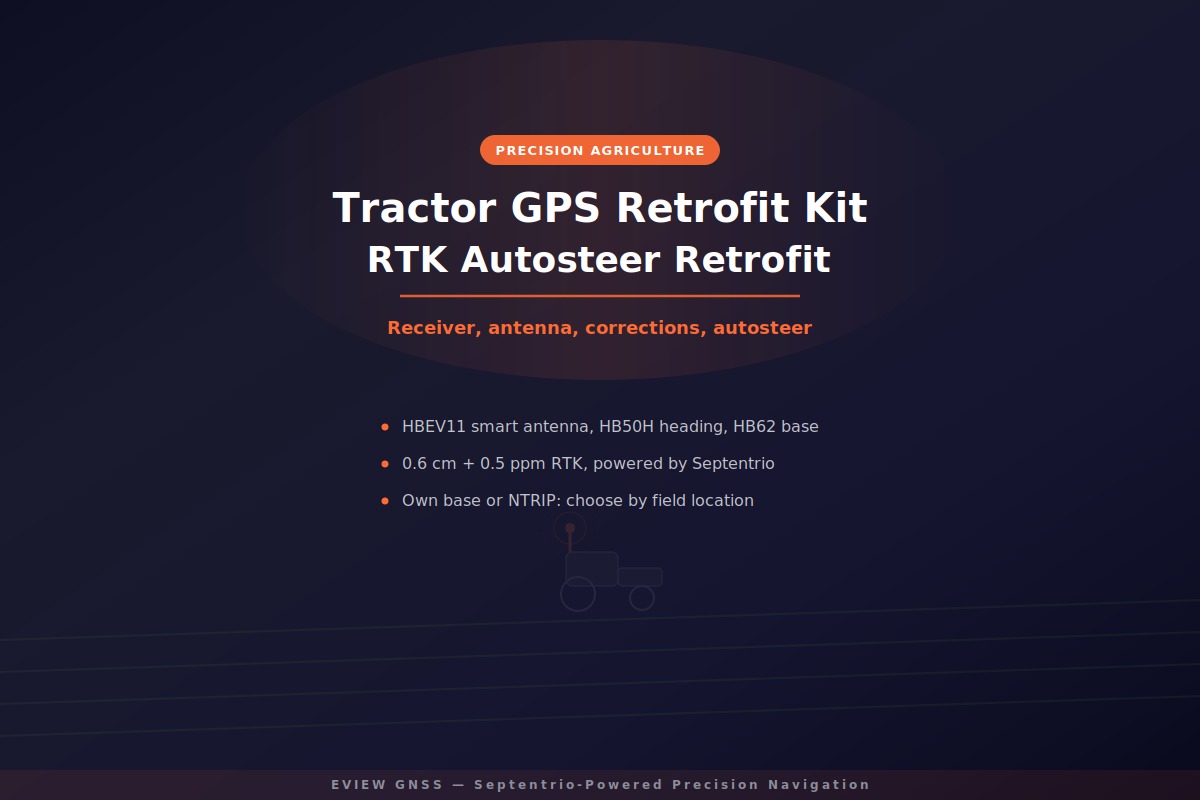
The HBEV11 RTK smart antenna puts receiver and antenna in one housing, powered by Septentrio’s mosaic-G5 P3. One M12 cable carries 5–12 V power plus USB, UART or RS232, so installation is a roof bracket, a cable run and a connector at the display. It reaches 0.6 cm + 0.5 ppm horizontal RTK in a typical 7 s, outputs NMEA 0183, SBF and RTCM v3.x at up to 20 Hz, and draws about 0.44 W — welcome on an older tractor with a modest alternator. For spraying and spreading at 10 cm implement width, this is the kit that works by evening. The mosaic-G5 also decodes Galileo High Accuracy Service corrections, giving decimetre-level positioning where no base or NTRIP coverage exists.
Accurate autosteer with heading: HB50H + 2× EV288
The HB50H is a compact dual-antenna receiver powered by Septentrio’s mosaic-G5 P3H. Two antennas give true heading plus pitch or roll: 0.15° heading and 0.25° pitch/roll on a 1 m baseline, improving to 0.03° and 0.05° on 5 m. Position, velocity and attitude output together at 20 Hz, with RTK at 0.6 cm + 0.5 ppm.
Heading from a baseline is not compass heading. It is measured from the geometry between the two antennas, so it stays valid at standstill and ignores the steel, alternator and steering motor around it — precisely what a tractor needs on a headland turn or a side slope, where a single-antenna system has no reliable course over ground.
Pair it with two EV288 antennas: full-band coverage of GPS L1/L2/L5, GLONASS L1/L2/L3, Galileo E1/E5a/E5b/E6, BeiDou B1/B2/B3 and L-band, a 33 ± 2 dB LNA, IP67 sealing, a 5/8″-11 mount and a 650 mm cable to SMA. It is tested for vibration, impact, drop and salt spray — the daily life of a roof mount on working machinery. Fit them fore and aft as far apart as the roof allows, on a rigid bracket. Loose brackets are the most common cause of a heading that drifts under load.
Your own corrections: HB62 base + EV288
The HB62 base station is a rugged reference receiver powered by Septentrio’s mosaic-X5: 448 channels, RTCM v3.x MSM4–7 over Ethernet or NTRIP, two RS232 ports for a UHF radio, 64 GB internal logging, IP67, 9–36 V DC, −40 °C to +85 °C. On a stable mast with a geodetic or choke ring antenna, your corrections stay on your property with no subscription and no cellular dependency.
Two things to plan for. The base needs a surveyed or well-averaged position: a base a metre out puts every rover a metre out, consistently, which stays invisible until you compare seasons. And AIM+ interference filtering matters more here than on a rover, because a base that loses lock takes every machine on the farm with it. For small areas without Ethernet, an HBEV11 also works as a simple base, streaming RTCM v3.x MSM to a radio modem.
Where the RTK corrections come from
| Correction source | Range | Setup | Running cost | Best for |
|---|---|---|---|---|
| Own base station | A few km on UHF; 15–20 km with a repeater or NTRIP | Mast, power, radio modem, surveyed position | None after installation | Fields beyond cellular coverage, several machines, no third-party dependency |
| Network RTK (NTRIP) | Wherever there is cellular data | SIM, caster credentials, NTRIP client on receiver or display | Annual subscription | Farms inside a commercial network, contractors on many sites |
| Satellite corrections | Wide area, no local infrastructure | Galileo HAS, or an L-band service enabled on the receiver | Free (HAS) or subscription | Decimetre spraying and spreading, areas with no RTK network |
Most farms end up hybrid: own base on the home fields, NTRIP on land inside coverage, Galileo HAS as fallback. Because the receiver accepts all three, that choice is a configuration item rather than a purchase decision. If NTRIP is new to you, our guide to NTRIP, RTCM and RINEX explains what is actually sent over the link.
What accuracy does autosteer need?
Less than the datasheet suggests, more than bare GPS gives. The number that matters in the field is repeatability — how closely this pass sits to the last one — not absolute accuracy against a survey point.
- Spraying and spreading. 10–30 cm works for the application; RTK earns its place through section control, where 10 cm of drift across a 36 m boom is real product.
- Seeding and planting. 2–3 cm pass-to-pass, because a row 10 cm out cannot be recovered by the next operation.
- Controlled-traffic farming. The strictest case, needing absolute accuracy as well as repeatability so tramlines line up with last season’s passes.
RTK at 0.6 cm + 0.5 ppm clears all three with margin. What erodes the margin is installation: offsets entered wrongly, a mast that flexes, a base averaged too quickly, or heading taken from the wrong source. Implement control and section switching are covered on our precision agriculture page.
Retrofit installation checklist
- Mount the antenna, then measure. Cab roof, upright, clear of exhaust, beacons and radio antennas. Record height above ground.
- Enter the offsets. Forward/aft, left/right and height from the rear axle, in the unit the controller expects. On dual-antenna systems, enter both antennas and the baseline direction.
- Route the coax away from power. Clear of the alternator, starter cable and any inverter wiring, with a drip loop before the connector.
- Power from a fused, switched circuit. Not the cigarette lighter — start-up voltage sag is a common cause of mid-field reboots.
- Confirm RTK Fix outdoors. Watch the fix type for a full minute before moving. Float is not ready.
- Check the heading source. Heading should match the tractor’s real direction and stay stable at standstill. If it spins, the antennas are swapped or the baseline offset is wrong.
- Run an A-B test. Two passes on flat ground, two on a slope, one headland turn, then measure the offset with a tape. Over 3 cm is an install fault, not a receiver fault.
- Log the first day. Keep raw data so any later complaint can be checked against measurements instead of memory.
Cost factors
No fixed prices here — the same tractor can be kitted at very different levels. What drives the number:
- Position only or position plus heading. A smart antenna is the lowest-cost entry; dual-antenna adds a receiver and a second antenna.
- Corrections. Own base is capital cost with no subscription; network RTK is a small annual fee; satellite services sit between.
- Steering interface. A wheel motor is universally compatible and adds fitting labour; a steer-ready tractor needs a CAN harness instead.
- Display. Reusing an existing screen or a tablet changes the bill more than the receiver does.
- Job accuracy class. Spraying tolerates simpler hardware than controlled-traffic drilling. Buying for the strictest job once costs less than upgrading twice.
- Installation labour. Brackets, cable runs and offset entry are where a cheap kit turns expensive if rushed.
Frequently asked questions
Can I add RTK GPS to an older tractor?
Yes. The retrofit needs only a 12 V supply, a roof for the antenna and a place for the steering motor. Older machines usually use a wheel motor rather than a CAN interface, which is the more universal option anyway.
Do I need my own RTK base station?
Only if your fields sit outside network coverage, or if you want corrections that do not depend on a cellular link. NTRIP is cheaper to start and covers most farmland inside a commercial network. A base pays back when several machines work the same ground.
What accuracy do I need for autosteer?
2–3 cm pass-to-pass for seeding and planting; 10–30 cm for spraying and spreading. RTK at 0.6 cm + 0.5 ppm covers all of it. In practice the installation and offsets limit accuracy before the receiver does.
Will a retrofit kit fit a compact tractor?
Yes, and the limits are physical: a smaller roof, a shorter wheelbase, less room around the steering column. A smart antenna like the HBEV11 avoids most of that, and a 50–60 cm baseline still gives usable heading from a dual-antenna receiver.
Why use dual-antenna heading on a tractor?
A single-antenna receiver only knows which way it is moving, and a tractor at low speed on a slope is barely moving. Dual-antenna heading comes from the baseline between the antennas, so it works at standstill and is unaffected by steel, motors or the alternator.
Tell us what you are working with
The right kit depends on the tractor, the implements and the field layout, not only on an accuracy figure. Send us the tractor model, what you want to steer and your field size, and we will tell you which receiver, antenna count and correction source fits.
Email sales@gnss-solutions.com with your tractor model and field size.