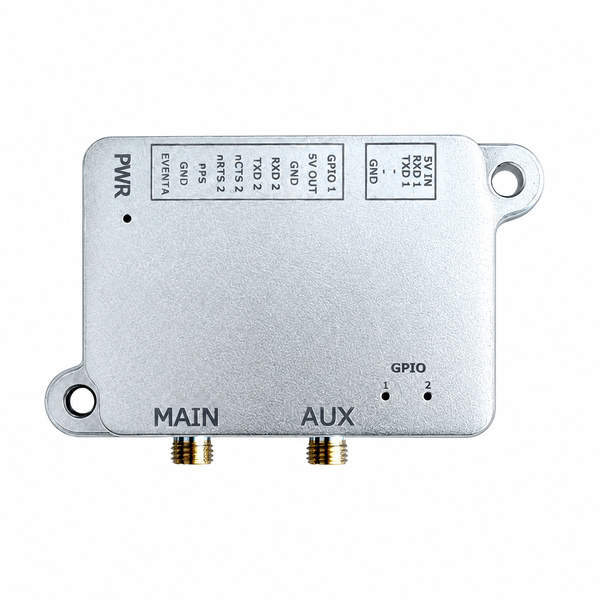
HB50H Compact GNSS Heading Receiver — Septentrio mosaic-G5 P3H
Compact dual-antenna RTK receiver with GNSS heading and pitch or roll
- Septentrio mosaic-G5 P3H, all-constellation, multi-frequency
- Dual-antenna heading: 0.15° heading, 0.25° pitch/roll (1 m baseline)
- Centimetre-level RTK: 0.6 cm + 0.5 ppm horizontal
- 20 Hz position, velocity and attitude output
- AIM+ anti-jamming and Galileo OSNMA anti-spoofing
- Low power: 0.60 W typical
- Compact aluminium housing: 59 × 44 × 12 mm, 50 g
No forms to fill in — we reply within one business day.
Compact GNSS heading receiver with dual-antenna RTK
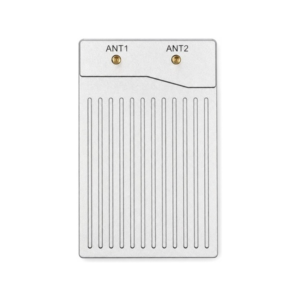
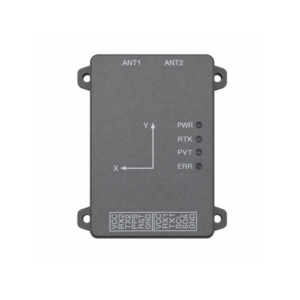
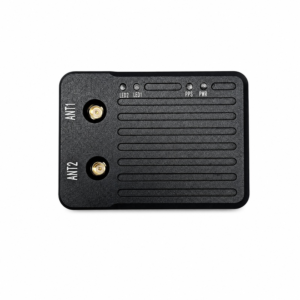
The Eview HB50H is a compact GNSS heading receiver built around the Septentrio mosaic-G5 P3H module. With two antennas it gives true heading and pitch or roll without vehicle motion, together with centimetre-level RTK positioning at up to 20 Hz. The single-antenna HB50 uses the mosaic-G5 P3 for positioning only. Both belong to our mosaic-G5 box receivers.
Dual-antenna heading and attitude
The HB50H measures the vector between its two antennas to output heading and pitch or roll: 0.15° heading and 0.25° pitch/roll with a 1 m baseline, improving to 0.03° and 0.05° with a 5 m baseline. Unlike a magnetic compass, it is not affected by nearby steel or motors. See how dual-antenna GNSS heading works.
Multi-frequency RTK positioning
With RTCM v3.x or CMR corrections, the HB50H reaches 0.6 cm + 0.5 ppm horizontal and 1 cm + 1 ppm vertical accuracy (RMS), with 3 cm/s velocity accuracy. It tracks GPS, GLONASS, Galileo, BeiDou and QZSS on multiple frequencies.
AIM+ anti-jamming and OSNMA anti-spoofing
Septentrio AIM+ detects and suppresses narrowband and wideband interference, and Galileo OSNMA authenticates navigation messages to protect against spoofing. LOCK+, IONO+, APME+ and RAIM+ keep tracking stable under vibration, scintillation and multipath, and monitor integrity. Learn more about anti-jamming GNSS receivers and OSNMA anti-spoofing.
Applications
- UAVs and drones: GNSS heading for take-off without magnetometer calibration.
- Marine and USVs: heading for unmanned surface vessels and small craft.
- Robots and AGVs: position and heading for outdoor autonomous robots, even when stationary.
- Precision agriculture: heading for auto-steering and implement control.
- Construction and mining: orientation for machine guidance on steel machines.
- Vehicles and logistics: lane-level position and heading for vehicles and port equipment.
Frequently asked questions
Which Septentrio module is inside the HB50H?
The HB50H uses the Septentrio mosaic-G5 P3H, the dual-antenna heading version of the mosaic-G5, with a maximum update rate of 20 Hz. It is not a mosaic-H receiver.
What is the difference between the HB50H and the HB50?
Both share the same housing, signals and RTK accuracy. The HB50H has two antenna inputs and adds heading and pitch or roll. The HB50 is the single-antenna positioning version with slightly lower power use (0.44 W typical).
Does the HB50H need the vehicle to move to find heading?
No. Heading comes from the two antennas, so it is available when the vehicle is stationary. Read more about GNSS attitude from a moving base.
How far apart should the two antennas be?
A longer baseline gives better accuracy: 0.15° heading at 1 m and 0.03° at 5 m. Mount both antennas with a clear sky view and a fixed, measured separation.
How do I get the full HB50H datasheet or a quote?
Email sales@gnss-solutions.com for the complete datasheet, or ask a quote with your application and quantity.
Related reading
HB50H specifications
| GNSS engine | Septentrio mosaic-G5 P3H, 789 hardware channels |
|---|---|
| Antenna | Dual antenna inputs: positioning + heading |
| GNSS signals | GPS L1C/A, L1C, L2C, L2P(Y), L5 · GLONASS L1, L2, L3 CDMA · Galileo E1, E5a, E5b, E6 · BeiDou B1I, B1C, B2a, B2I, B2b, B3I · QZSS L1C/A, L1C/B, L2C, L5, L6 · NavIC · SBAS |
| RTK accuracy (RMS) | 0.6 cm + 0.5 ppm horizontal, 1 cm + 1 ppm vertical |
| Heading / pitch-roll accuracy | 0.15° / 0.25° (1 m baseline); 0.03° / 0.05° (5 m baseline) |
| RTK initialization / TTFF | Cold start <35 s, warm start <10 s, reacquisition 1 s |
| Velocity accuracy | 0.03 m/s |
| Maximum update rate | 20 Hz |
| Timing accuracy | xPPS 1.4 ns, event <3 ns |
| Data formats | RTCM v3.x (incl. MSM) and CMR v2.0 / CMR+ input · NMEA 0183 (v2.3, v3.03, v4.0) and Septentrio SBF output |
| Interfaces | 2 × UART, USB Type-C, GPIO, event marker input, PPS output, SD/MMC logging |
| Power consumption | 0.60 W typical, 0.79 W maximum |
| Dimensions / weight | 59 × 44 × 12 mm, 50 g |
| Operating temperature | −40 °C to +85 °C (storage −55 °C to +85 °C), 5–95% RH non-condensing |
| Complete datasheet | On request: sales@gnss-solutions.com |
Product datasheet
The complete datasheet (GNSS signals, interfaces, pin-out, electrical and environmental specifications) is available on request. Email sales@gnss-solutions.com with the product name and your application.
Support documentation
Email sales@gnss-solutions.com for a quote, user manuals or integration support.