GNSS Anti-Jamming vs Anti-Spoofing: What Every Engineer Needs to Know
Anti-jamming keeps a receiver tracking when radio interference drowns the satellite signals; anti-spoofing stops it from trusting fake signals. Every Eview GNSS receiver has both layers: Septentrio AIM+ interference mitigation is on by default, and Eview receivers built on the mosaic-X5 and mosaic-G5 add Galileo OSNMA authentication. This guide explains the difference and which Eview receiver to choose.
- HB6: mosaic-X5, 100 Hz, 45 g, AIM+ and OSNMA
- HB52 / HB52H: mosaic-G5, ultralight, AIM+ and OSNMA; HB52H adds heading
- HB62: mosaic-X5 rugged base station, IP67, AIM+ and OSNMA
- HB10: AsteRx-m3 Pro+, 100 Hz dual-antenna heading, AIM+
The core difference: denial vs deception
Jamming is denial. A jammer transmits noise on GNSS frequencies and drowns the weak satellite signals, so the receiver loses its fix. It can be deliberate (a personal privacy device in a vehicle) or accidental (harmonics from on-board electronics, radar, power infrastructure).
Spoofing is deception. A spoofer transmits fake GNSS signals that look real, so the receiver computes a wrong position without any obvious warning. Because the operator may not notice, spoofing can be more dangerous than jamming.
| Anti-jamming | Anti-spoofing | |
|---|---|---|
| What it stops | Interference that drowns GNSS signals | Fake signals that trick the receiver |
| Effect without protection | Fix lost, operator usually notices | Wrong position, operator may not notice |
| How Eview receivers handle it | Septentrio AIM+, on by default | AIM+ signal-consistency checks plus Galileo OSNMA (mosaic-X5 and mosaic-G5 receivers) |
| Learn more | Anti-jamming (AIM+) | OSNMA anti-spoofing |
How anti-jamming works in Eview receivers
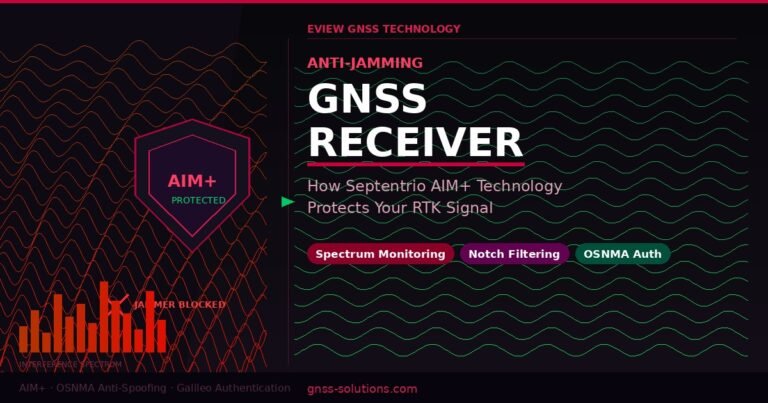
Septentrio AIM+ is built into every module Eview uses (mosaic-X5, mosaic-H, mosaic-G5 and AsteRx-m3 Pro+). It handles:
- Narrowband (CW) and multi-frequency narrowband interference: detected tones are notched out of the band.
- Wideband and chirp interference: the wideband energy is filtered so satellites can still be tracked.
- Pulsed interference such as radar and aviation DME: pulses are blanked and the clean signal is kept.
- Spectrum monitoring: real-time spectrum plots show interference so you can find its source.
Results from open field testing are summarised in our JammerTest 2025 report.
How anti-spoofing works in Eview receivers
- Galileo OSNMA: Galileo satellites broadcast signed navigation data (TESLA protocol). The receiver checks it against a stored key, so forged navigation data is flagged. OSNMA Initial Service has been operational since 24 July 2025 and is free.
- Signal-consistency checks: AIM+ compares timing, Doppler, geometry, frequencies and constellations. This also catches meaconing (replayed real signals), which OSNMA alone does not detect.
- RAIM+ integrity monitoring: inconsistent measurements are detected and excluded.
OSNMA is available on Eview receivers built on the mosaic-X5 (HB6, HB56, HB62) and mosaic-G5 (HB50, HB50H, HB51, HB52, HBEV11, HBEV322).
When you need both
- Inspection drones: interference near power lines and towers; spoofing awareness near sensitive sites.
- Autonomous vehicles: dense urban RF and a need to trust every position.
- Surveying: reliable fixes near infrastructure and trustworthy base data.
- Agriculture: interference from machinery and power lines over long working days.
- Marine: busy ports and coastal zones.
A combined attack, and how layered protection helps
A capable attacker may jam first to break lock, then offer a spoofed signal while the receiver re-acquires. AIM+ keeps tracking through the interference, which narrows that window, and OSNMA plus signal-consistency checks flag forged signals if they appear.
Which Eview receiver should you choose?
| Need | Eview receiver | Why |
|---|---|---|
| Lightest drone or robot payload | HB52 / HB52H | mosaic-G5, AIM+, OSNMA, optional heading |
| 100 Hz control with heading | HB10 | AsteRx-m3 Pro+, under 10 ms latency |
| Rugged base station | HB62 | mosaic-X5, NTRIP, IP67 |
| Smart antenna | HBEV11 | mosaic-G5, base or rover on one cable |
Talk to Eview
Tell us your platform, environment and quantity, and we will recommend the right Eview receiver and antenna. Email sales@gnss-solutions.com for pricing, datasheets and user manuals; we reply within 24 hours.
Frequently asked questions
What is the difference between GNSS anti-jamming and anti-spoofing?
Anti-jamming keeps the receiver tracking through interference that would drown the signals. Anti-spoofing stops the receiver from trusting fake signals. Jamming denies service; spoofing deceives.
Do all Eview receivers have anti-jamming?
Yes. Septentrio AIM+ is built into every module Eview uses and is on by default, so every Eview receiver has it.
Which Eview receivers support Galileo OSNMA?
Receivers built on the mosaic-X5 (HB6, HB56, HB62) and mosaic-G5 (HB50, HB50H, HB51, HB52, HBEV11, HBEV322).
Can OSNMA alone stop every spoofing attack?
No. OSNMA authenticates Galileo navigation data but does not by itself detect meaconing, the replay of real signals. That is why Eview receivers layer it with AIM+ signal-consistency checks.
Do drones need both?
For professional work, yes: anti-jamming for reliable lock near interference and anti-spoofing to trust the position. The HB52 and HB6 are common drone choices.