Best RTK GNSS Receivers for Drone Mapping: 2026 Comparison
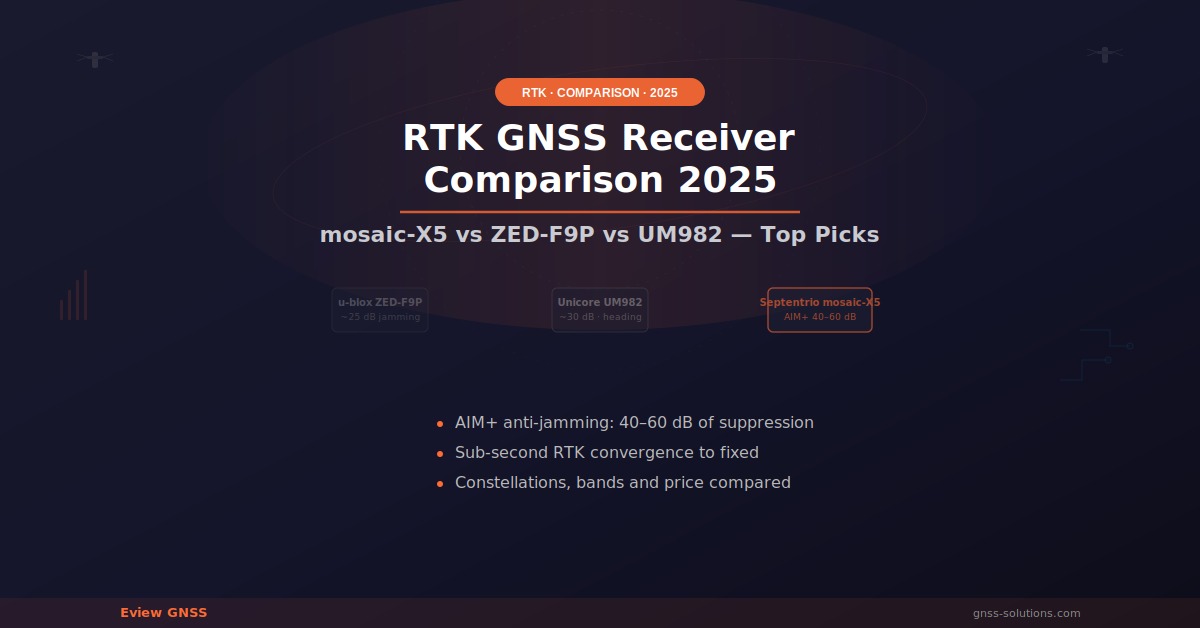
Short answer: for drone mapping in 2026, pick a multi-band RTK receiver that also logs raw data for PPK backup. The Septentrio mosaic-G5 and mosaic-X5 add AIM+ interference mitigation and Galileo OSNMA, and the mosaic-X5 outputs up to 100 Hz. The u-blox ZED-F9P suits low-cost builds and the Unicore UM982 suits budget dual-antenna heading. Eview builds finished receivers on the Septentrio modules: the HB52 and HBEV322 (mosaic-G5), the HB6 (mosaic-X5) and the HB6 Pro (mosaic-H heading).
Updated October 2026. Figures from the Septentrio, u-blox and Unicore public datasheets.
Quick picks: best RTK GNSS receiver for each drone mapping job
| Mapping job | What matters most | Best fit |
|---|---|---|
| Survey-grade photogrammetry and LiDAR | Multi-band RTK, raw data logging for PPK backup, high update rate | Septentrio mosaic-X5: Eview HB6 |
| Sites with radio interference (cities, towers, industrial plants) | AIM+ interference mitigation and Galileo OSNMA authentication | Septentrio mosaic-G5: Eview HB52 or HBEV322 |
| Corridor mapping (roads, rail, power lines) | True heading from two antennas, even when hovering | Septentrio mosaic-H: Eview HB6 Pro |
| Low-cost hobby or test builds | Lowest cost, dual-band RTK | u-blox ZED-F9P class boards |
What to look for in a drone mapping RTK receiver
- Signal bands. Multi-band tracking (L1/L2/L5 and Galileo E5/E6) fixes faster and holds the fix better near trees and structures.
- Raw data logging. Logging raw observations (SBF or RINEX) lets you fall back to PPK if the RTK link drops.
- Size, weight and power. Every gram and watt counts on small multirotors.
- Update rate. 5–20 Hz suits most mapping; fast fixed-wing aircraft and INS fusion benefit from higher rates.
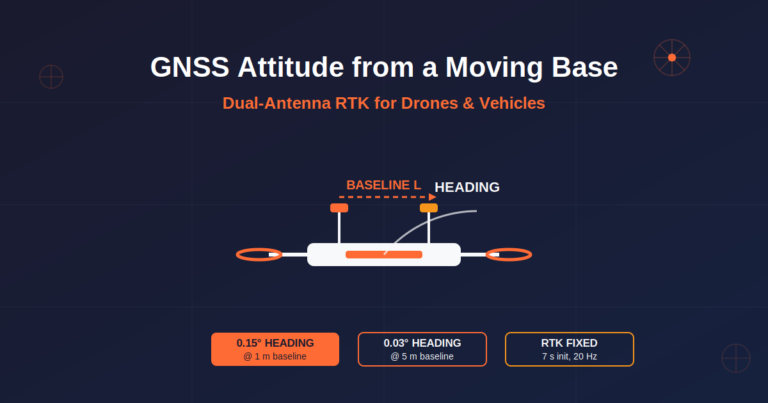
- Heading. Dual-antenna heading replaces the magnetometer where it is unreliable.
- Interference resilience. Motors, ESCs, video links and nearby radios all raise the noise floor around the antenna.
- Signal authentication. Galileo OSNMA lets the receiver check that navigation data is genuine.
Module comparison (datasheet figures)
| Septentrio mosaic-X5 | Septentrio mosaic-G5 | u-blox ZED-F9P | Unicore UM982 | |
|---|---|---|---|---|
| Bands | All bands incl. L5 and E6 | Quad-band | L1/L2 (-05B) or L1/L5 (-15B) | Multi-band incl. E6 |
| Max update rate | Up to 100 Hz | Up to 20 Hz | Up to 20 Hz RTK | Up to 20 Hz |
| RTK accuracy (horizontal) | 0.6 cm + 0.5 ppm | 0.6 cm + 0.5 ppm | 1 cm + 1 ppm | 0.8 cm + 1 ppm |
| Dual-antenna heading | No (use mosaic-H) | P3H variant: 0.15° at 1 m | Via a second receiver (moving base) | Yes, 0.1° at 1 m |
| Interference features | AIM+ | AIM+ | Interference detection, CW mitigation | States 60 dB narrowband suppression |
| Galileo OSNMA | Yes | Yes | On the -05B | Not stated |
| Module size | 31 × 31 × 4 mm | 22.8 × 16.4 × 2.4 mm, 2.2 g | 17 × 22 × 2.4 mm | 16 × 21 × 2.6 mm |
For more detail, see mosaic-X5 vs ZED-F9P and Septentrio alternatives compared.
Interference on drones
GNSS signals arrive very weak, and a drone carries its own noise sources close to the antenna: motors, ESCs, video and telemetry links. Mapping near cell towers, power lines or industrial sites adds more. Septentrio AIM+ is designed to suppress narrowband, wideband, chirp and pulsed interference and to report jamming and spoofing, which helps hold the RTK fix. Antenna placement away from the electronics still matters for every receiver.
RTK, PPK or both
RTK gives centimetre positions in flight; PPK corrects the logged data after landing and needs no live link. Most crews now do both with one receiver. See RTK vs PPK for drone mapping.
Which Eview receiver fits which drone
| Use case | Eview receiver | Septentrio module |
|---|---|---|
| Small mapping multirotor, light payload | HB52 or HBEV322 smart antenna | mosaic-G5 |
| High-rate positioning, INS fusion, fast fixed-wing | HB6 (up to 100 Hz) | mosaic-X5 |
| Heading without a magnetometer | HB6 Pro, HB50H | mosaic-H, mosaic-G5 P3H |
| 100 Hz dual-antenna heading | HB10 | AsteRx-m3 Pro+ |
| Base station for the survey site | HB62 | mosaic-X5 |
Tell us your drone, payload and accuracy target and we will recommend a receiver and antenna: sales@gnss-solutions.com. See also UAV and drone RTK GNSS.
Frequently asked questions
What is the best RTK GNSS receiver for drone mapping in 2026?
It depends on the drone. For most mapping drones, a multi-band receiver built on the Septentrio mosaic-G5 or mosaic-X5 gives centimetre RTK, raw logging for PPK and AIM+ interference mitigation. The mosaic-X5 adds output up to 100 Hz. The u-blox ZED-F9P suits low-cost builds, and the Unicore UM982 suits budget dual-antenna heading.
How does the Septentrio mosaic-X5 compare with the u-blox ZED-F9P?
On the datasheets, the mosaic-X5 tracks all signal bands, outputs up to 100 Hz and is specified at 0.6 cm + 0.5 ppm horizontal RTK accuracy. The ZED-F9P is dual-band, outputs RTK at up to 20 Hz and is specified at 1 cm + 1 ppm. The mosaic-X5 also adds AIM+ interference mitigation.
Is the Unicore UM982 a good RTK receiver for drones?
Yes, where dual-antenna heading is needed on a tight budget. Unicore specifies 0.8 cm + 1 ppm RTK, 0.1° heading at a 1 m baseline and up to 20 Hz output.
Do I need dual-antenna heading on a mapping drone?
Not for mapping accuracy itself. Heading helps where magnetometers are unreliable, for example near steel structures or power lines, and for fast yaw-sensitive platforms. Eview heading receivers include the HB6 Pro (mosaic-H) and the HB52H and HB50H (mosaic-G5 P3H).
Can I use RTK and PPK together?
Yes. Run RTK in flight and log raw data at the same time. If the correction link drops, you post-process the log as PPK. Eview receivers log Septentrio SBF, which converts to RINEX.
How do I get a datasheet or a quote?
Email sales@gnss-solutions.com with your drone, payload and accuracy needs. Datasheets and user manuals are sent by email, and we reply within 24 hours.
Do I need RTK for drone mapping, or are ground control points enough?
Ground control points alone can produce an accurate map, but they take time to survey on every site. An RTK or PPK receiver on the drone tags each photo with a centimetre position, so you need far fewer control points, usually a few check points to verify the result.
What accuracy can I expect from an RTK drone mapping receiver?
A multi-band RTK receiver typically positions each image to about 1–2 cm horizontally in good sky view. The final map accuracy also depends on camera calibration, flight height, overlap and the processing software, so always verify with independent check points.