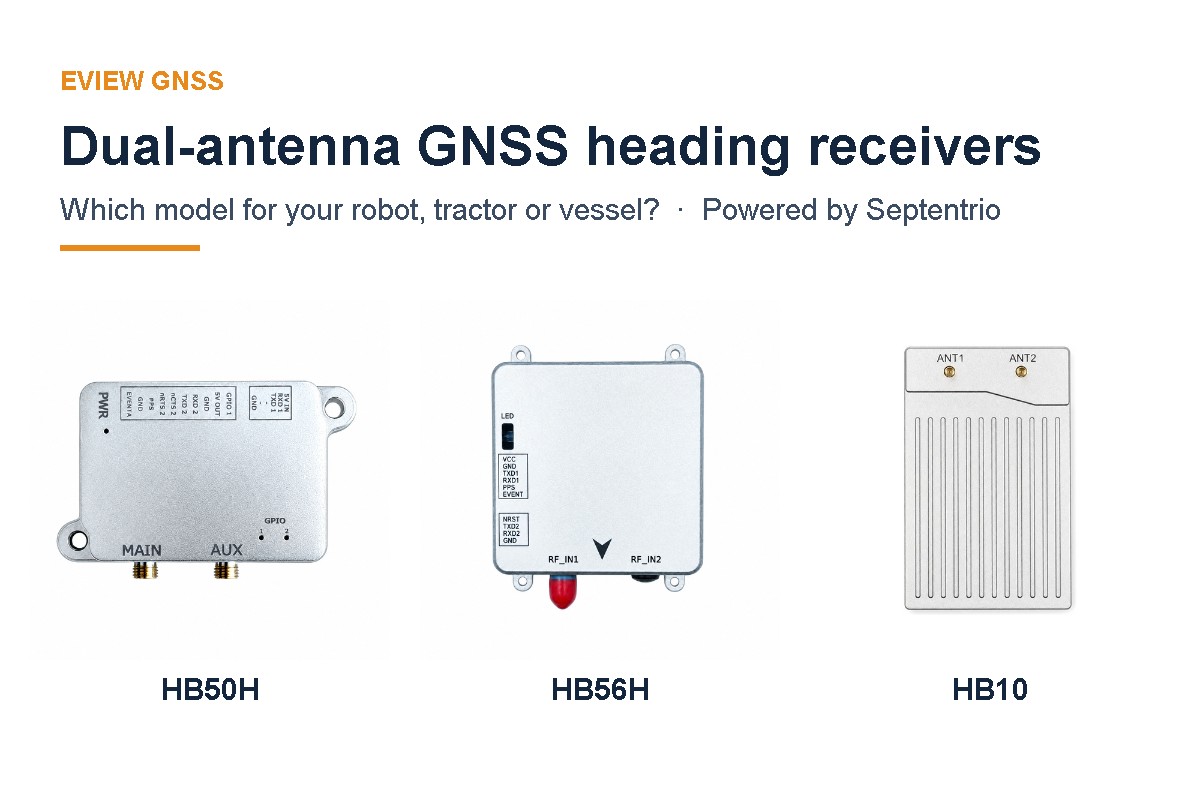
Dual-antenna GNSS heading receivers compared: which model for your robot, tractor or vessel?
If your machine needs to know which way it is facing, not just where it is, you need GNSS heading. A dual-antenna receiver measures the vector between two antennas and gives true heading at standstill, with no magnetometer and no need to move first. Steel, motors and cabling do not affect it.
Eview builds five dual-antenna heading receivers, all powered by Septentrio modules. They share the same RTK accuracy and the same 0.15° heading at a 1 m antenna baseline, so the right choice depends on your platform: size, power budget, mounting, output rate and interfaces. This guide matches each model to the job.
Quick answer: which model for which machine
| Your platform | Recommended model | Why |
|---|---|---|
| Compact robot, AGV or small machine with a tight power budget | HB50H | Smallest full-featured heading receiver: 59 × 44 × 12 mm, 50 g, 0.60 W typical |
| System that needs a fallback when GNSS heading is unavailable | HB51 | Adds a 3-axis magnetometer next to dual-antenna heading |
| Weight-critical integration | HB52H | 48 × 35 × 12.6 mm with USB-C and microSD |
| Field robot, tractor or implement that needs rugged mounting and logging | HB56H | Flange mount, on-board SD/MMC logging, raw data up to 100 Hz |
| Boat, USV or fast vehicle with 100 Hz control loops | HB10 | AsteRx-m3 Pro+, 100 Hz output with under 10 ms latency |
Full comparison
| HB50H | HB51 | HB52H | HB56H | HB10 | |
|---|---|---|---|---|---|
| Septentrio module | mosaic-G5 P3H | mosaic-G5 P3H + magnetometer | mosaic-G5 | mosaic-H | AsteRx-m3 Pro+ |
| Heading / pitch-roll at 1 m | 0.15° / 0.25° | 0.15° / 0.25° | 0.15° | 0.15° / 0.25° | 0.15° / 0.25° |
| Max. output rate | 20 Hz | 20 Hz | 20 Hz | 20 Hz (raw data 100 Hz) | 100 Hz |
| Interfaces | 2 × UART, USB-C, SD/MMC | 2 × UART, I2C, PPS, event, 2 × MMCX | USB-C, microSD | 2 × UART, Micro USB, SD/MMC, PPS, event | 3 × UART, USB-C, microSD, xPPS, event |
| Size | 59 × 44 × 12 mm, 50 g | See product page | 48 × 35 × 12.6 mm | 76 × 69 × 13 mm (with ears), 60 g | 71.8 × 20.5 × 12.5 mm |
All five deliver RTK accuracy of 0.6 cm + 0.5 ppm horizontal and 1 cm + 1 ppm vertical (RMS). With a 5 m baseline, heading improves to 0.03° and pitch/roll to 0.05°. Pair any model with two EV288 full-band antennas.
Five questions to answer before you choose
1. How far apart can you mount the antennas?
Heading accuracy scales with the baseline: 0.15° at 1 m, 0.03° at 5 m. On a small robot, 0.5–1 m is typical; on a tractor or boat you can often fit 1.5–3 m. Use the longest fixed separation the platform allows, on a rigid bar or the chassis.
2. How fast does the machine move and turn?
Robots, tractors and implements are well served by 20 Hz. For boats, USVs and fast vehicles where the controller runs at high rate, the HB10’s 100 Hz output and low latency make a measurable difference.
3. What does your controller read?
All models output NMEA 0183 (including heading), accept RTCM 3 corrections and support Septentrio SBF. Count the serial ports you need: the HB10 offers three UARTs, the HB50H and HB56H two.
4. Do you need to log raw data?
For field validation, post-processing or troubleshooting, on-board logging saves a laptop on every test. The HB56H and HB50H log to SD/MMC; the HB52H and HB10 to microSD.
5. How will it be mounted?
The HB56H has mounting ears for bolting to a frame. The HB50H, HB52H and HB10 are designed to be integrated inside an enclosure.
Where our heading receivers are used
- Outdoor robots and AGVs: position and heading for path following, even before the robot moves.
- Agriculture: heading for auto-steering and implement control on steel machines.
- Marine and USVs: a GNSS compass unaffected by hulls and engines. See GNSS compass for vessels.
- Construction and mining: machine orientation where magnetic compasses drift.
New to dual-antenna heading? Read how dual-antenna GNSS heading works.
Frequently asked questions
Do I need RTK corrections for heading?
No. Heading comes from the two antennas and works without corrections. Corrections (NTRIP or your own base) are needed for centimetre-level position.
Can I use a single-antenna receiver instead?
A single antenna gives heading only from movement (course over ground), so it is unavailable at standstill and noisy at low speed. If the machine must know its orientation before it moves, use dual-antenna heading.
Does Eview supply OEM volumes?
Yes. We supply single units for prototypes and volume orders for OEM integration. Email us your platform and annual volume.
Get a recommendation
Send us your platform, speed, the antenna separation you can fit and your interfaces, and we will recommend a model and send the datasheet: sales@gnss-solutions.com.