GNSS With Heading: How Dual-Antenna Heading Works (Engineer’s Guide)
Short answer: a GNSS receiver with heading uses two antennas a known distance apart and compares their carrier-phase signals to measure the direction the vehicle points, even when it is stationary. With a 1 m baseline, Septentrio-based receivers reach about 0.15°, and longer baselines are more accurate. Eview heading receivers include the HB6 Pro, HB52H and HB10.
Updated October 2026.
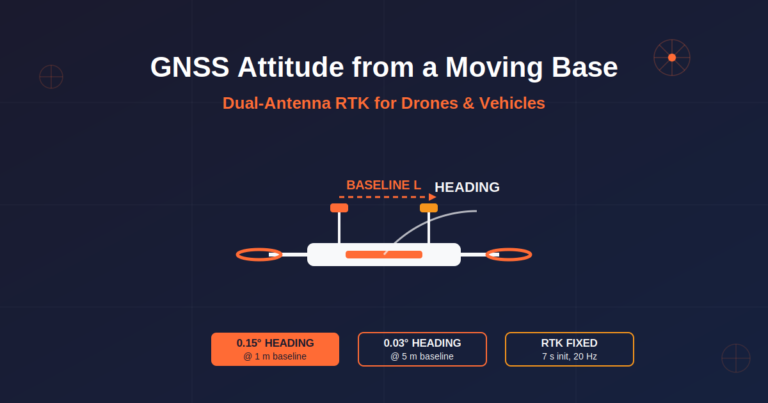
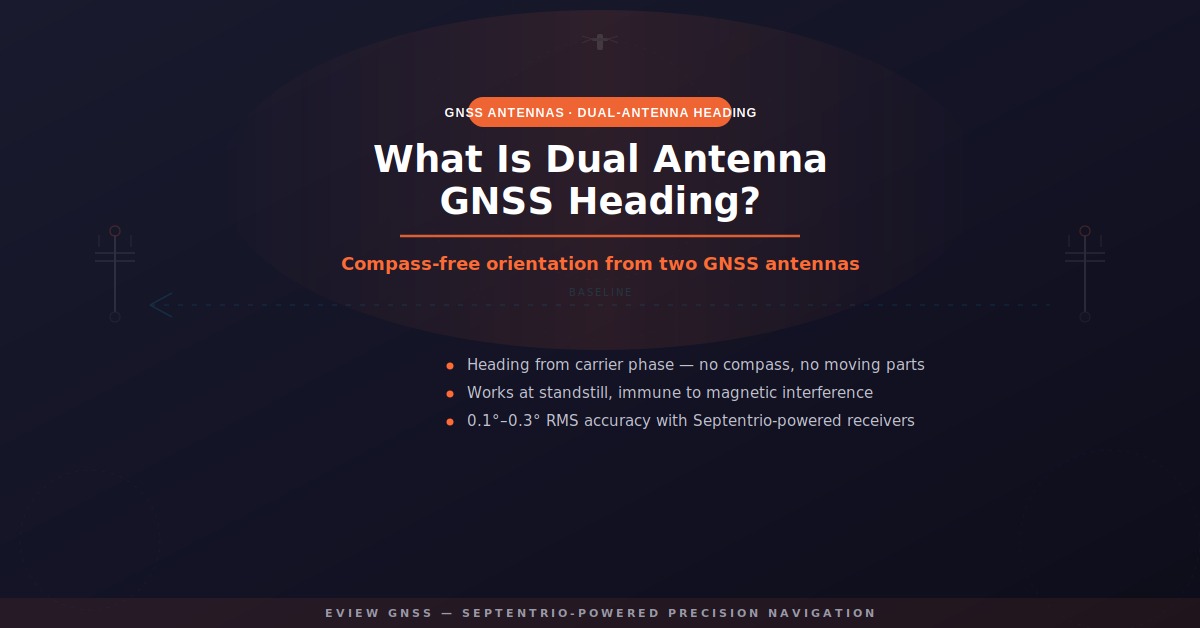
Dual antenna GNSS heading is a technique that measures a vehicle’s orientation (yaw angle) by comparing the carrier-phase signals from two GNSS antennas mounted a fixed distance apart on the same platform. Because it derives direction from satellite geometry rather than the Earth’s magnetic field, it needs no compass, no moving parts, and keeps providing heading even when the vehicle is stationary. Eview’s Septentrio-powered GNSS receiver box adds AIM+ anti-jamming so heading stays available near steel structures and powerlines.
How Dual Antenna GNSS Heading Works
A dual-antenna heading receiver uses two RF inputs connected to antennas separated by a precisely known baseline — typically 0.5–2 m on vehicles, longer on vessels. Both antennas track the same satellites, and the receiver measures the carrier-phase difference between the two signals for each satellite. The phase difference encodes the baseline’s direction, which the receiver resolves into east/north components and converts to heading.
The hard part is resolving integer carrier-phase ambiguities — the unknown whole number of wavelengths in each measurement. RTK solves the same problem; here the receiver simply differences the two antennas against each other rather than against an external base station. Multi-constellation, multi-frequency tracking (GPS, GLONASS, Galileo, BeiDou on L1/L2/L5 and E1/E5) supplies enough redundant measurements to fix ambiguities in seconds, and because both antennas share one receiver clock, common errors cancel out of the baseline solution.
Dual Antenna vs. Compass, COG, and Single-Antenna Solutions
A magnetic compass measures the magnetic field, not true north: ferrous hulls, motors, battery currents, and powerlines all bend the field. Course over ground from a single antenna works only while moving and collapses at low speed. IMU gyros supply rate data but drift unless continuously aided.
Dual antenna GNSS heading is an absolute measurement referenced to the satellite constellation: immune to magnetic interference, available at zero speed, stable under acceleration and vibration. That is why it is the preferred heading source for autonomous robots and construction machine control, where GNSS keeps an IMU-aided filter drift-free.
Where Dual Antenna GNSS Heading Is Used in Industry
Every application shares one trait: a machine must know which way it is pointing with no human in the loop. On marine vessels, dual-antenna receivers feed autopilots and dynamic positioning. In construction and mining, dozers, graders, and pavers use them so blades follow the design surface even in reverse, and agricultural robots steer accurately across row crops without gyro drift.
Larger UAVs, eVTOL aircraft, and drone RTK systems use it for orientation during pre-takeoff alignment and in GNSS-challenged corridors. Interference-heavy environments are exactly where Septentrio’s AIM+ technology matters: anti-jamming GNSS receivers keep producing valid heading where standard receivers lose lock.
How Accurate Is Dual Antenna GNSS Heading?
Heading accuracy scales with baseline length: a longer antenna separation produces a larger phase difference for the same angular change, so the same carrier-phase noise maps to a smaller angle error. A professional dual-antenna receiver typically achieves 0.1–0.3° RMS with a 1 m baseline, improving to well under 0.1° with a 2 m baseline and multi-frequency tracking. Multipath is the main enemy — reflections corrupt carrier phase at both antennas — so receiver-level mitigation matters as much as the antenna pair itself.
Septentrio-based receivers such as the mosaic-X5 and AsteRx series used in Eview products output heading at up to 100 Hz and re-acquire it almost instantly after signal loss. Paired with survey-grade GNSS antennas, the baseline mounting accuracy becomes the practical limit.
Choosing a Dual-Antenna GNSS Receiver
The receiver must have two phase-coherent RF inputs sampled from one clock — two separate single-antenna receivers cannot produce a meaningful baseline. It should track all constellations on multiple frequencies for fast ambiguity resolution and output heading at 10–100 Hz. Match it to the environment: Septentrio-powered OEM boards bring AIM+ anti-jamming and anti-spoofing to compact embedded designs, while rugged enclosure receivers suit vehicles and vessels needing IP-rated hardware out of the box.
Eview GNSS receivers with heading
| Eview receiver | Septentrio module | Best for |
|---|---|---|
| HB6 Pro | mosaic-H | Dual-antenna RTK and heading in a compact receiver |
| HB56H | mosaic-H | Heading with SD card logging |
| HB52H, HB50H, HB51 | mosaic-G5 P3H | Light, low-power heading for drones and small robots (0.15° at 1 m) |
| HB10 | AsteRx-m3 Pro+ | Heading at up to 100 Hz for fast vehicles |
Tell us your vehicle, antenna spacing and update-rate needs and we will recommend a heading receiver: sales@gnss-solutions.com. Datasheets and manuals are sent by email.
FAQ: Dual Antenna GNSS Heading
What is a GNSS receiver with heading? It is a GNSS receiver that outputs the direction a vehicle is pointing (heading or yaw) as well as its position, by using two antennas a known distance apart. Unlike a compass it is not affected by magnetic disturbance, and unlike course-over-ground it works when the vehicle is stationary.
What is dual antenna GNSS heading? It computes a vehicle’s orientation by comparing carrier-phase measurements from two GNSS antennas mounted a known distance apart. The receiver resolves the baseline vector between the antennas and derives heading — no compass, no moving parts, and it works at standstill.
How accurate is dual antenna GNSS heading? With a 1 m baseline, professional receivers typically achieve 0.1–0.3° RMS in good conditions; longer baselines and multi-frequency, multi-constellation tracking push accuracy below 0.1°. Multipath and mounting errors, not receiver noise, usually dominate in real installations.
Does dual antenna GNSS heading work when the vehicle is stationary? Yes. Heading comes from instantaneous carrier-phase differences between two antennas, not from motion, so it is available at zero speed — a key advantage over single-antenna course over ground.
Do I need RTK corrections for dual antenna GNSS heading? No. Heading is a relative measurement between the two antennas, so it needs no external base station or correction stream. If the platform also needs centimeter-level position, the same receiver can run RTK or PPP on the primary antenna.
How far apart should the two antennas be? Longer baselines give better heading accuracy but are limited by the platform. Vehicles and robots typically use 0.5–2 m; vessels and large machines can use several meters. The baseline is surveyed or auto-calibrated during installation.
Which GNSS receivers support dual antenna heading? Any receiver with two phase-coherent RF inputs and dual-antenna firmware, such as the Septentrio mosaic-X5 and AsteRx-series modules used in Eview GNSS receivers, whose AIM+ mitigation keeps heading available in jamming and high-multipath environments.