Ionospheric Scintillation: Why Your RTK Fix Drops After Sunset
The Short Answer
Ionospheric scintillation is the distortion of GNSS signals by irregular electron density in the ionosphere, and it is the reason an RTK fix that held centimetres all afternoon can wander after sunset and drop to float by nightfall in equatorial regions. It is measured with two indices — S4 for amplitude (strong above 0.6) and sigma-phi for phase (strong above 0.3). Because the corruption is in the signal rather than the satellite geometry, adding constellations does not remove it. Receivers that handle it identify the affected measurements and exclude them, and estimate the ionospheric delay internally instead of relying on a reference-station network — which is why Septentrio receivers with IONO+ manage with a single base station at up to 40 km, or 80 km while the ionosphere is quiet.
Specifying GNSS for a low-latitude site? Send us the deployment region, the baseline you can support and the accuracy you need — we will match a receiver to it. Talk to us or review the AIM+ / resilient GNSS range.
Why an RTK fix fails after sunset
GNSS signals travel roughly 20,000 km to reach the antenna, and the final 1,000 km pass through the ionosphere, the charged layer between about 100 km and 1,000 km altitude. A smoothly ionised layer can be modelled. When the layer becomes irregular — local fluctuations in electron density — the signal is refracted and diffracted, distorting its phase and amplitude. That is scintillation, and it is at its worst in the hours after sunset.
How the failure escalates
| Scintillation severity | What the receiver does |
|---|---|
| Mild | Position accuracy degrades by several metres — RTK may still report a fix |
| Stronger | Cycle slips: the carrier-phase measurement jumps and RTK has to re-resolve ambiguities, so the solution drops to float |
| Extreme | Complete loss of signal lock; ordinary radio communication is disturbed in the same window |
Where and when scintillation occurs
Events are most frequent and most intense near the geomagnetic equator, with a weaker occurrence at the poles; mid-latitude events are also documented in Western Europe and the United States. Timing follows the sun: solar activity runs on an 11-year cycle measured by sunspot count, so events increase around solar maximum, and on top of that there is a strong daily pattern in which sunset triggers a sharp increase in ionospheric activity for hours.
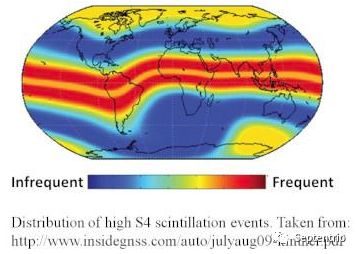
Image courtesy of Septentrio
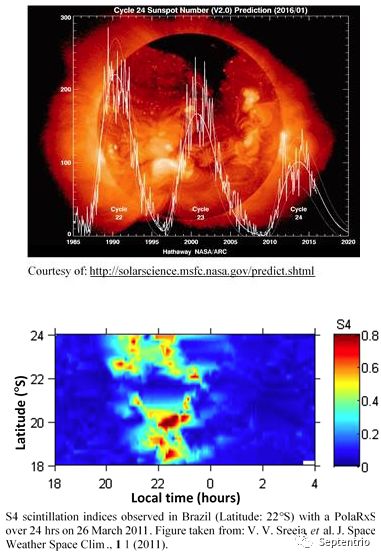
Image courtesy of Septentrio
What IONO+ changes in the receiver
Septentrio developed IONO+ out of project work in Brazil, one of the countries most affected by scintillation. Receivers with IONO+ keep tracking satellites under conditions that disrupt a standard receiver, identify scintillation events, and remove the affected signals from the position computation instead of letting them bias it.
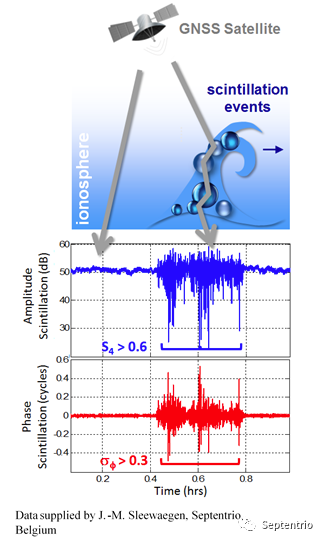
Image courtesy of Septentrio
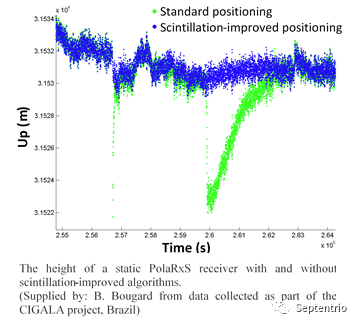
Image courtesy of Septentrio
The second half of the design concerns baseline logistics. With standard RTK you normally need a reference-station network to interpolate the ionospheric delay and compensate for it at the rover. With IONO+ the delay is estimated inside the receiver, so no network is required: one reference station at up to 40 km baseline is sufficient, and up to 80 km while the ionosphere is quiet. On projects where a dense CORS network does not exist, that is the difference between a viable RTK layout and none.
Receiver-side estimate versus network interpolation
| Network-interpolated RTK | Receiver-side estimate (IONO+ class) | |
|---|---|---|
| Ionospheric delay | Interpolated from a reference-station network, compensated at the rover | Estimated inside the receiver |
| Reference network | Normally required | Not required |
| Usable baseline | Limited by ionospheric activity | 40 km; up to 80 km in quiet conditions |
| During a scintillation event | Degradation propagates into the correction | Affected signals are identified and excluded from the position computation |
Eview receivers that carry this capability
IONO+ is receiver behaviour, shipped with the Septentrio Inside platform rather than sold as a service. In the Eview line-up:
- Eview HB50 / HB56 — multi-frequency receiver on a Septentrio mosaic-X5 core, 100 Hz, xPPS at 5 ns, with AIM+, IONO+, APME+, LOCE+ and RAIM+;
- Eview HBEV322 / HBEV322H — compact RTK receiver on mosaic-G5 P3H with dual-antenna heading;
- Eview HB52H / HB52 — ultralight mosaic-G5 module for mass-limited platforms;
- Eview HB10 — dual-antenna receiver on AsteRx-m3 Pro+ for position and heading together.
FAQ: scintillation and RTK
Can scintillation move my position without losing the fix?
Yes. Tracking and timing degrade differently, and a receiver can report a fixed solution while the measurements feeding it are already affected. That is why the useful diagnostic is the C/N0 and fix-type log rather than the fix indicator alone.
Does a higher update rate or more constellations help?
Not by itself. Scintillation corrupts the signal itself, so the affected measurements have to be identified and excluded; extra satellites only help if the receiver can tell which ones are distorted.
How long does an event last?
Activity increases sharply at sunset and can stay elevated for several hours, and the overall pattern follows the 11-year solar cycle. Sites in the equatorial band should expect repeat events near solar maximum.
Do I still need a base station?
You still need a correction source, but with a receiver-side ionospheric estimate a single base at up to 40 km is enough (80 km in quiet conditions), rather than a dense network to interpolate the delay across the site.
Is this only a tropical problem?
No. The equatorial band is worst, but scintillation is also reported at mid-latitudes including Western Europe and the United States, and geomagnetic activity during solar maximum raises the baseline everywhere.
Sources
Septentrio technical note on ionospheric scintillation and IONO+ (S4 / sigma-phi indices, PolaRxS static receiver test); S4 observations from V. V. Sreeja et al., J. Space Weather Space Clim. 1 (2011); CIGALA project data (Brazil); Eview product documentation.