Jammertest 2025 Results: AIM+ Anti-Jamming GNSS Holds Centimeter Accuracy Through 100+ Interference Scenarios

Septentrio AIM+ is the anti-jamming technology inside every Eview receiver, from the HB6 and HB62 (mosaic-X5) to the HB52 and HBEV11 (mosaic-G5) and the HB10 (AsteRx-m3 Pro+). These JammerTest 2025 results, published by Septentrio, show what that protection means in the field.
Eview products for this application
- Eview HB6 — mosaic-X5, 100 Hz, AIM+ and OSNMA
- Eview HB52 / HB52H — mosaic-G5, ultralight, AIM+ and OSNMA
- Eview HB62 — rugged mosaic-X5 base station, AIM+ and OSNMA
- Eview HB10 — AsteRx-m3 Pro+, 100 Hz heading, AIM+
GNSS jamming and spoofing incidents are rising worldwide, and for reference stations, drone operations, and time synchronization, a degraded or lost PNT (positioning, navigation, timing) signal can have serious consequences. That is why GNSS receivers used in critical applications need high-level anti-jamming and anti-spoofing protection so they keep operating reliably in challenging environments. This article summarizes the Jammertest 2025 results: Septentrio AIM+ receivers held centimeter-level accuracy through roughly 100 jamming and spoofing scenarios — while competitor receivers drifted meters, sometimes more than 10 meters, off position.
What Is Jammertest and Why It Matters
Jammertest is an annual jamming and spoofing exercise organized by the Norwegian government on a remote island. For five days, receivers are tested against live interference and spoofing in a controlled environment. Septentrio attends every year, because testing receiver technology under real-time interference is essential for validating and continuously improving anti-jamming and anti-spoofing algorithms. While Septentrio takes part in other similar tests, many are confidential and their results are never published — Jammertest is one of the few public events that shares results.
AIM+ Anti-Jamming and Anti-Spoofing Protection
Septentrio offers one of the highest levels of protection against intentional and unintentional GNSS interference and spoofing. The proprietary AIM+ (Advanced Interference Mitigation) technology detects, characterizes, and mitigates jamming, while its anti-spoofing algorithms continuously monitor for spoofing attacks — and Eview builds this protection into every receiver as standard. Jammertest is where that technology is put through its paces.
Interference Complexity Keeps Growing
Jammertest evolves every year, and 2025 was the toughest edition yet: Septentrio tested its receivers in roughly 100 jamming scenarios, more challenging than previous years with far more diversity in frequency, power, and interference type. The rigorous schedule covered many scenarios, including high-power, multi-frequency and chirp interference. After five days of intensive testing across jamming and spoofing scenarios, Septentrio’s proprietary AIM+ technology demonstrated a significant advantage over the competing receivers. The spoofing tests also showed that the best spoofing protection comes from multiple anti-spoofing mechanisms working together — and that Septentrio’s spoofing flags gave operators the best situational awareness of any receiver in the test.
Jammertest 2025 Results: Anti-Jamming Performance
Over the five days in Norway, Septentrio receivers and several competitor receivers were tested under challenging jamming scenarios.
Static jamming test
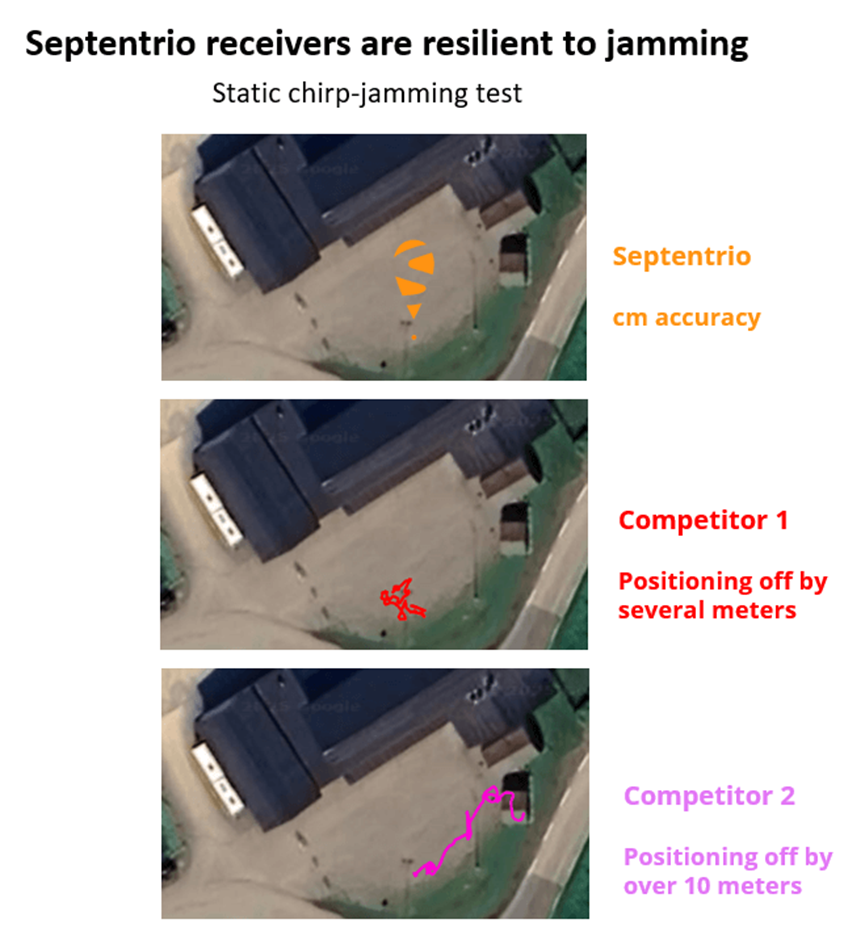
The chart below shows a static test under a powerful, commercially available jammer. The Septentrio receiver detected and mitigated the interference and continuously provided centimeter-level accuracy. The red line shows one competitor receiver’s position, off by several meters; the purple line shows another competitor, off by more than 10 meters during jamming.
In the real world, losing GNSS position disrupts operations, can damage equipment, endanger third parties, and harm reputations. A jammed drone, for example, can lose control and crash. Even advanced drones with autopilots may fall back to “hover”, “land”, or “orbit” modes, or switch to alternative sensors such as inertial navigation systems (INS) — which drift severely as GNSS loss extends and cannot provide absolute positioning. During a spoofing attack, attackers typically first blast strong jamming to break the receiver’s lock on genuine GNSS signals, increasing the chance the receiver re-acquires the spoofed signals instead.
GNSS Anti-Spoofing: the Circular Spoofing Test
The figure below shows a circular spoofing test, with the device under test absolutely static inside the spoofed signal area. Two competitor brands (purple and red) were spoofed, their tracks following the trajectory planned by the spoofer. The Septentrio receiver was not spoofed and reported the spoofing with status flags.
Spoofing test results
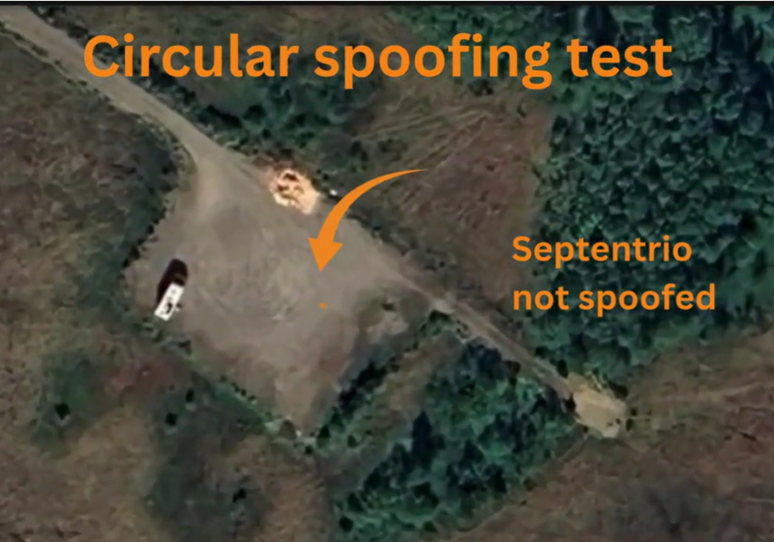
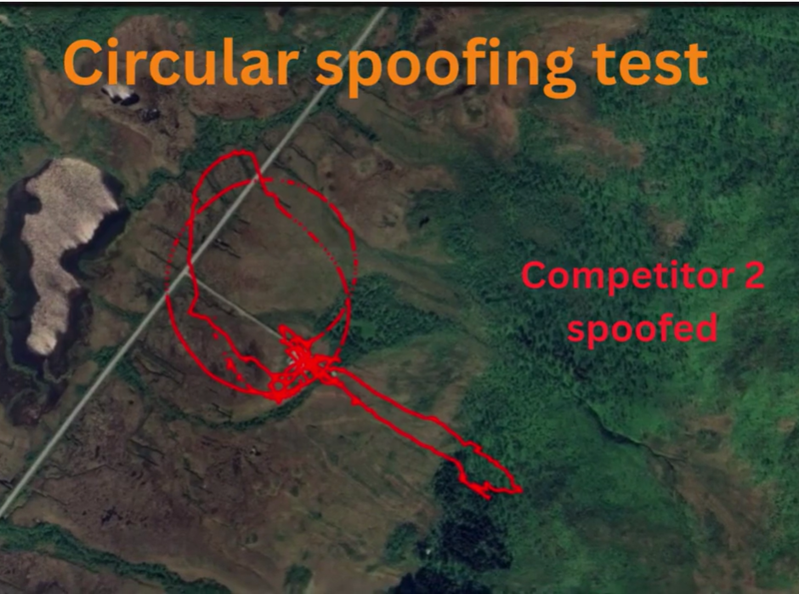
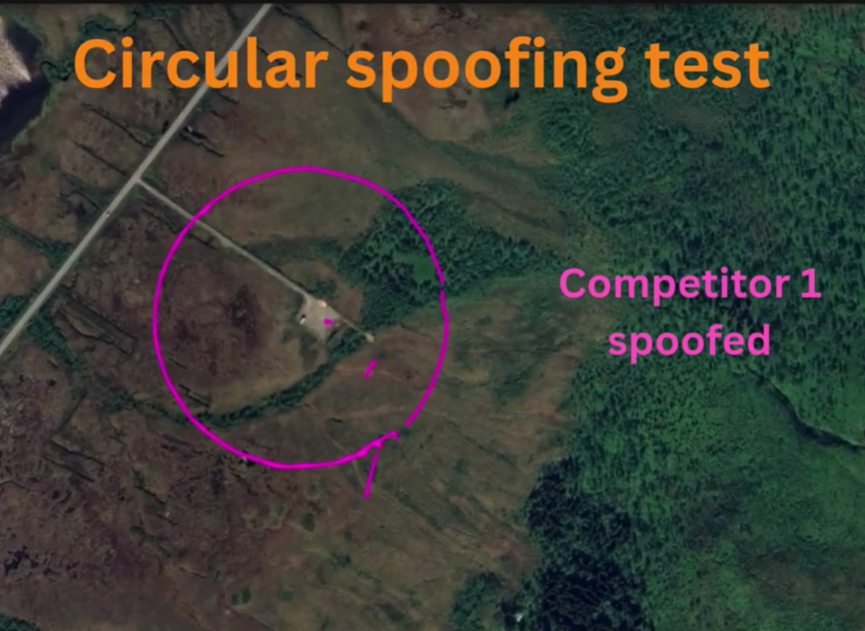
In this static circular spoofing test, the Septentrio receiver was not spoofed, while competitors followed the spoofed path.
Danger: Spoofed Position Without Warning
The Septentrio receiver continuously detected spoofing throughout the test, demonstrating unmatched spoofing-signal identification, especially under malicious spoofing attacks; spoofing was typically mitigated. Competitors showed very little spoofing detection, and only occasionally mitigated it. Moments where spoofing is neither detected nor mitigated — shown as red warning flags in the figure — are especially dangerous in real use: the system keeps relying on GNSS positioning that is inaccurate or outright wrong, which can lead to navigation hijacking or loss of control, damaging or losing equipment.
Galileo OSNMA Against GPS Spoofing
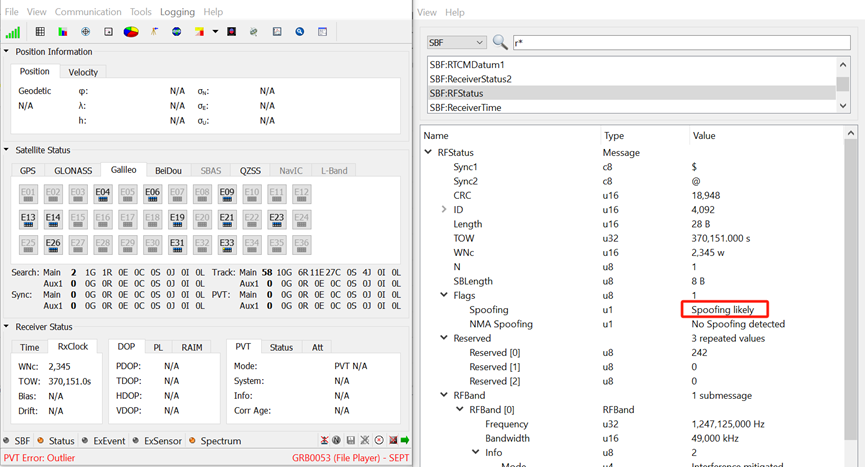
During Jammertest, Galileo OSNMA (Open Service Navigation Message Authentication) was also validated on Septentrio receivers. OSNMA authenticates Galileo navigation data end-to-end, from the Galileo satellites to OSNMA-capable GNSS receivers. By authenticating the navigation data — which carries satellite position information — OSNMA prevents spoofing of Galileo signals. In one spoofing test at Jammertest, an OSNMA-enabled Septentrio receiver flagged the spoofing, as shown in the built-in web-interface screenshot below.
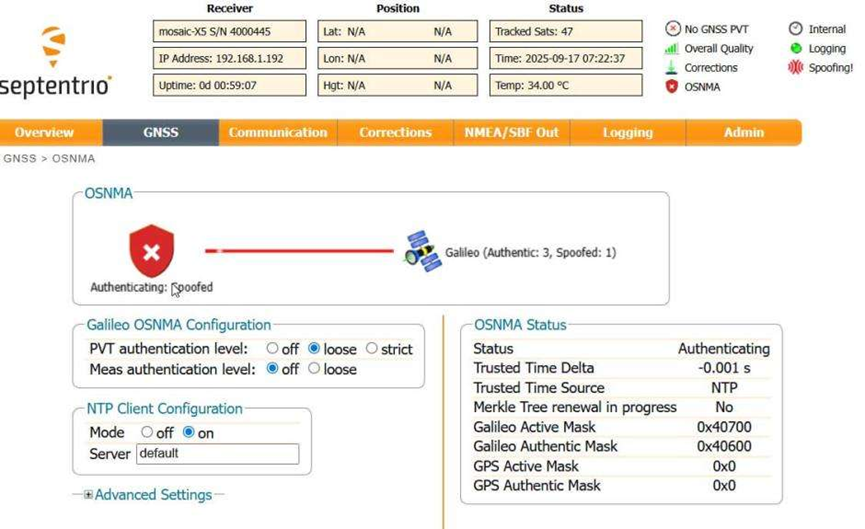
Septentrio Galileo OSNMA.
GNSS Timing Resilience Verified
The chart below shows results from a test where satellite navigation time was spoofed. The Septentrio receiver maintained precise time synchronization, while a competitor receiver was spoofed and displayed a wrong time from 3 minutes earlier. Applications such as telecommunications, power grids, and financial institutions depend on precise GNSS time synchronization. Malicious spoofing can cause service outages with total losses in the millions of dollars or euros — investing in highly reliable GNSS technology protects mission-critical systems and the users who depend on them.

With GNSS time forged, the Septentrio receiver kept providing correct timing information, while a competitor receiver displayed an incorrect time — 3 minutes in the past.
Multi-Layered Receiver Protection That Works
During the 2025 Jammertest, Septentrio receivers equipped with AIM+ demonstrated excellent performance against high-power jamming and various spoofing attacks. This reflects more than 25 years of Septentrio experience developing reliable GNSS positioning technology, built on multiple layers of protection:
- Multi-frequency technology for signal diversity — a backup when one GPS/GNSS band is jammed or spoofed.
- Encrypted signal authentication (OSNMA) to verify genuine signals.
- Anomaly detection driven by big data continuously updated by years of field observation.
As news reports show, GNSS spoofing is becoming more common because signal simulator hardware and software are widely available. Spoofing is more dangerous than jamming: it can not only disrupt normal operation but also take over navigation systems, enabling manipulation of end devices and irreversible damage. Securing the system at the receiver core is the most effective strategy for high stability and reliability.
Proven in the Field
Always-accurate, always-available positioning, navigation, and timing — reliable PNT — is the key to successful industrial or mission-critical operations in complex environments. By regularly participating in live events such as Jammertest, anti-jamming and anti-spoofing technology is continuously tested and improved against the latest interference attacks. The technology is also proven by field users who operate receivers in areas with persistent malicious interference.
Septentrio-Powered Receivers for Every Form Factor
Septentrio receivers come in many form factors, from rugged boxes to boards and compact modules such as the low-weight, low-power mosaic-X5 and mosaic-G5 P3/P3H receivers/modules — easy to integrate and compatible with mainstream flight controllers including Pixhawk, ArduPilot, and PX4 Autopilot. Eview builds ready-to-use GNSS receivers on these modules — from rugged receiver boxes to UAV RTK solutions — with AIM+ anti-jamming built in as standard, for UAV, robotics, construction, mining, survey, and agriculture applications.
Which Eview receivers carry this protection
| Eview receiver | Septentrio module | AIM+ | Galileo OSNMA |
|---|---|---|---|
| HB6, HB56, HB62 | mosaic-X5 | Yes | Yes |
| HB50, HB50H, HB51, HB52, HBEV11, HBEV322 | mosaic-G5 | Yes | Yes |
| HB6 Pro, HB56H | mosaic-H | Yes | Not stated |
| HB10, HB59 | AsteRx-m3 Pro+ | Yes | Not stated |
Read how AIM+ works on our anti-jamming technology page and how authentication works on the OSNMA page. For a quote, email sales@gnss-solutions.com.
FAQ: AIM+ Anti-Jamming GNSS at Jammertest 2025
What is Jammertest?
Jammertest is an annual jamming and spoofing test organized by the Norwegian government on a remote island. For five days, GNSS receivers are tested against live interference in a controlled environment; it is one of the few such events that publishes its results.
How much interference can AIM+ reject?
AIM+ (Advanced Interference Mitigation) detects and mitigates narrowband, wideband, chirp and pulsed interference. At JammerTest 2025, a Septentrio receiver kept centimetre-level accuracy under a powerful commercial jammer while two competitor receivers were off by metres.
What is Galileo OSNMA and how does it stop spoofing?
OSNMA (Open Service Navigation Message Authentication) is a free Galileo service that cryptographically authenticates the navigation data broadcast by Galileo satellites. Receivers that support OSNMA can verify signals are genuine and flag spoofed ones.
Do Eview receivers include AIM+ and OSNMA support?
Yes. Every Eview receiver includes AIM+. Galileo OSNMA is supported on mosaic-X5 receivers (HB6, HB56, HB62) and mosaic-G5 receivers (HB50, HB50H, HB51, HB52, HBEV11, HBEV322).
Why does GNSS timing matter?
Telecom networks, power grids, and financial institutions synchronize via GNSS time. If a receiver is spoofed into displaying wrong time, services can break — with losses that can run into millions.
What happened to competitor receivers at Jammertest 2025?
Under jamming, competitor receivers drifted meters to more than 10 meters; in the circular spoofing test they followed the spoofed trajectory; and under time spoofing one displayed a time 3 minutes in the past.
Related Reading
- Jammertest 2025: AIM+ Anti-Jamming GNSS Keeps UAVs on Mission Through 100+ Interference Scenarios (uav-gnss.com)
- ROSaic Deep Dive: Integrating Septentrio GNSS/INS Receivers with ROS 1 & ROS 2 (gnss-solutions.com)
- Septentrio GNSS + ROS Integration: Official ROSaic Driver, Compatibility & Technical Advantages (uav-gnss.com)
Sources & References
Author: Jack Wang (Eview GNSS)
Published: August 25, 2026
External reference: https://www.septentrio.com/en/learn-more/insights/results-jammertest-2025-withstanding-gps-jamming-and-spoofing
Images: All figures are the original Septentrio Jammertest 2025 figures, used with source credit. Photo credit where noted: David Jensen.
Talk to Eview about your project
Tell us your application and volumes and we will recommend the right Eview receiver, board or antenna.
Eview products for this application
- Eview HB6 — mosaic-X5, 100 Hz, AIM+ and OSNMA
- Eview HB52 / HB52H — mosaic-G5, ultralight, AIM+ and OSNMA
- Eview HB62 — rugged mosaic-X5 base station, AIM+ and OSNMA
- Eview HB10 — AsteRx-m3 Pro+, 100 Hz heading, AIM+